

Ever experienced a product breakdown while it’s still under warranty? A claim request letter for service warranty compensation is your official way to seek repair, replacement, or refund. This letter formally communicates your issue to the manufacturer or service provider. Its purpose is to initiate the warranty claim process and get your product fixed.
Filing a warranty claim can be daunting. We understand. That’s why we have prepared you with practical resources. This article provides various claim request letter templates and examples. Need to claim warranty on a faulty gadget? Or, perhaps a defective appliance? We’ve got you covered.
Our goal is simple. We aim to help you draft your own effective claim letter. These sample letters will guide you. Writing a service warranty claim has never been easier. We’ll show you how to articulate your issue clearly. Get ready to put the power of a well-written letter in your hands!
[Your Name/Company Name]
[Your Address]
[Your Phone Number]
[Your Email Address]
[Date]
[Warranty Provider Name]
[Warranty Provider Address]
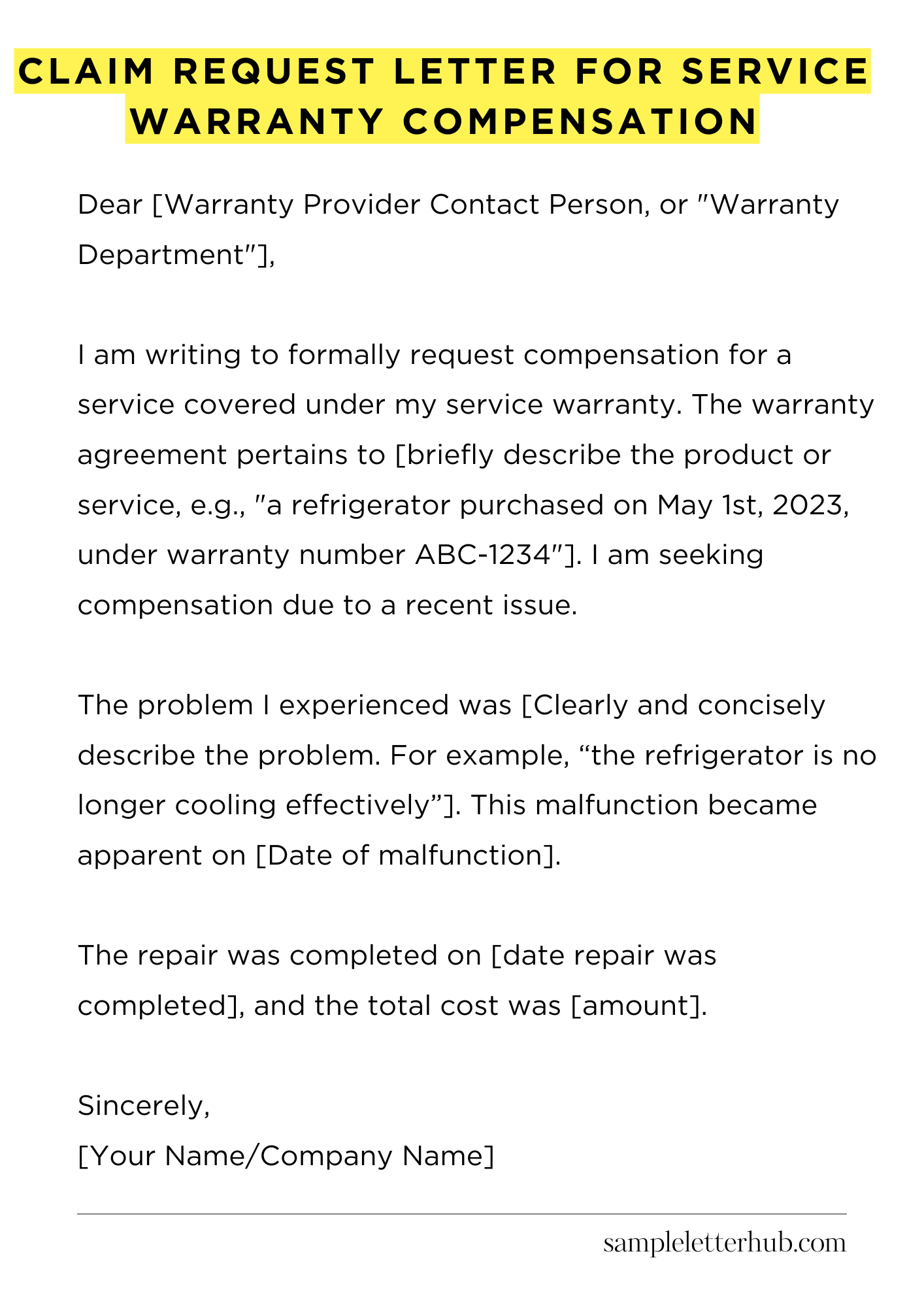
Dear [Warranty Provider Contact Person, or “Warranty Department”],
I am writing to formally request compensation for a service covered under my service warranty. The warranty agreement pertains to [briefly describe the product or service, e.g., “a refrigerator purchased on May 1st, 2023, under warranty number ABC-1234”]. I am seeking compensation due to a recent issue.
The problem I experienced was [Clearly and concisely describe the problem. For example, “the refrigerator is no longer cooling effectively”]. This malfunction became apparent on [Date of malfunction]. I took steps to rectify the situation by [briefly explain any actions taken, e.g., “contacting a local repair technician on October 26th”].
The repair was completed on [date repair was completed], and the total cost was [amount]. I am attaching copies of the following documents as proof of purchase and the necessary repairs: [list attached documents, e.g., “the original purchase receipt, the warranty agreement, and the repair invoice”]. These documents are crucial.
Based on the terms and conditions outlined in my warranty, I believe I am eligible for compensation. The warranty specifically covers [mention the relevant part of the warranty that covers the issue, e.g., “repair costs related to refrigeration system failures”]. My claim aligns directly with the documented coverage.
I kindly request that you review my claim and process the compensation as per the warranty agreement. Please let me know the status of my claim, including the expected timeline for reimbursement. Contact me at your earliest convenience. I look forward to your prompt response.
Thank you for your time and attention to this matter.
Sincerely,
[Your Name/Company Name]
How to Write Claim Request Letter for Service Warranty Compensation
Navigating the terrain of service warranty claims can often feel like traversing a bureaucratic maze. However, armed with the proper approach and a well-crafted letter, you can significantly enhance your prospects of a favorable outcome. This guide will provide the essential steps needed to author a compelling claim request for service warranty compensation.
1. Commence with Meticulous Documentation
Before you even begin to draft your missive, meticulous preparation is paramount. Gather all pertinent documentation related to the product or service in question.
This includes, but is not limited to, the original purchase receipt, the service warranty agreement itself, and any prior communication records with the service provider.
Ensure you have concrete evidence in the form of photographs or videos that exhibit the malfunction or damage. Scrutinize the warranty stipulations to ascertain the scope of coverage and the stipulated procedures for claims.
2. Formulate a Formal Salutation
Commence your letter with a formal and professional salutation. Address the letter to the appropriate individual or department responsible for warranty claims.
Utilize their official title if known (e.g., “Warranty Claims Manager,” “Customer Service Department”). Avoid generic salutations like “To Whom It May Concern” when possible. Instead, try to unearth the correct contact person to facilitate a direct correspondence.
3. Clearly Articulate the Pertinent Information
Begin the body of your letter with an unambiguous statement of your purpose: to file a claim for service warranty compensation. Instantly identify the product or service covered by the warranty, providing specific details such as the model number, serial number, and the date of purchase.
Succinctly describe the issue or defect that necessitates the claim. Ensure that this description is comprehensive and leaves no room for ambiguity. A well-defined narrative is crucial for effective communication.
4. Chronicle the Incidents
Provide a precise timeline of events related to the problem. Detail when the issue initially surfaced, any attempts you made to rectify it, and any previous interactions you’ve had with the service provider.
Note the dates of any repairs or diagnostic assessments. Be scrupulous in your reporting, as an accurate chronology provides essential context for your claim. This methodical approach will fortify your case.
5. Cite the Relevant Clauses of the Warranty
Refer explicitly to the specific clauses within the warranty agreement that pertain to your claim. Quote these clauses directly, using quotation marks, to bolster your argument.
This demonstrates that your claim is grounded in the terms and conditions of the warranty. This will display that your understanding of the warranty is thorough and well-informed.
6. State the Requested Remedy
Clearly articulate the compensation or resolution you seek. Be specific. Do you want a repair, replacement, refund, or a combination thereof? If seeking monetary compensation, specify the precise amount you’re claiming and the rationale behind it. Make it unequivocal as to what you expect from the service provider, leaving no room for misunderstanding.
7. Conclude with a Professional Closing
Conclude your letter with a polite, yet assertive closing statement. Restate your expectations and reiterate your contact information, including your full name, address, phone number, and email address.
Express your willingness to provide further information or documentation if needed. Use a professional closing, such as “Sincerely,” “Respectfully,” or “Yours faithfully,” followed by your typed name and signature if sending a hard copy. The goal is to leave a lasting impression that underscores your commitment to a resolution.
FAQs about Claim Request Letter for Service Warranty Compensation
What is the primary purpose of a claim request letter for service warranty compensation?
The primary purpose of a claim request letter for service warranty compensation is to formally notify a service provider or manufacturer about a product or service defect covered under a warranty. This letter initiates the claims process, requesting repair, replacement, or compensation for the issue.
What essential information should be included in a claim request letter?
A comprehensive claim request letter should include the date, your contact information, the recipient’s contact information, a clear description of the defect or problem, the date of purchase, the product/service details (model number, serial number), a copy of the warranty (if applicable), details of any previous attempts to resolve the issue, and the desired resolution (repair, replacement, refund).
How do I determine if my issue is covered under the service warranty?
You can determine warranty coverage by carefully reviewing the terms and conditions of your service warranty. Look for clauses outlining what is covered (e.g., manufacturing defects, workmanship) and what is excluded (e.g., accidental damage, normal wear and tear). If your issue aligns with the covered items within the warranty period, it is likely covered.
What supporting documentation should I include with my claim request letter?
You should include copies of all relevant documentation, such as the original purchase receipt, the warranty document itself, any previous communication records with the service provider (emails, etc.), and photos or videos demonstrating the defect or issue. These materials strengthen your claim and provide supporting evidence.
What is the typical timeframe for receiving a response to a claim request letter, and what should I do if I don’t receive one?
The response time varies depending on the service provider and the complexity of the claim, but typically, you should expect a response within 14-30 business days.
If you haven’t received a response within a reasonable timeframe, you should follow up with a phone call or email. Keep records of all communication. If the issue remains unresolved, you may need to escalate the claim further, possibly involving consumer protection agencies or legal counsel.
Related:
Resignation letter due to rude boss
Resignation letter moving to another state
Resignation letter due to illness of family member
Resignation letter due to study