

So, you’ve been hit by a burglary? We understand it’s a stressful time. A Claim Request Letter for Burglary Loss Claim is a formal document. It is your official request for financial help. You send it to your insurance company. The purpose is to get your stolen or damaged property covered.
Writing this letter can seem daunting. Where do you start? What details do you include? Don’t worry, we’re here to assist. This article provides helpful examples. You will find different Claim Request Letter for Burglary Loss Claim samples. They’re designed to make the process easier.
We have a variety of sample claim letters for burglary claims. You can adapt them to your specific situation. This guide helps you craft a clear and effective letter. Use these burglary claim letter templates to get your claim started today!
[Your Name]
[Your Address]
[Your Phone Number]
[Your Email Address]
[Date]
[Insurance Company Name]
[Insurance Company Address]
Subject: Claim Request for Burglary Loss
Dear [Insurance Adjuster Name or “Claims Department”],
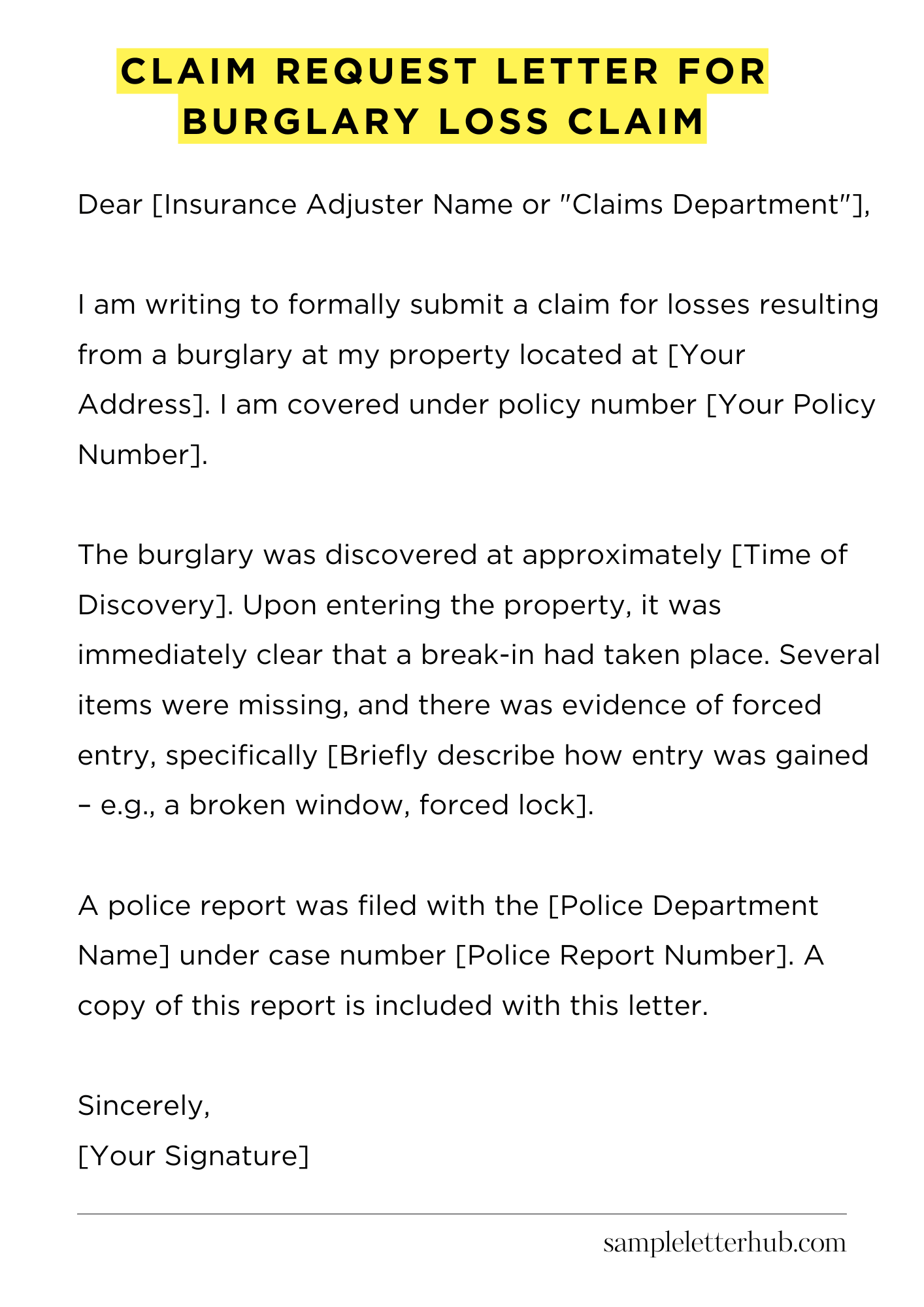
I am writing to formally submit a claim for losses resulting from a burglary at my property located at [Your Address]. I am covered under policy number [Your Policy Number]. This unfortunate incident occurred on [Date of Burglary].
The burglary was discovered at approximately [Time of Discovery]. Upon entering the property, it was immediately clear that a break-in had taken place. Several items were missing, and there was evidence of forced entry, specifically [Briefly describe how entry was gained – e.g., a broken window, forced lock].
A police report was filed with the [Police Department Name] under case number [Police Report Number]. A copy of this report is included with this letter. The police have been investigating the matter.
I have compiled a detailed list of the stolen and damaged items. This includes a description of each item, the estimated value, and, where possible, supporting documentation such as receipts or photographs. This list is attached to this claim. It is quite extensive.
Some of the items are of significant sentimental value. I understand the claims process can take time. However, I kindly request that you consider the urgency of this matter.
I would appreciate it if you could begin processing this claim as soon as possible. Please let me know if you require any further information or documentation from my end. I am available to discuss this claim at your earliest convenience. Please feel free to contact me. You can reach me by phone or email.
Thank you for your prompt attention to this important matter.
Sincerely,
[Your Signature]
How to Write Claim Request Letter for Burglary Loss Claim
A burglary can be a deeply unsettling experience. Subsequently, navigating the aftermath, including filing an insurance claim, can be arduous. Your claim request letter is your first, and potentially most crucial, communication with your insurance provider.
It serves to formally notify them of the incident and initiate the claims process. Successfully composing this letter requires precision, clarity, and adherence to specific guidelines. Let’s delineate the steps involved in crafting a compelling and effective claim request letter for burglary losses.
1. Initiate with a Formal Salutation
Begin your letter with a formal salutation. Employ the appropriate title (Mr., Ms., Dr., etc.) followed by the full name of the designated claims adjuster or the specific department. If you are unsure of the recipient, address the letter to “Claims Department” or the “Loss Adjuster.” It showcases respect and professionalism, setting the tone for a serious matter.
2. Detail the Date and Circumstances of the Infraction
Clearly state the date and time of the burglary. Be as precise as possible, including the day, date, and approximate time frame. Next, furnish a concise, yet detailed, account of the events.
This should include a brief narrative of how you discovered the burglary. Also, mention any observed evidence of forced entry and any immediate actions taken, such as contacting the police. This builds the foundation of your claim.
3. Accurately Inventory Stolen Items
This is arguably the most vital section. Compile a meticulous list of all stolen items. Include a detailed description of each item: brand, model, serial number (if available), and any other identifying features.
Moreover, note the estimated value of each item. This estimate should be based on its current market value, not the original purchase price. Consider utilizing photographs or purchase receipts for substantiation. Ensure the list is comprehensive; failure to include an item may preclude its coverage.
4. Include Supporting Documentation
Your letter should be accompanied by pertinent documentation. This encompasses a copy of the police report (or crime incident report), photographs of the point of entry and any other damage, and receipts or proof of ownership for the stolen items.
Including all the necessary documentation upfront will expedite the claim evaluation process. These documents are the tangible evidence that supports your assertions.
5. Stipulate Your Claim Amount
Explicitly state the total amount of your claim. This is the sum of the estimated value of all stolen and damaged property. It is important to remember, that this is just a request. Consider the policy terms, deductibles, and coverage limits. The precise and itemized calculation will provide clarity to the insurer.
6. Request Prompt Response and Contact Information
In the closing of your letter, politely request a prompt response from the insurance provider. Give your contact information, including your full name, address, phone number, and email address.
Offer your availability for any further inquiries or inspections. Express your commitment to cooperating fully with the claims process. A courteous closing underscores your reliability as a claimant.
7. Finalize with a Formal Closing and Signature
Conclude your letter with a formal closing, such as “Sincerely,” or “Respectfully.” Sign your full name above your typed name. If the policyholder is different from the person who wrote the letter, include the relationship to the policyholder. Proofread the entire document before submitting it.
This ensures accuracy and professionalism. Remember: Precision matters when claiming a burglary loss.
FAQs about Claim Request Letter for Burglary Loss Claim
Below are frequently asked questions regarding claim request letters for burglary loss claims, along with concise answers to provide clarity on the subject.
What is a Claim Request Letter for Burglary Loss Claim?
A claim request letter for a burglary loss claim is a formal document submitted to an insurance company or relevant party to initiate a claim for financial compensation due to property loss or damage resulting from a burglary. It officially notifies the recipient of the incident, provides details of the loss, and requests the processing of the claim.
What Information Should Be Included in a Claim Request Letter?
A comprehensive claim request letter should include the policyholder’s information, policy number, date and time of the burglary, a detailed list of lost or damaged items with estimated values (supported by evidence such as receipts or photographs), a description of the circumstances surrounding the burglary, police report information (if applicable).
What Supporting Documentation is Typically Required with the Letter?
Supporting documentation is crucial for a successful claim. This typically includes a copy of the police report (if filed), photographs or videos of the damaged property or the burglary scene, receipts or proof of ownership for the stolen or damaged items, appraisals for valuable items, and any other evidence that substantiates the loss and supports the claim’s validity.
The more detailed the documentation, the stronger the claim.
How Should the Letter Be Submitted, and What is the Timeline for a Response?
The claim request letter should be submitted according to the insurance company’s guidelines, which often involve submitting it online, via mail (certified mail is recommended for proof of delivery), or by email. The response timeline varies depending on the insurance provider and the complexity of the claim.
Generally, the insurer acknowledges receipt and begins the claims process within a few days or weeks. Policyholders should review their insurance policy for specific response time frames.
What Should You Do if Your Claim is Denied?
If the claim is denied, carefully review the reasons for the denial provided by the insurance company. If you believe the denial is unjustified, gather any additional supporting evidence or documentation that could strengthen your case.
Then, you can file an appeal with the insurance company, typically within a specific timeframe. If the appeal is unsuccessful, you may have the option to seek assistance from a consumer protection agency or consider legal action. Consulting with an attorney is also an option.
Related:
Resignation letter due to rude boss
Resignation letter moving to another state
Resignation letter due to illness of family member
Resignation letter due to study