

Dealing with business losses? Need help recovering? A claim request letter for business loss insurance is your key. It’s a formal document. It informs your insurance company about the financial setbacks your business has faced. Its purpose? To initiate the insurance claim process.
This article simplifies things. We’ll share valuable claim request letter templates. You’ll find examples of different loss scenarios. These sample claim letters make it easy. Writing your own is now less daunting. Crafting a strong business loss claim becomes manageable.
Use these tools to write your letter. Our aim is to provide practical guidance. We help you present your claim effectively. Recover your business loss. Ensure a smoother experience. Let’s get started with your business loss insurance claim!
[Your Name/Business Name]
[Your Address]
[Your Phone Number]
[Your Email Address]
[Date]
[Insurance Company Name]
[Insurance Company Address]
Subject: Claim Request for Business Loss – Policy Number [Your Policy Number]
Dear [Claims Department/Recipient Name],
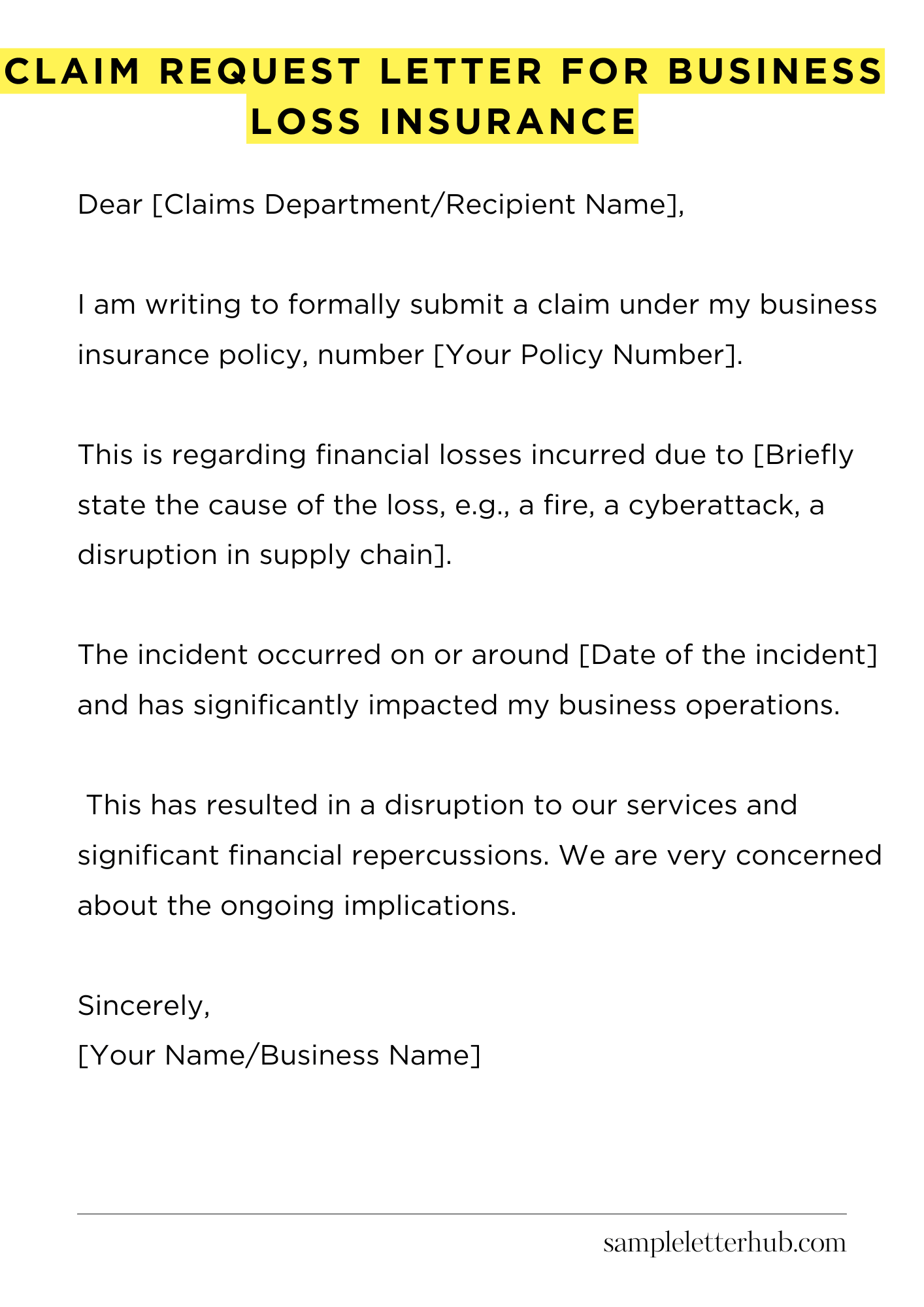
I am writing to formally submit a claim under my business insurance policy, number [Your Policy Number]. This is regarding financial losses incurred due to [Briefly state the cause of the loss, e.g., a fire, a cyberattack, a disruption in supply chain].
The incident occurred on or around [Date of the incident] and has significantly impacted my business operations. This has resulted in a disruption to our services and significant financial repercussions. We are very concerned about the ongoing implications.
Specifically, the losses include [List the types of losses in bullet points. Be clear and concise. Examples:
- Loss of income due to business interruption: [Estimate amount]
- Costs associated with damage repair and replacement: [Estimate amount]
- Additional expenses incurred to mitigate the impact of the loss: [Estimate amount]].
I have attached supporting documentation to substantiate these losses. This includes [List the types of documents included, e.g., financial statements, invoices, repair quotes, police reports, etc.]. Please carefully review the documentation.
I kindly request that you initiate the claim process as quickly as possible. We depend on this insurance to help us recover from this unexpected event and resume normal business activities. Time is of the essence here.
Please let me know if you require any further information or documentation from my end. I am available to discuss this matter further at your earliest convenience. I look forward to your prompt response and assistance in resolving this claim.
Thank you for your time and consideration.
Sincerely,
[Your Name/Business Name]
How to Write Claim Request Letter for Business Loss Insurance
Experiencing a business loss can be devastating. Navigating the insurance claim process can be equally daunting. A well-crafted claim request letter is your first line of defense.
It’s a formal declaration, a critical document that initiates the compensation process. This guide provides a strategic roadmap to writing a claim request letter for business loss insurance, making sure you articulate your claim effectively.
1. Understand Your Policy’s Tenets
Before you begin, scrutinize your insurance policy. This document is your bedrock. It’s crucial to grasp the policy’s specifics: what is covered, what are the exclusions, and what are the stipulated procedures for filing a claim.
Familiarize yourself with the *stipulations* and *provisos* outlined. Pay close attention to the definition of “business loss” within your policy. Many policies have particular interpretations of what constitutes an insurable event. Ensure your loss aligns precisely. Missing this step can result in rejection.
2. Gather the Requisite Ephemera
Documentation is king. Begin compiling all necessary supporting evidence. This includes, but isn’t limited to: financial records, such as balance sheets, income statements, and tax returns; invoices and receipts detailing the lost revenue; photographs and videos illustrating the damage or incident that caused the loss; police reports or incident reports (if applicable).
The more thorough your documentation, the stronger your claim will be. The insurer will assess all the proof that you give.
3. Craft a Compelling Narrative in the Opening
Your opening paragraph is crucial. It’s the introduction to your *litany* of distress. Clearly state that you are submitting a claim for business loss. Include your policy number, the date of the incident or period of loss, and a concise summary of what transpired. Explain the cause of the business loss and provide a brief overview of the impact.
The tone should be formal, professional, and factual. You are painting a picture and you are creating a record that will be important in the process.
4. Detail the Pertinent Circumstances with Precision
In subsequent paragraphs, provide a detailed account of the events leading up to the loss. Include the date, time, and location. Explain *precisely* how the loss occurred. Be specific and provide factual information.
Avoid conjecture or unsubstantiated opinions. If the loss resulted from a specific event (e.g., a fire, a natural disaster), provide as much detail as possible, including the cause and any contributing factors. Remember, clarity is key. Be thorough.
5. Quantify the Damages Systematically
This section is vital for determining the compensation. Provide a clear and itemized list of your losses. This should include direct financial losses (e.g., lost revenue, damaged inventory), and any associated expenses incurred as a result of the loss. Use financial data to support your claims.
For instance, you might use prior year sales data to estimate lost profits. Attach supporting documentation for each loss category. Be meticulous in your calculations. If there are various components to your loss, then it is important that you show them individually.
6. Articulate Your Expectations and Next Steps
Clearly state what action you are requesting from the insurer. This includes the amount of compensation you are seeking. Specify how you would like to receive the funds.
Outline any specific assistance or information you need from the insurer to facilitate the claim process. Politely request a prompt response and a clear timeline for the claim’s evaluation. Remember that your end goal is compensation.
7. Finalize and Dispatch Your Communication
Before submitting your letter, proofread it carefully. Check for grammatical errors, spelling mistakes, and factual inaccuracies. Ensure that all supporting documents are attached and properly labeled. Keep a copy of the letter and all attachments for your records. Send the letter via certified mail with return receipt requested.
This provides proof of delivery and acknowledgement from the insurance company. This is the last thing you need to do to make sure everything is in order.
FAQs about Claim Request Letter for Business Loss Insurance
What is a claim request letter for business loss insurance, and why is it important?
A claim request letter for business loss insurance is a formal document submitted to your insurance provider to initiate the process of receiving compensation for financial losses incurred by your business.
It is a critical step because it officially notifies the insurer of the loss, providing essential information to support your claim. This letter initiates the claims process and demonstrates your intent to seek reimbursement as per the terms of your insurance policy.
What specific information should be included in a claim request letter?
The claim request letter must contain several key pieces of information. This includes your business’s name, the policy number, and the date the loss occurred. Detailed descriptions of the event causing the loss are crucial, along with specifics on the type of loss (e.g., property damage, lost income).
Provide the estimated financial impact, supporting documentation like invoices, receipts, financial statements, and police reports. Additionally, outline the specific damages or losses you are claiming and the insurance coverage(s) applicable.
What is the proper format for writing a business loss insurance claim request letter?
The letter should be written formally and professionally. Begin with your company’s contact information, the date, and the insurance company’s address. Use a clear and concise language.
State the purpose of the letter and the policy number immediately. Include a detailed description of the incident, the losses sustained, and the supporting documentation attached. It should conclude with a request for claim processing and a polite request for follow-up, providing your contact information for further communication.
What types of business losses are typically covered by insurance?
Business loss insurance policies cover a variety of potential financial setbacks. Common coverages include property damage (due to fire, theft, or natural disasters), business interruption (loss of income due to covered events), and liability claims (costs associated with injuries or damages caused by the business).
Coverage can also extend to data breaches, cyber attacks, and employee dishonesty, depending on the specifics of the policy.
What are the common mistakes to avoid when submitting a business loss insurance claim?
Common mistakes to avoid include delaying the claim submission, as it may violate your policy terms. Providing incomplete or inaccurate information is also a significant error. Ensure that you have a detailed assessment of losses, including documentation, and do not underestimate or overestimate the financial impact.
Failing to follow the insurer’s specific claim instructions and neglecting to keep copies of all correspondence is also a common pitfall. Finally, not reviewing and understanding your insurance policy terms can lead to significant problems during the claims process.
Related:
Resignation letter due to rude boss
Resignation letter moving to another state
Resignation letter due to illness of family member
Resignation letter due to study