

A claim request letter for workplace injury is a formal document. Its purpose is to officially report a work-related injury. It initiates the process of seeking workers’ compensation benefits. This letter is crucial for employees to get the support they need.
Need help writing this important letter? You are at the right place. We’ve got you covered. We’ll provide you with sample claim request letters for workplace injury. We’ll show you different letter formats. Consider these your friendly, ready-to-use templates.
Writing this letter will be easy. Our samples make it simple. Adapt these letter samples to your specific situation. Quickly craft a workers’ compensation claim letter. Get the process started!
[Your Name]
[Your Address]
[Your Phone Number]
[Your Email Address]
[Date]
[Insurance Company Name or Employer Name]
[Address of Insurance Company or Employer]
Subject: Claim Request for Workplace Injury
Dear [Insurance Adjuster Name or Employer Contact Person],
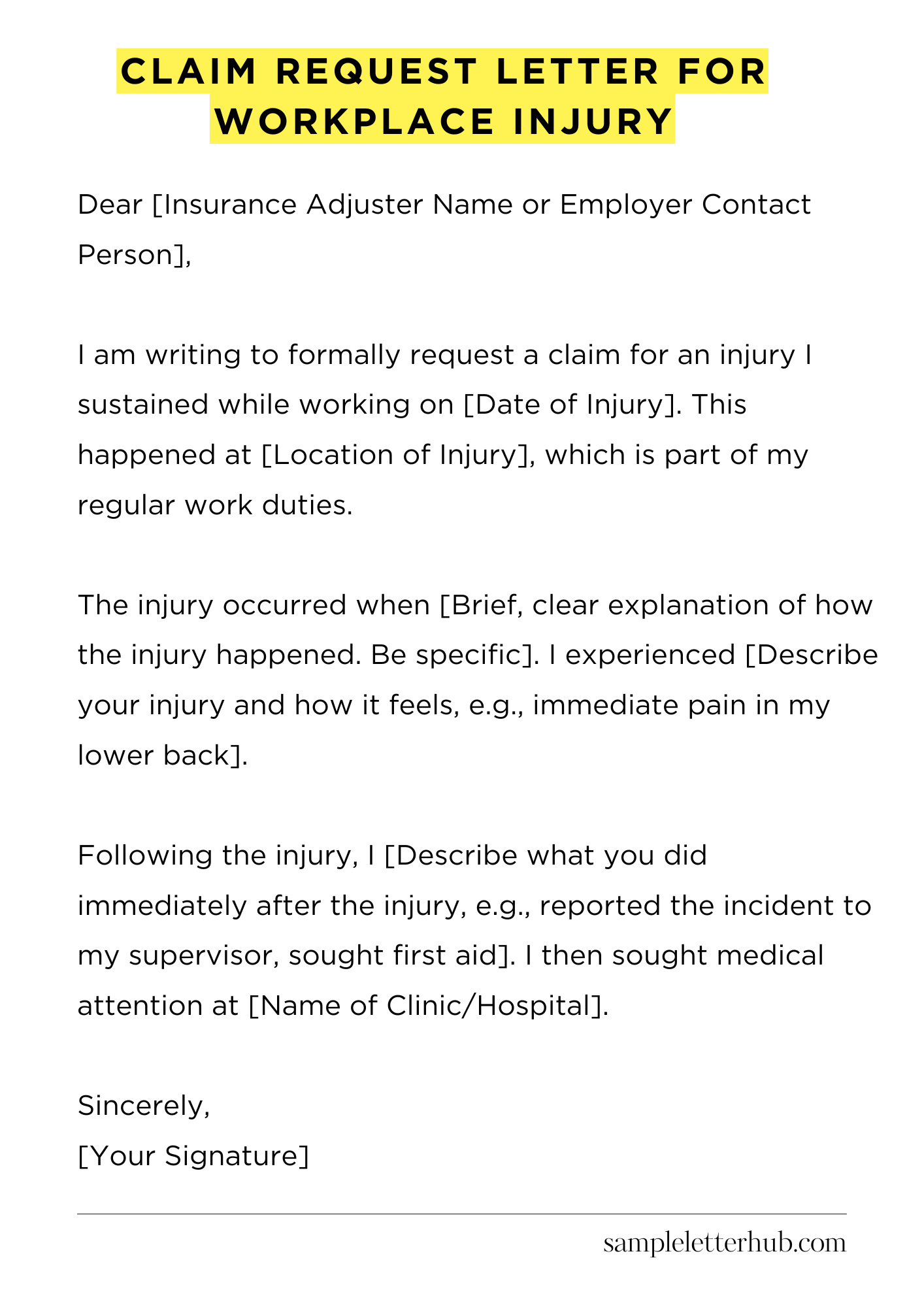
I am writing to formally request a claim for an injury I sustained while working on [Date of Injury]. This happened at [Location of Injury], which is part of my regular work duties.
The injury occurred when [Brief, clear explanation of how the injury happened. Be specific]. I experienced [Describe your injury and how it feels, e.g., immediate pain in my lower back].
Following the injury, I [Describe what you did immediately after the injury, e.g., reported the incident to my supervisor, sought first aid]. I then sought medical attention at [Name of Clinic/Hospital]. The doctor’s diagnosis was [State the diagnosis].
Attached to this letter are copies of the following documents: a medical report from [Doctor’s Name], a witness statement from [Witness Name, if applicable], and any other relevant documentation. This should provide sufficient information regarding the incident.
Due to this injury, I have been unable to perform my regular work duties. My work has been significantly impacted. I am requesting compensation for medical expenses and lost wages, as per the terms of my workplace insurance policy. This situation is impacting my ability to function normally.
I look forward to your prompt response and assistance in processing this claim. Please let me know if you require any further information. It is important that we resolve this quickly.
Sincerely,
[Your Signature]
How to Write Claim Request Letter for Workplace Injury
A workplace injury can be a debilitating experience, potentially leading to substantial financial and personal hardship. Navigating the claims process, however, can be equally challenging. This guide provides a comprehensive methodology for drafting a robust claim request letter.
1. Initiate: Gathering Your Documentary Corpus
Before you even begin to compose your letter, meticulous preparation is paramount. Amass every piece of evidence. This entails, but is not limited to, securing medical reports elucidating the injury’s nature and severity, records of all treatments administered, and any witness testimonials validating the incident.
Detailed photographic documentation of the injury site is also beneficial. Preserving these records meticulously will fortify your claim.
2. Exordium: Formulating Your Salutation
Begin your letter with a formal and professional salutation. Address the letter to the appropriate entity – typically, the employer’s insurance provider or the designated claims administrator.
If the specific recipient is known, address the letter directly to that individual. Employ a conventional salutation such as “Dear [Recipient’s Name],” or if a specific contact is unavailable, “To Whom It May Concern.” This establishes a tone of seriousness from the outset.
3. Narration: Detailing the Accident’s Circumstances
Provide a clear and concise account of the accident itself. Precisely describe the date, time, and location of the incident.
This section must be factual and devoid of embellishment. Include a detailed description of the events leading up to the injury, the precise nature of the injury sustained, and any immediate actions taken. Use clear, unambiguous language to present an irrefutable narrative.
4. Enunciation: Describing the Injury and Treatment
This segment requires you to meticulously document your injury and its subsequent treatment. Precisely specify the injury you sustained, using medical terminology if possible.
The narrative should include a list of all medical treatments you have received, the names of the attending physicians, and a record of any ongoing care. Reference the attached medical documentation to substantiate your claims. This meticulous attention to detail is crucial.
5. Accusation (Optional): Outlining Employer Negligence (If Applicable)
If employer negligence contributed to your injury, this is the section to articulate it. Clearly delineate the specific actions or inactions of your employer that, you contend, led to the accident.
Include any relevant company policies or safety regulations that were violated. Be sure to provide corroborating evidence to strengthen your argument. Be cautious and factual in your accusations.
6. Petition: Formulating Your Claim Request
Clearly state your claim and the specific compensation you are seeking.
This could include reimbursement for medical expenses, lost wages, and pain and suffering. If applicable, specify the duration of your inability to work. Provide a precise financial estimate for each category of damages, supported by relevant documentation. Leave no room for ambiguity when articulating your claim.
7. Peroration: Formalizing the Conclusion and Delivery
Conclude your letter with a formal closing, such as “Sincerely,” or “Respectfully,” followed by your full name and contact information. Sign the letter manually, if possible.
Retain a copy of the letter and all supporting documentation for your records. Send the original letter via certified mail with a return receipt requested. This provides proof of delivery and ensures a formal record of your claim.
FAQs about Claim Request Letter for Workplace Injury
What is a Claim Request Letter for a Workplace Injury?
A claim request letter for a workplace injury, often called a workers’ compensation claim letter, is a formal document an employee submits to their employer, insurance provider, or relevant authority.
It formally notifies them of a work-related injury or illness, and requests compensation for medical expenses, lost wages, and other related costs as per workers’ compensation laws.
What Information Should be Included in a Claim Request Letter?
A comprehensive claim request letter typically includes the employee’s full name, contact information, the date of the injury, a detailed description of how the injury occurred (including the specific activity and location), the body part(s) affected, the names of any witnesses, any immediate medical treatment received.
What is the Deadline for Filing a Claim Request Letter?
Deadlines vary by jurisdiction and are crucial to adhere to. Generally, there’s a time limit, often measured in weeks or months, from the date of the injury or the date the employee became aware of the injury or illness.
The specific deadline is usually determined by state or federal workers’ compensation laws. Failure to file within the stipulated timeframe may result in the denial of the claim. Always consult your local and state guidelines.
Where Do I Send My Claim Request Letter?
The claim request letter is usually submitted to the employer. Your employer will then forward it to their workers’ compensation insurance provider. In some cases, depending on local regulations, you might also be required to send a copy to a specific state agency or commission responsible for overseeing workers’ compensation claims.
What Happens After I Submit My Claim Request Letter?
After submitting the letter, the employer or insurance provider will usually investigate the claim. This may involve gathering information from witnesses, reviewing medical records, and contacting the employee for further details. The insurance company will then decide whether to accept or deny the claim.
If the claim is accepted, the employee will receive benefits, as dictated by workers’ compensation laws. If the claim is denied, the employee has the right to appeal the decision through a formal process, which varies by jurisdiction.
Related:
Resignation letter due to rude boss
Resignation letter moving to another state
Resignation letter due to illness of family member
Resignation letter due to study