

Dealing with damaged furniture is frustrating. You may need to file a claim request letter for damaged furniture. This letter is a formal document. Its purpose is to request compensation. You’re seeking reimbursement for the damage to your furniture. It’s often sent to the shipping company, insurance provider, or seller.
Writing this letter can feel daunting. We’re here to help you get it right. We’ll provide several sample claim request letters for damaged furniture. They are easy to adapt. Use these examples to craft your own letter quickly. Don’t worry, we got you.
Our templates cover various scenarios. Need a claim letter for shipping damage? We have it. Have issues with furniture purchased from a store? You’re covered. Our samples will guide you. Write with confidence. Get your claim started today!
[Your Name/Company Name]
[Your Address]
[Your Phone Number]
[Your Email Address]
[Date]
[Recipient’s Name/Company Name]
[Recipient’s Address]
Dear [Recipient’s Name],
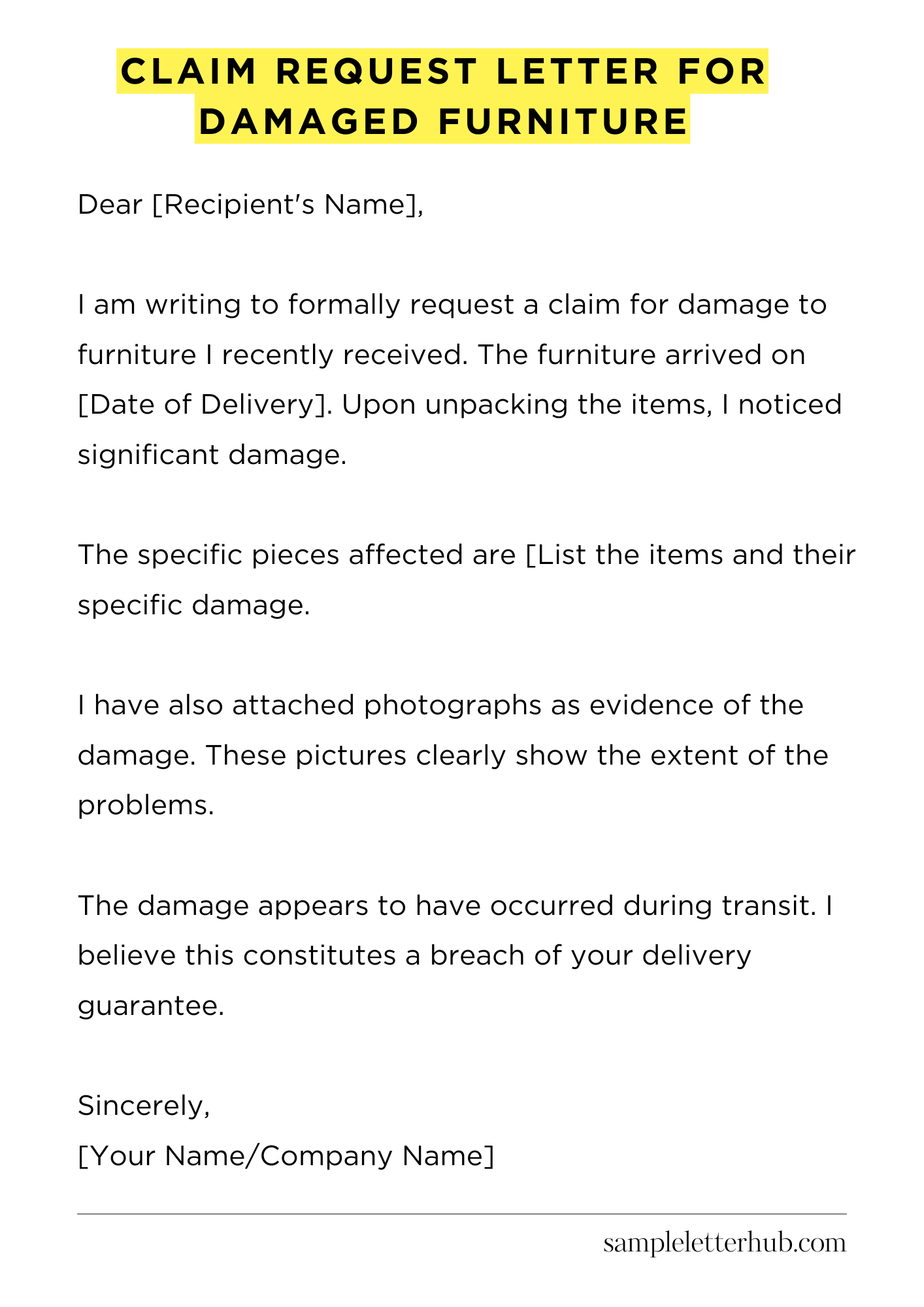
I am writing to formally request a claim for damage to furniture I recently received. The furniture arrived on [Date of Delivery]. Upon unpacking the items, I noticed significant damage.
The specific pieces affected are [List the items and their specific damage, e.g., “the coffee table, with a large scratch across the top” or “the sofa, with a tear in the fabric”]. It was very disappointing to see these issues. I have also attached photographs as evidence of the damage. These pictures clearly show the extent of the problems.
The damage appears to have occurred during transit. I believe this constitutes a breach of your delivery guarantee. I would appreciate it if you could look into this situation as soon as possible.
I would like to request [Specify what you want, e.g., “a repair of the damaged items,” “a replacement of the damaged items,” or “a partial refund to cover the cost of repairs”]. Please let me know what steps are needed to process this claim. I hope we can resolve this matter efficiently.
I look forward to your prompt response and resolution. You may reach me at the phone number or email address listed above. Thank you for your time and attention to this matter.
Sincerely,
[Your Name/Company Name]
How to Write Claim Request Letter for Damaged Furniture
Accidents happen. You’ve received your long-awaited furniture, only to discover it’s been marred during transit. Don’t despair; your recourse lies in a well-crafted claim request letter.
This missive is your formal plea for recompense, a crucial step in obtaining a resolution, be it a repair, replacement, or refund. Below, we’ll delve into the necessary components to render your letter a potent instrument for securing a satisfactory outcome.
1. Your Initial Salutation and Identification
Commence your letter with a formal salutation; “Dear [Recipient Name/Title]” is standard. Following this, clearly identify yourself. Include your full name, address, phone number, and email address.
You must demonstrate that you are the aggrieved party. State the date of the letter and the date of the furniture delivery. Be unequivocal in this introductory section, laying the groundwork for the ensuing discourse.
2. Precise Account of the Damage
The crux of your letter resides in a lucid and exhaustive description of the damage. Be meticulous. Document everything. Detail the specific piece of furniture, utilizing model numbers, and purchase dates.
Pinpoint exactly where the damage is located, what form it takes (scratches, dents, tears, etc.), and the estimated extent of the impairment. Attach clear, high-resolution photographs as supplementary evidence; these visual corroborations are often instrumental. The more granular you are in your description, the less room there is for ambiguity or contention.
3. The Delivery, the Damage, and the Timeline
Next, delineate the circumstances surrounding the damage. Explain how and when the furniture was delivered. Was the packaging intact? Did you sign a delivery receipt noting the damage?
If so, include a copy. If you discovered the damage shortly after delivery, state this explicitly. Provide the exact date the damage was noticed, highlighting any delays in reporting, if they exist, along with the reasons for those delays. This creates a clear timeline, establishing the sequence of events and aiding in attributing liability.
4. Pinpointing the Responsible Party
Identify the party responsible for the damage. Was it the manufacturer, the retailer, the shipping company, or a third-party delivery service? Reference any warranty information, shipping contracts, or policies relevant to your situation. If you have contact information for a specific representative or department, provide it.
The letter must be addressed to the appropriate authority who can address the issue. Being precise in your identification of the responsible entity expedites the claims process.
5. Your Explicit Claim and Desired Remedy
This is where you make your definitive request. Be explicit about the redress you seek. Do you desire a complete replacement of the furniture? A repair performed by a qualified technician?
A partial or full refund? Clearly state your preferred remedy and the rationale behind it. Explain why this solution is appropriate given the nature and extent of the damage. Be reasonable in your demands, aligning them with industry standards and the terms of your purchase agreement. This clarity significantly improves the efficacy of your claim.
6. Documentation and Supporting Evidence
Reinforce your claim with supporting documentation. As previously mentioned, include high-quality photographs of the damage. Attach copies of the purchase receipt, the delivery receipt, any warranty documentation, and relevant correspondence.
Organize these attachments neatly and reference them within the body of your letter. This comprehensive dossier fortifies your claim, strengthening its validity and bolstering your case.
7. Closing and Anticipated Response
Conclude your letter with a professional and assertive closing. State that you look forward to a prompt response and a resolution to the matter. Include a reasonable timeframe for a reply – typically within 14 to 30 days. Indicate that you are willing to discuss the matter further and provide your contact information again.
Thank the recipient for their time and consideration, and sign the letter. This demonstrates your commitment to a resolution, leaving the impression that you take the claim seriously, and expect them to do the same.
FAQs about Claim Request Letter for Damaged Furniture
What is the purpose of a claim request letter for damaged furniture?
The primary purpose of a claim request letter for damaged furniture is to formally notify the seller, manufacturer, or shipping company about the damage sustained by the furniture. It serves as an official record of the incident and initiates the process of seeking compensation, repair, or replacement of the damaged item.
What information should I include in a claim request letter for damaged furniture?
Your letter should include your contact information, the seller’s or responsible party’s contact information, the date of purchase, the order or invoice number, a detailed description of the damage, photographs of the damage, the desired resolution (e.g., repair, replacement, refund), and any supporting documentation, such as the purchase agreement or delivery receipt.
Who should I send the claim request letter to?
The recipient of your letter depends on the source of the damage or the terms of your purchase agreement. Typically, you would send the letter to the seller, the manufacturer (if there’s a warranty), or the shipping company responsible for delivering the furniture. Refer to your purchase documents or warranty for specific instructions.
What supporting documents should I attach to my claim request letter?
You should attach any documents that support your claim. This usually includes clear photographs of the damage from multiple angles, the original purchase receipt or invoice, the delivery receipt, any warranty information, and any communication you’ve already had regarding the issue.
What should I do if my claim is denied?
If your claim is denied, carefully review the reasons provided by the seller, manufacturer, or shipping company. You may consider gathering additional evidence to support your claim.
You could escalate the issue by contacting the customer service department, the manager or owner of the business. Finally, you might consider pursuing legal action if the amount in question is significant and you have a strong case.
Related:
Resignation letter due to rude boss
Resignation letter moving to another state
Resignation letter due to illness of family member
Resignation letter due to study