

Ever paid for a service that never happened? A “Claim Letter for Service Not Provided” is your official way to seek a refund or resolution. It’s a formal complaint. Its purpose is to document the issue. You are telling the service provider: “Hey, I didn’t get what I paid for!”
Writing a claim letter can feel daunting. Don’t worry, we’ve got you covered. We’re sharing templates and examples of a claim letter for service not provided. These are your tools. Use these claim letter samples to create your own letter. Need a service not provided complaint letter? We have many options for you.
Our goal is to simplify things. These claim letter examples make it simple. Adapt them to fit your specific situation. This article makes writing a claim letter easy.
[Your Name/Your Company Name]
[Your Address]
[Your Phone Number]
[Your Email Address]
[Date]
[Name of Service Provider]
[Service Provider’s Address]
Subject: Claim for Service Not Provided – Account [Your Account Number if applicable]
Dear [Name of Contact Person or “Customer Service Department”],
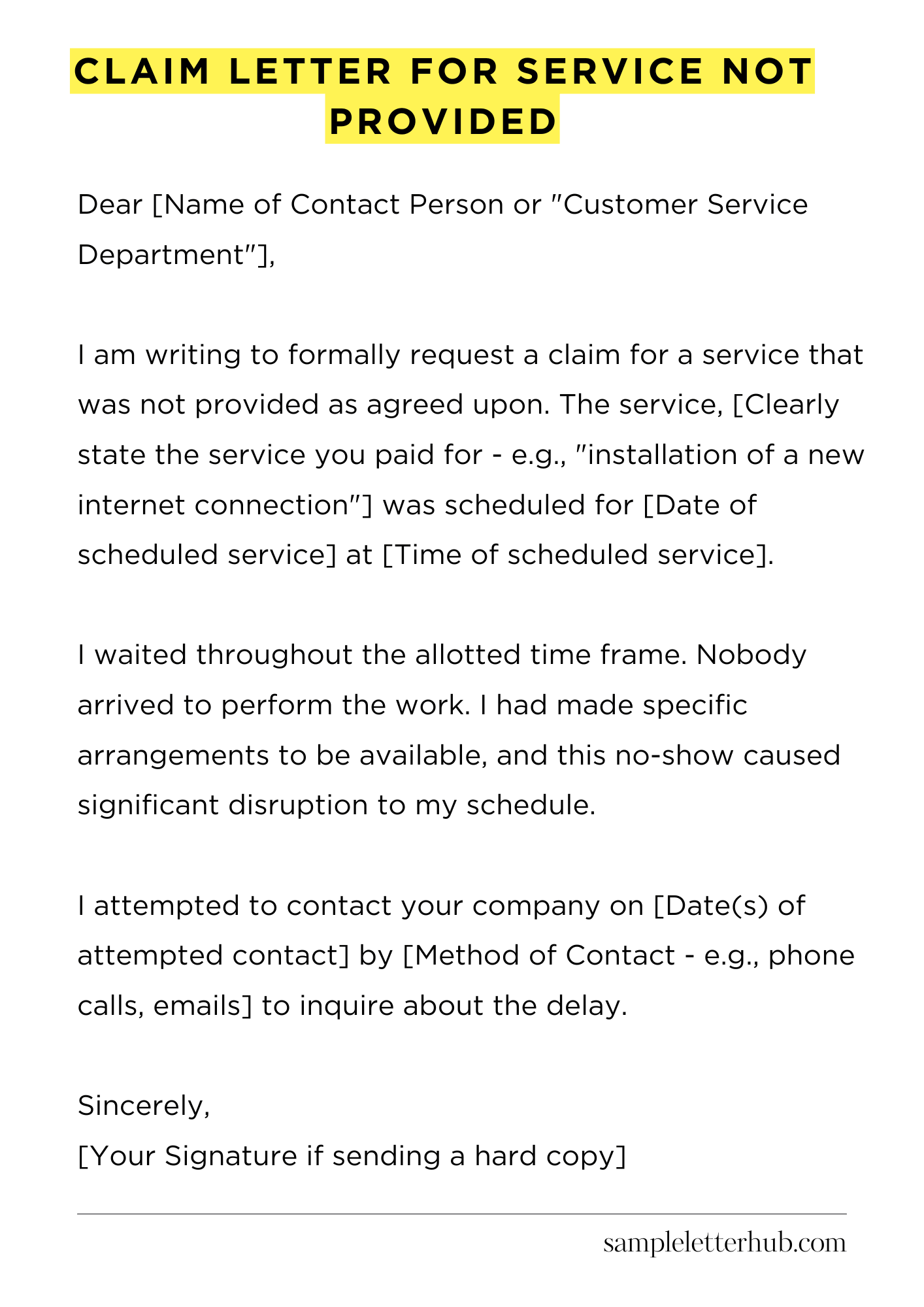
I am writing to formally request a claim for a service that was not provided as agreed upon. The service, [Clearly state the service you paid for – e.g., “installation of a new internet connection”] was scheduled for [Date of scheduled service] at [Time of scheduled service]. Unfortunately, the service did not take place.
I waited throughout the allotted time frame. Nobody arrived to perform the work. I had made specific arrangements to be available, and this no-show caused significant disruption to my schedule.
I attempted to contact your company on [Date(s) of attempted contact] by [Method of Contact – e.g., phone calls, emails] to inquire about the delay. I received [briefly describe the response you received, or lack thereof – e.g., “no response,” “conflicting information,” “was told someone would call back”]. This lack of communication further exacerbated the issue.
As a result of this failure to provide the promised service, I am requesting [State your desired outcome – e.g., “a full refund of the payment of $ [amount] for the service,” “rescheduling of the service at your earliest convenience,” “a discount on future services”]. This is a very important matter.
I have attached [List any attached documents – e.g., “a copy of my service agreement,” “a copy of my payment confirmation”]. These documents should help clarify the details of this agreement.
I look forward to your prompt attention to this matter and a resolution. You can reach me at the above address or phone number. I anticipate a response within [State a reasonable timeframe – e.g., “seven business days”].
Sincerely,
[Your Signature if sending a hard copy]
How to Write Claim Letter for Service Not Provided
Encountering a service shortfall can be a frustrating experience. But don’t fret; a well-crafted claim letter is your first line of defense. This guide will walk you through the process of composing a cogent claim, ensuring your voice is heard and your needs addressed.
1. Identifying the Locus of Your Grievance
Before you pen a single word, meticulously pinpoint the exact nature of the service failure. Was the promised service wholly absent, or did it merely fall short of expectations? Document precisely what was agreed upon – dates, times, specific tasks outlined in any contract or agreement. The more granular you are, the stronger your case will be.
2. Orchestrating Pre-Letter Reconnaissance
Have you already attempted to resolve the issue informally? Telephone calls, emails, or conversations? If so, chronicle these interactions, including the names of individuals you spoke with and the outcomes, or lack thereof. This demonstrates a good-faith effort and builds your credibility.
3. Crafting the Salutation: Addressing the Cognoscenti
Begin your letter with a formal salutation. “Dear [Name of Relevant Person, Title]” is the standard. If you are unsure of the specific contact, use a title like “To Whom It May Concern.” Avoid informal greetings; professionalism is paramount. Ensure you correctly spell the recipient’s name.
4. The Body Politic: Articulating Your Claim
The body of your letter is where you build your case. Start by clearly stating the purpose of the letter: “I am writing to formally claim for the service failure…” Then, provide a concise and chronological account of the events.
Mention when you contracted for the service. Detail precisely what service was supposed to be delivered. Mention when the service was not delivered or improperly rendered.
5. Substantiation: The Veritable Arsenal
Strengthen your claims with supporting documentation. Provide copies (never originals unless specifically requested) of contracts, invoices, receipts, and any other evidence that bolsters your position. Number and reference these attachments within your letter (e.g., “See Attachment 1: Invoice dated…”) This provides additional clarity.
6. Demanding Rectification and Recompense
Explicitly state what action you expect the service provider to take. Do you seek a full refund, a partial refund, or the completion of the service? Clearly outline your desired outcome. Include a specific timeframe for their response and action. Be reasonable, but firm in your requests. It’s also wise to explain the possible legal ramifications if the issue is not resolved.
7. Epilogue: The Closing Cadence
Conclude your letter with a polite but assertive closing. “Sincerely,” or “Respectfully,” followed by your full name, address, phone number, and email address.
Proofread your entire letter carefully before sending it. Keep a copy for your records. Consider sending the letter via certified mail with return receipt requested to ensure proof of delivery.
FAQs about Claim Letter for Service Not Provided
Here are some frequently asked questions about claim letters for services not provided:
What is a claim letter for service not provided?
A claim letter for service not provided is a formal document sent to a service provider when a service you paid for was not delivered as agreed upon. The purpose is to request a resolution, such as a refund, re-performance of the service, or other compensation for the failure to provide the service.
What information should be included in a claim letter?
A claim letter should contain the following: your name and contact information, the date, the name and contact information of the service provider, a clear description of the service that was not provided, the date and any relevant details of when the service was supposed to be provided, the amount paid for the service, copies of any supporting documentation (e.g., contract, receipts).
It’s also wise to keep a copy for your records.
When should I send a claim letter?
You should send a claim letter as soon as possible after discovering the service was not provided. This helps establish a clear timeline of events and reinforces your claim. Waiting too long may weaken your position if the provider claims you did not raise the issue promptly. However, consider any deadlines stipulated within the service agreement or contract.
How do I send a claim letter?
It’s generally recommended to send your claim letter via certified mail with return receipt requested, or another method that provides proof of delivery.
This ensures you have documentation that the provider received your letter. Sending it via email, with a read receipt requested, is also acceptable, but always keep a copy of your sent email. Regardless of method, make sure the delivery method you use provides a record of sending.
What happens if the service provider doesn’t respond to my claim letter?
If the service provider doesn’t respond within the timeframe specified in your letter (or a reasonable time if none was specified), you may need to escalate the matter.
Options include contacting consumer protection agencies, filing a complaint with the Better Business Bureau (if applicable), or pursuing legal action, such as small claims court, depending on the amount of money involved and the specific circumstances. Keep detailed records of all communication and actions taken.
Related:
Resignation letter due to rude boss
Resignation letter moving to another state
Resignation letter due to illness of family member
Resignation letter due to study