

Dealing with damaged electronics is frustrating. You may need to file a claim request letter to get it fixed, replaced, or compensated. This letter formally requests action from a company or insurer. Its purpose is to clearly state the damage and seek a resolution.
This article makes it easy. We will provide templates and examples of Claim Request Letters for Damaged Electronics. Think of it as your writing cheat sheet. Use these sample letters to guide you. Easily create your own effective claim letter.
We’re here to help you get your electronics situation sorted. Our provided letter samples cover various scenarios. From TV damage to a broken phone, we’ve got you covered. Simplify the process with our ready-to-use Claim Request Letter guides.
[Your Name]
[Your Address]
[Your Phone Number]
[Your Email Address]
[Date]
[Name of Company]
[Company Address]
Subject: Claim for Damaged Electronics – [Your Account Number or Policy Number, if applicable]
Dear [Name of Contact Person, or “Claims Department”],
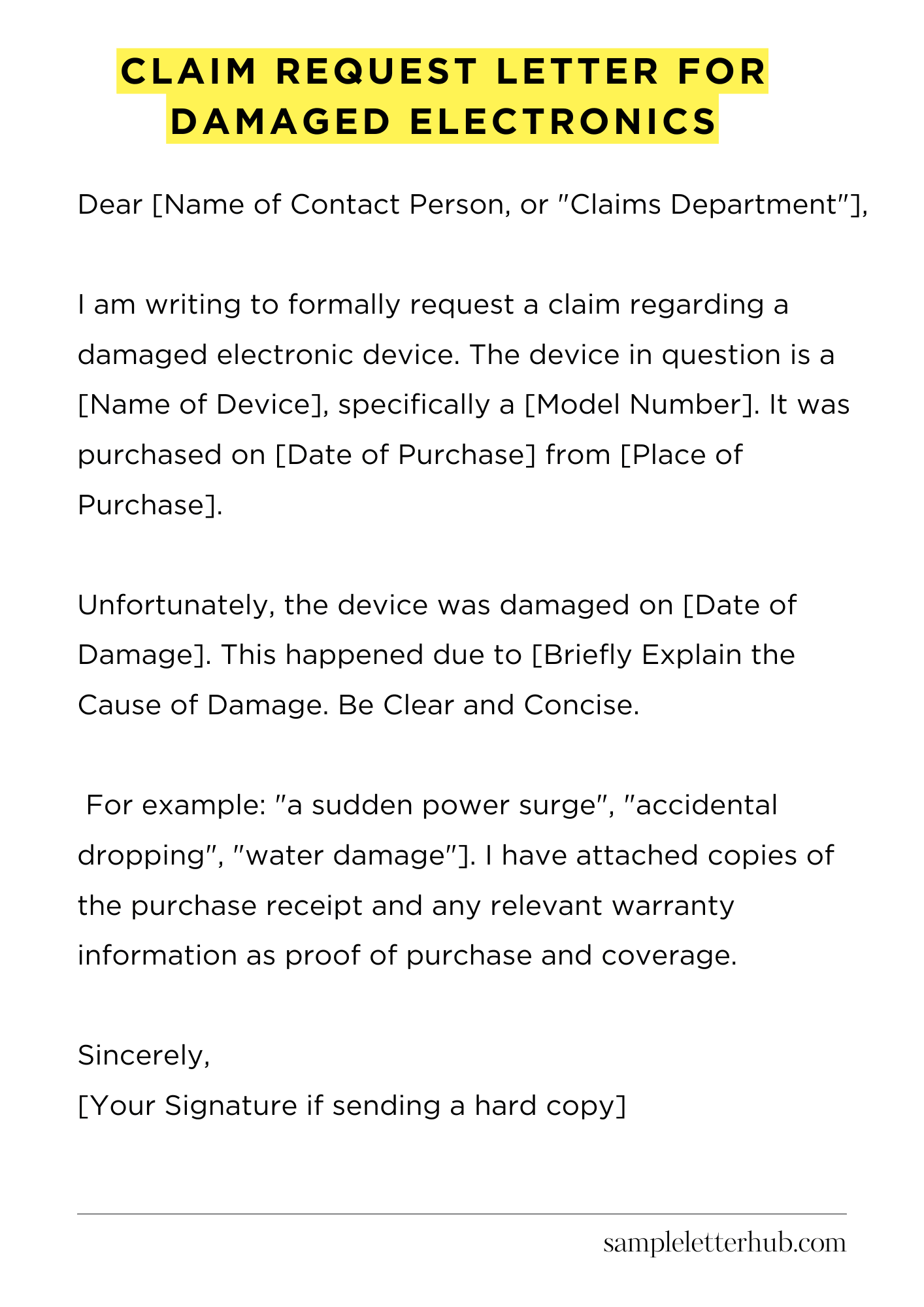
I am writing to formally request a claim regarding a damaged electronic device. The device in question is a [Name of Device], specifically a [Model Number]. It was purchased on [Date of Purchase] from [Place of Purchase].
Unfortunately, the device was damaged on [Date of Damage]. This happened due to [Briefly Explain the Cause of Damage. Be Clear and Concise. For example: “a sudden power surge”, “accidental dropping”, “water damage”]. I have attached copies of the purchase receipt and any relevant warranty information as proof of purchase and coverage.
The damage appears to be [Describe the Damage. Be specific. For example: “a cracked screen”, “non-functional power button”, “severe internal damage”].
This damage currently renders the device [Explain the impact of the damage. For example: “completely unusable”, “unable to perform its primary function”]. I believe this damage is covered under [Mention Warranty, Insurance, or Company Policy].
I would appreciate it if you would review my claim and initiate the necessary procedures for repair or replacement of the device. Please let me know what steps are required on my part. I am available to provide any further information or documentation you might need to process my request.
I look forward to hearing from you soon regarding the resolution of this matter. Your prompt attention to this is greatly appreciated.
Thank you for your time and assistance.
Sincerely,
[Your Signature if sending a hard copy]
How to Write Claim Request Letter for Damaged Electronics
Navigating the complexities of filing a claim for damaged electronics can be a perplexing ordeal. One of the most effective methods to initiate this process is by composing a meticulously crafted claim request letter.
This missive serves as your formal declaration of grievance and is the bedrock upon which your compensation claim will rest. Let’s dissect the anatomy of this crucial document, section by section.
1. Your Salutation and Addressee
Commence your letter with a professional salutation. Always address the recipient appropriately. “Dear [Recipient’s Title and Last Name]” is the gold standard, demonstrating respect and formality.
Ensure you have the correct name and title of the person responsible for handling claims at the retailer or manufacturer. This seemingly minor detail can significantly influence the initial impression and streamline the process. A generic “To Whom It May Concern” should be your last resort.
2. The Introductory Statement
Your opening paragraph needs to be crystal clear. Explicitly state the purpose of your letter: to formally request compensation or replacement for a damaged electronic device.
Include the model number, purchase date, and where you bought it, the specific details of the item. This information provides instant context and alerts the reader to the crux of the matter. Be direct and avoid unnecessary preamble; get straight to the point and showcase your intent.
3. Detailing the Debacle
This is where you narrate the circumstances surrounding the damage. Provide a comprehensive, chronological account of the events. Mention the date and time of the incident.
This section demands scrupulous precision. Be factual and objective; avoid emotive language. Describe precisely how the damage occurred. Detail the extent of the damage. Include any contributing factors, such as improper packaging (if applicable). Clarity is the paramount virtue here; every detail strengthens your claim.
4. The Evidential Arsenal
Your claim’s veracity is contingent on robust supporting evidence. Explicitly state what supporting documents you’re including. Attach legible copies of your purchase receipt, warranty information, and any other relevant documentation, such as photographs of the damaged electronics.
Your documentary evidence acts as the tangible corroboration of your assertions. The inclusion of strong visual proof will provide a greater chance of success. Organize your attachments and refer to them throughout your description of events.
5. Articulating Your Request
Clearly state what you seek as redress. Do you want a replacement of the device? Are you requesting a repair? Are you looking for a partial refund? Be precise and unequivocal about your desired outcome.
This ensures there’s no ambiguity about your expectations. State what you want, when you want it, and what happens if these terms are not followed. This can improve the chance of getting a positive outcome.
6. The Call to Action
Conclude your letter with a decisive call to action. Specify the timeframe you expect a response within. Provide your contact information (phone number and email address) again, just for good measure.
Express your willingness to collaborate further and resolve the matter amicably. A well-defined call to action expedites the claims process and demonstrates your commitment to reaching a resolution.
7. Closing and Signatory
Employ a professional closing, such as “Sincerely,” or “Respectfully.” Sign your full name clearly below, and if sending via post, print your name too for clarity. If you are sending it through digital means, your typed name should suffice.
A proper closing is not just etiquette; it reinforces the professionalism of your communication and leaves a lasting positive impression. This final flourish completes the letter.
FAQs about Claim Request Letter for Damaged Electronics
What information should I include in a claim request letter for damaged electronics?
Your claim request letter should include: your full name and contact information, the date, the name and address of the seller or manufacturer, a clear description of the damaged electronic item (including model number and serial number), the date of purchase, the purchase price.
What supporting documents should I include with my claim request letter?
You should include: a copy of your purchase receipt or proof of purchase, any warranty information, photographs or videos clearly showing the damage, and any repair estimates you’ve obtained. If the damage resulted from shipping, also include documentation from the shipping carrier.
How do I determine who to send the claim request letter to?
Determine who is responsible by referring to your purchase agreement and warranty. If the damage occurred during shipping, contact the shipping carrier. Otherwise, address the letter to the seller or the manufacturer, as indicated by the product’s warranty or the retailer’s return policy.
How long do I have to submit a claim request letter?
The timeframe for submitting a claim request letter depends on the retailer’s or manufacturer’s warranty and return policies. Review these documents carefully. Generally, there’s a specific period from the date of purchase or the date the damage occurred to file a claim. Act promptly to avoid missing the deadline.
What should I do if my claim is denied?
If your claim is denied, carefully review the reasons for the denial. You may have the option to appeal the decision by providing additional information or evidence. If the denial seems unjust or violates the terms of the warranty or applicable consumer protection laws, consider consulting a legal professional.
Related:
Resignation letter due to rude boss
Resignation letter moving to another state
Resignation letter due to illness of family member
Resignation letter due to study