

Lost luggage is a traveler’s nightmare. A claim request letter for lost luggage is your key to getting compensated. It’s a formal document you send to the airline or transportation provider. Its purpose? To officially report your lost baggage and request financial reimbursement.
We understand how frustrating this can be. That’s why we’re here to help you navigate this process. We have prepared some awesome sample claim letters for lost luggage. These templates will assist you in crafting your own. You can use these claim request letter samples as your starting point.
These letter samples are easy to adapt. They cover different scenarios you might encounter. We’ve simplified the language. You can easily customize them to suit your needs. Get ready to write a solid lost luggage claim letter quickly.
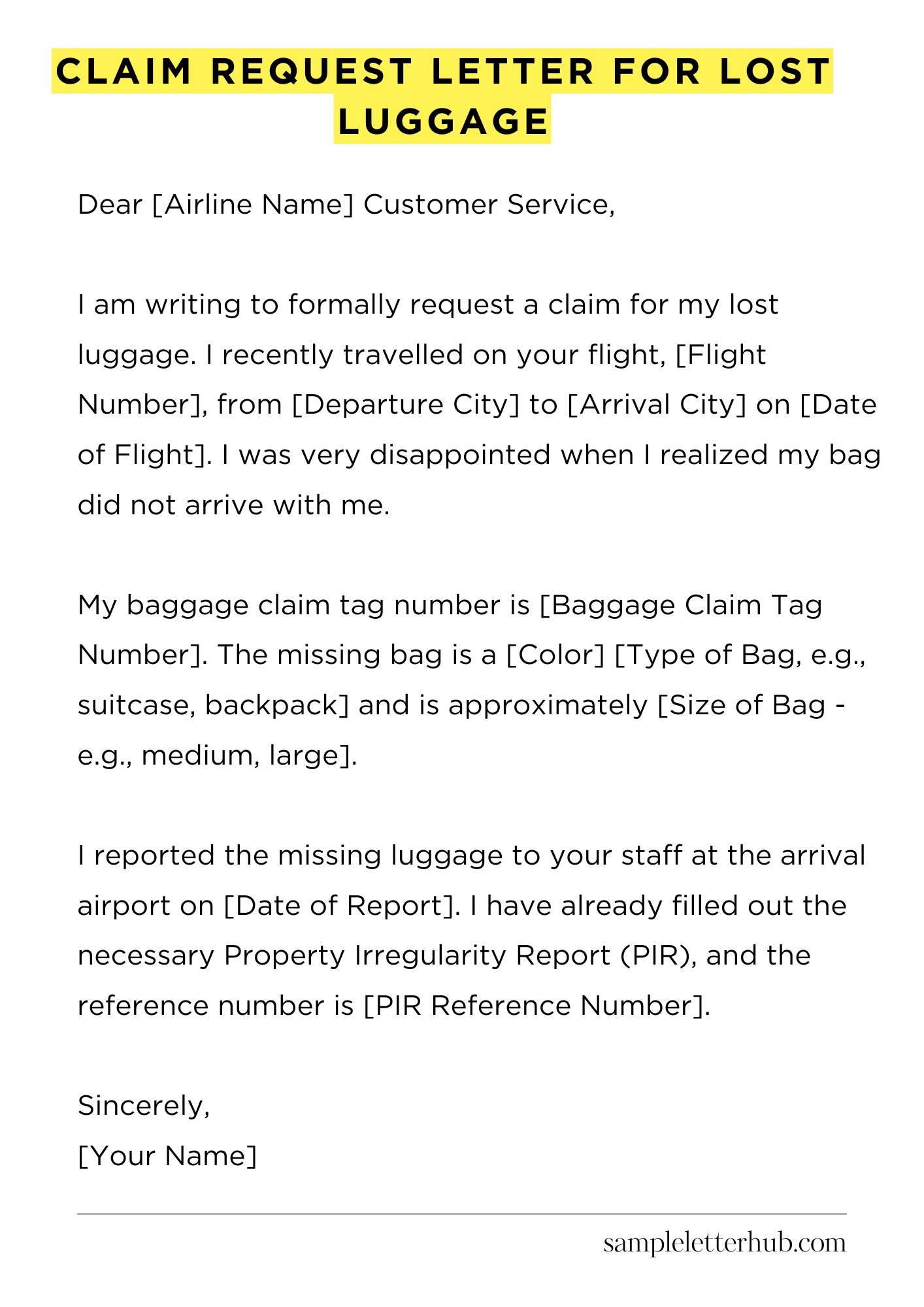
[Your Name/Address]
[Your Phone Number]
[Your Email Address]
[Date]
[Airline Name]
[Airline Address]
Subject: Claim for Lost Luggage – Flight [Flight Number]
Dear [Airline Name] Customer Service,
I am writing to formally request a claim for my lost luggage. I recently travelled on your flight, [Flight Number], from [Departure City] to [Arrival City] on [Date of Flight]. I was very disappointed when I realized my bag did not arrive with me.
My baggage claim tag number is [Baggage Claim Tag Number]. The missing bag is a [Color] [Type of Bag, e.g., suitcase, backpack] and is approximately [Size of Bag – e.g., medium, large]. I packed it with essential items. The contents included clothing, toiletries, and some personal belongings.
I reported the missing luggage to your staff at the arrival airport on [Date of Report]. I have already filled out the necessary Property Irregularity Report (PIR), and the reference number is [PIR Reference Number]. I understand that these things can happen.
I would appreciate it if you could start the process to find my luggage immediately. I kindly request you keep me updated on the progress of your search. Finding the luggage as quickly as possible is important to me, because I need the items within the bag.
Please let me know the steps I need to take to receive compensation for the loss of my luggage. I have attached a copy of my flight ticket and baggage claim tag for your review. I look forward to your prompt response.
Thank you for your time and assistance in this matter.
Sincerely,
[Your Name]
How to Write Claim Request Letter for Lost Luggage
Losing your luggage is a colossal inconvenience. This guide will help you navigate the process of composing a claim request letter to the airline or transportation company, ensuring you have the best possible chance of retrieving your belongings or securing appropriate compensation.
1. Identifying the Recipient and Formatting the Header
Precision is paramount. Begin by accurately identifying the entity you’re addressing. This might be the airline’s baggage claim department, customer relations, or a designated claims office. Find their official mailing address – avoid informal channels.
The header should feature your contact information: full name, address, phone number, and email. Date the letter clearly, placing this date beneath your address.
2. The Salutation: A Formal Overture
Initiate the letter with a formal salutation. “Dear Sir/Madam” is a universally accepted starting point if you lack a specific contact name. If you possess a name, “Dear Mr./Ms. [Surname]” is preferable, adding a personal touch without being overly familiar.
3. Providing Pertinent Details of the Debacle
This section is crucial. State the purpose of your letter immediately: a claim for lost luggage.
Then, provide a comprehensive chronicle of the situation. Include your flight number(s), the date(s) of travel, the origin and destination airports, and the baggage tag number(s). Detail the specific date and time you reported the luggage missing. Emphasize the verifiable facts surrounding the situation.
4. Describing the Missing Articles
Meticulously catalog the contents of your missing luggage. Create a detailed inventory. Mention the brand, color, approximate value, and any distinguishing characteristics of each item.
This detailed description is critical for identification. Attach copies of receipts or purchase proofs, if available. The more specific you are, the better your chances are of recovery or proper compensation.
5. Outlining the Desired Resolution
Clearly state what resolution you are seeking. This might include requesting the airline to locate and return the luggage. Or, it could be a request for compensation for the lost items.
State the compensation amount you are seeking, based on your documented losses. Be reasonable in your expectations, factoring in the airline’s policies and any applicable international regulations.
6. Concluding the Letter: A Call to Action
Conclude your letter with a polite but assertive closing. Reiterate your contact information. Express your expectation of a prompt response and the willingness to cooperate in the investigation. Use a professional closing, such as “Sincerely” or “Yours faithfully” (if you began with “Dear Sir/Madam”).
7. Proofreading and Submission: The Final Ascent
Before dispatching your letter, meticulously proofread it for grammatical errors and typos. Ensure all details are accurate and the language is professional. Make a copy of the letter and all supporting documents for your records. Send the letter via certified mail with a return receipt requested.
This provides proof of delivery and acknowledgement, which can be invaluable in case further action is needed. Keep tracking the updates until resolution.
FAQs about Claim Request Letter for Lost Luggage
What information should I include in a claim request letter for lost luggage?
Your claim request letter for lost luggage should comprehensively include: your full name and contact information (address, phone number, email), the date of the flight and flight number, the baggage tag number(s), a detailed description of the lost luggage (including brand, color, size, and any distinguishing features).
Include copies of supporting documents like your ticket, baggage tag, and any receipts for the items inside the luggage.
To whom should I address the claim request letter?
The claim request letter should be addressed to the airline’s baggage claim department or customer service department. You can usually find the specific department and address by searching the airline’s website or contacting their customer service.
If you are unsure, you can often address the letter “To Whom It May Concern” or to the “Baggage Claims Department” of the airline.
What is the timeframe for submitting a claim request letter for lost luggage?
The timeframe for submitting a claim request letter for lost luggage typically varies depending on the airline and the specific regulations. However, it’s generally recommended to submit the letter as soon as possible after discovering your luggage is lost. Most airlines have specific deadlines, often within a few days or weeks of the incident.
Review the airline’s policy on their website or contact customer service to ensure you adhere to their specific time constraints.
What happens after I submit a claim request letter for lost luggage?
After submitting the claim request letter, the airline will typically investigate the matter. This may involve searching their system for the luggage, contacting their baggage handling partners, and communicating with you to gather additional information.
The airline will keep you informed of the progress. If the luggage is found, it will be returned to you. If the luggage is not found, the airline will usually provide compensation based on their policy, which may be determined by the weight or value of the contents of the luggage.
What if the airline denies my claim for lost luggage?
If the airline denies your claim, you have several options. First, review the reason for the denial and the airline’s policy. You may be able to provide additional documentation or evidence to support your claim.
You can also appeal the decision by writing a follow-up letter or contacting the airline’s customer service department to discuss the denial. If you are unsatisfied with the airline’s final decision, you may consider further actions such as filing a complaint with a consumer protection agency or seeking legal advice.
Related:
Resignation letter due to rude boss
Resignation letter moving to another state
Resignation letter due to illness of family member
Resignation letter due to study