

A flood damage claim letter is a formal document. Its purpose is to request compensation. You send it to your insurance company. This is after flood waters have damaged your property. It outlines the flood damage and the losses you’ve suffered.
Dealing with flood damage is stressful. Writing a flood damage claim letter shouldn’t be. That’s why we’re here! We’ll provide flood damage claim letter samples. We also have examples and templates for you.
Our goal is simple. We aim to simplify the process. These samples will guide you. You can easily create your own claim letter. Get the help you need, right here.
[Your Name/Company Name]
[Your Address]
[Your Phone Number]
[Your Email Address]
[Date]
[Insurance Company Name]
[Insurance Company Address]
Subject: Flood Damage Claim – Policy Number [Your Policy Number]
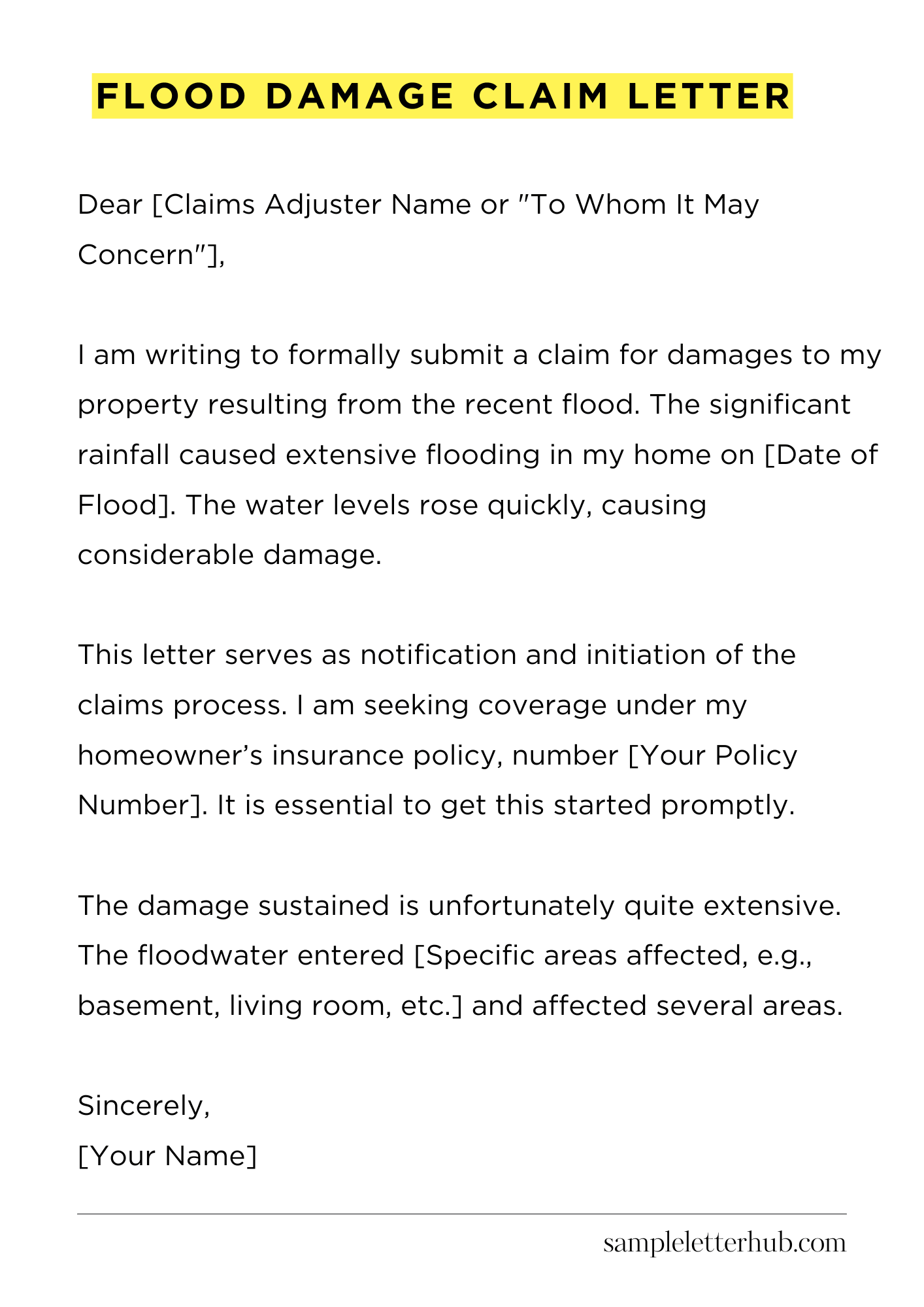
Dear [Claims Adjuster Name or “To Whom It May Concern”],
I am writing to formally submit a claim for damages to my property resulting from the recent flood. The significant rainfall caused extensive flooding in my home on [Date of Flood]. The water levels rose quickly, causing considerable damage.
This letter serves as notification and initiation of the claims process. I am seeking coverage under my homeowner’s insurance policy, number [Your Policy Number]. It is essential to get this started promptly.
The damage sustained is unfortunately quite extensive. The floodwater entered [Specific areas affected, e.g., basement, living room, etc.] and affected several areas. My belongings, including furniture, appliances, and personal items, have been severely impacted.
Attached to this letter, you will find preliminary documentation that supports my claim. This includes photographs of the damage, which shows the severity of the flooding. I have also included a list of the damaged items.
Furthermore, I will be providing estimates for the necessary repairs and replacements as soon as they are available. I am already working with qualified contractors.
I request that you assign a claims adjuster to my case as soon as possible. Please contact me at your earliest convenience to arrange for an inspection of the property. I am available to meet on [List your available dates/times]. I will make sure everything is accessible.
I understand that the claims process can take time. However, I kindly request your prompt attention to this matter. I look forward to your quick response. I appreciate your assistance in helping me recover from this unfortunate event. Thank you for your time and consideration.
Sincerely,
[Your Name]
How to Write a Flood Damage Claim Letter
A flood can wreak havoc, leaving a trail of destruction in its wake. Filing a comprehensive and persuasive claim is paramount to recouping your losses. Here’s a structured approach to composing a Flood Damage Claim Letter that stands a better chance of success:
1. Commence with an Impeccable Salutation
Your missive should begin with a professional salutation. Address the letter to the appropriate claims adjuster or insurance representative, if known. If you’re uncertain, you can address it to the “Claims Department” or the “Claims Manager.”
Using formal titles such as “Mr.,” “Ms.,” or “Dr.” adds a touch of decorum. For instance: “Dear Ms. Evelyn Reed,” or if unspecified, “To Whom It May Concern,” are good starts.
2. Explicitly State Your Purpose and Policy Information
Clearly state the purpose of your letter from the outset. In the first paragraph, unambiguously declare that you are submitting a claim for flood damage. Immediately provide your policy number, the date of the incident (flood), and the address of the affected property.
Ensure all this critical data is readily accessible and accurate. This initial section forms the bedrock of your claim, laying a foundation of transparency.
3. Detail the Cataclysmic Events and Scope of Damage
This section is where you paint a vivid picture of the calamity. Describe the flood event with particularity, including the water levels, the duration of the inundation, and the source of the floodwater.
Be scrupulous in detailing the precise damages. Enumerate each damaged item, including its pre-flood condition, its current state, and a brief description of the damage. Use concise, precise language.
Include photographs or videos, if available, to substantiate your statements. The more detail you provide, the better. Consider using bullet points to organise the damage.
4. Comprehensive Documentation: The Linchpin of Your Claim
This is arguably the most crucial section. Include all supporting documentation. This should encompass: photos, videos, repair estimates from reputable contractors, receipts for temporary housing, and any proof of purchase or ownership for damaged possessions. Any document that validates your claim is advantageous.
The more evidence you accumulate, the better your chances. Organize these documents meticulously and refer to them within the body of your letter for easy referencing.
5. Financial Assessment: Itemizing Your Monetary Losses
This section demands meticulousness. Provide a detailed summary of your financial losses. Categorize these losses into separate sections: property damage, personal belongings, and any additional living expenses incurred due to the displacement.
Alongside each item, clearly specify the estimated repair or replacement cost. Consider creating a spreadsheet, or attaching a detailed document. Ensure that the total amount claimed reflects all losses and aligns with the documentation provided.
6. The Formal Closing and Affirmation of Accuracy
Conclude your letter with a formal closing and an assertion of truthfulness. Use a professional closing, such as “Sincerely,” or “Respectfully.”
Sign your name above the typed name. Include your contact information (phone number, email address) to enable the adjuster to reach you. In the final paragraph, reiterate that all information provided is accurate and factual to the best of your knowledge.
7. Submission and Follow-up: Navigating the Claims Process
Make a copy of the letter and all attachments before sending them via certified mail with a return receipt requested. This provides proof of delivery. Following submission, maintain open communication with the insurance adjuster. If you don’t receive an acknowledgment within a reasonable timeframe, follow up.
Inquire about the status of your claim. Be proactive in providing any additional information requested. Persistence and thoroughness are key to successfully navigating the claims process.
FAQs about Flood Damage Claim Letter
What is a flood damage claim letter, and why is it important?
A flood damage claim letter is a formal document submitted to your insurance provider to request compensation for damages caused by flooding.
It’s crucial because it officially initiates the claims process, providing your insurer with essential details about the event, the resulting damage, and the coverage you’re seeking. A well-written letter can significantly impact the speed and success of your claim.
What information should I include in a flood damage claim letter?
Your letter should include your policy number, the date and location of the flood, a detailed description of the damage (including specific items), an estimate of the repair or replacement costs, photos and videos of the damage, and any relevant supporting documentation (e.g., receipts, professional assessments). Be as thorough and accurate as possible to support your claim.
What is the typical process after submitting a flood damage claim letter?
After submitting your letter, the insurance company will typically acknowledge receipt and assign a claims adjuster. The adjuster will contact you to discuss the claim, inspect the damage, and assess its validity.
They may request additional information or documentation. Once the assessment is complete, the insurance company will inform you of their decision regarding coverage and payment.
What if my flood damage claim is denied?
If your claim is denied, you’ll receive a denial letter explaining the reasons. You have the right to appeal the decision. Review the denial letter carefully and gather any additional evidence that supports your claim.
Follow the appeal instructions outlined in your policy, which may involve submitting a formal appeal letter, providing additional documentation, or requesting mediation or arbitration.
How can I ensure my flood damage claim letter is effective?
To ensure effectiveness, write clearly and concisely, focusing on factual details. Include all necessary information and supporting documentation. Take photographs and videos to document the damage thoroughly.
Keep copies of everything you send to the insurance company and maintain a record of all communications. Consider consulting with a public adjuster or legal professional if you need assistance.
Related:
Resignation letter due to rude boss
Resignation letter moving to another state
Resignation letter due to illness of family member
Resignation letter due to study