

A fire damage insurance claim letter is a formal document. It is sent to your insurance provider. Its purpose is to officially report fire damage. The letter initiates the claims process. It requests financial compensation for covered losses.
Facing a fire is tough. Dealing with insurance claims can be even harder. This article helps you write the perfect letter. We’ll give you fire damage insurance claim letter samples. These examples cover various situations.
You’ll find templates for different scenarios. Need to claim for property damage? We’ve got you. Claiming for lost possessions? We have that too. Use these samples to create your fire claim letter quickly. Get the financial help you deserve.
[Your Name/Insurance Policy Holder Name]
[Your Address]
[Your Phone Number]
[Your Email Address]
[Date]
[Insurance Company Name]
[Insurance Company Address]
Subject: Fire Damage Claim – Policy Number [Your Policy Number]
Dear [Claims Department/Adjuster Name, if known, otherwise use “Sir/Madam”],
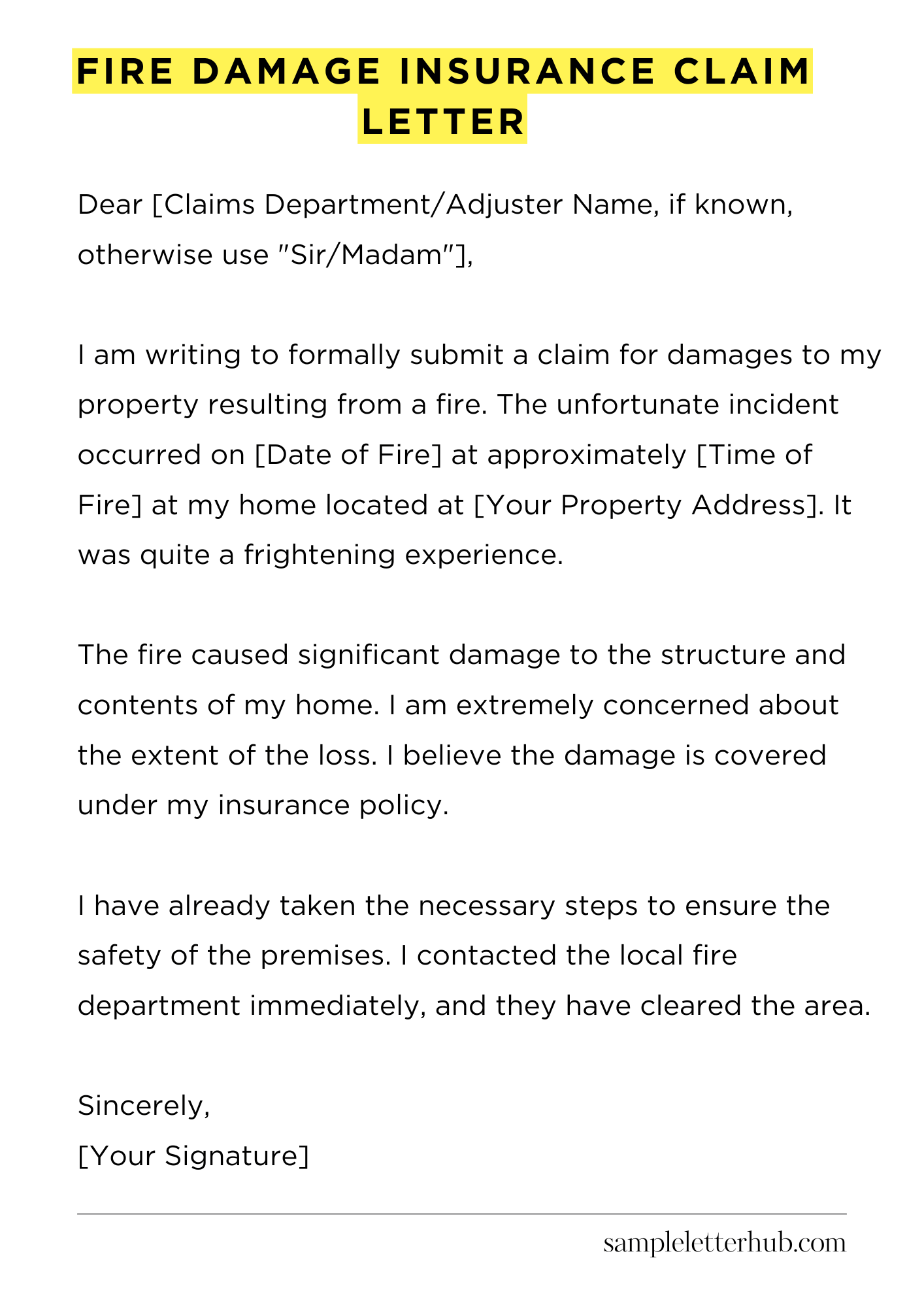
I am writing to formally submit a claim for damages to my property resulting from a fire. The unfortunate incident occurred on [Date of Fire] at approximately [Time of Fire] at my home located at [Your Property Address]. It was quite a frightening experience.
The fire caused significant damage to the structure and contents of my home. I am extremely concerned about the extent of the loss. I believe the damage is covered under my insurance policy, number [Your Policy Number], which I hold with your company.
I have already taken the necessary steps to ensure the safety of the premises. I contacted the local fire department immediately, and they have cleared the area. I have also begun documenting the damage with photographs and videos. This documentation includes pictures of the structural damage, damaged personal belongings, and overall affected areas.
I would appreciate it if you could assign a claims adjuster to my case as soon as possible. Please let me know what steps are required to expedite the claims process. I want to proceed without delay.
I have attached a preliminary list of the damaged items, and I will submit a more detailed inventory, including estimated values, within the next [Number] days. This detailed inventory will help to fully assess the damages.
I am available to meet with the adjuster at your earliest convenience to assess the damage. My schedule is quite flexible. Please feel free to contact me at your convenience to schedule a visit or request any further information.
Thank you for your prompt attention to this urgent matter. I look forward to hearing from you soon regarding the next steps in processing my claim.
Sincerely,
[Your Signature]
How to Write Fire Damage Insurance Claim Letter
1. Commence with a Cogent Salutation
Begin your missive with a formal salutation. Address the insurance adjuster by name, if possible; this imparts a personalized touch. If the adjuster’s identity is unknown, utilize a generic salutation like “To Whom It May Concern.”
Make sure to include the insurance company’s official address to prevent any misdirection. Your initial words should project a sense of decorum and earnestness.
2. Explicitly State Your Purpose
The cardinal principle of any correspondence is clarity. Immediately declare the letter’s purpose: to file a claim for fire damage. Include your policy number, the date of the fire, and the property’s address.
Avoid ambiguity; directly state that you are seeking compensation for losses sustained due to the fire. This lays the groundwork for a transparent and efficient claim process.
3. Detail the Catastrophe: A Chronicle of the Inferno
Provide a comprehensive account of the fire’s genesis and its aftermath. Describe the extent of the damage to your property and its contents. Be precise.
Specify the damaged items, including their approximate value, and mention if the items were salvaged. Incorporate photographic evidence and, if available, any official reports from the fire department or other relevant authorities. This section is essentially a visual and textual synopsis of the devastation.
4. Document Your Losses with Meticulousness
This is the keystone of your claim. Meticulously document all losses. Create an itemized list of damaged or destroyed possessions, their original purchase prices, and estimated replacement costs.
If receipts are unavailable, research current market values of similar items to substantiate your claims. Include supporting documentation: photographs, videos, and any proof of ownership that can fortify your request. This thoroughness will accelerate the processing of your claim.
5. Highlight Temporary Living Expenses
If the fire rendered your dwelling uninhabitable, you are likely entitled to reimbursement for temporary living expenses. Clearly state these expenses in your letter.
Detail the costs for accommodations, meals, and any other pertinent costs incurred while displaced. Retain all receipts, invoices, and bank statements to provide evidence. Demonstrate the necessity and the reasonableness of these expenses to bolster your claim.
6. The Concluding Summation and Call to Action
Conclude your letter with a polite but assertive tone. Summarize the claim, reiterating your request for compensation. Specify the total amount of damages you are seeking. Include your contact information—phone number and email address—for effortless communication.
Request a timely response from the insurance company, along with instructions on the subsequent steps in the claim’s execution. A definitive call to action is crucial for a swift resolution.
7. Finalizing and Formalities: Ensuring the Letter’s Integrity
Before dispatching your missive, proofread meticulously for any typographical errors or grammatical lapses. Ensure that all supporting documents—photographs, receipts, and reports—are attached.
Sign and date the letter; this action confirms its authenticity and your commitment to the information contained within. Send the letter via certified mail with a return receipt requested.
This provides proof that your claim was received. Make a copy of the letter and all attachments for your records. This is vital for your future reference.
FAQs about Fire Damage Insurance Claim Letter
What is the primary purpose of a fire damage insurance claim letter?
The primary purpose of a fire damage insurance claim letter is to formally notify your insurance company about the fire incident and to initiate the claims process. It serves as a documented record of the event, outlining the damages incurred and requesting compensation as per your insurance policy.
What essential information should be included in a fire damage insurance claim letter?
Your letter should include your policy number, the date and time of the fire, the location of the fire, a detailed description of the damages (including specific items), any injuries sustained, contact information, and a clear request for claim processing and assistance from the insurance company. It’s also wise to include any initial actions you’ve taken to mitigate further damage.
How soon after the fire should I send the insurance claim letter?
You should send the letter as soon as possible after the fire, ideally within the timeframe specified in your insurance policy. Prompt notification allows the insurance company to begin their investigation and assessment of the damage expeditiously. Delays might complicate the process and potentially impact your claim.
What supporting documents should I attach to my fire damage insurance claim letter?
Attach any available supporting documents such as photos and videos of the damage, police or fire department reports, receipts or documentation for damaged items (if available), and any other evidence that supports your claim. These documents help substantiate the extent of the damage and your losses.
How should I submit my fire damage insurance claim letter?
Most insurance companies accept claim letters via multiple channels, including mail, email, or an online claim portal. Confirm your insurance company’s preferred method. It’s often advisable to send the letter via certified mail with a return receipt requested to provide proof of delivery and ensure that your claim is formally acknowledged.
Related:
Resignation letter due to rude boss
Resignation letter moving to another state
Resignation letter due to illness of family member
Resignation letter due to study