


Dealing with damage to your home is stressful. A home insurance claim letter is how you tell your insurance company about it. The purpose? To formally request financial help. You’re seeking coverage for repairs or replacements. It’s the first step in getting your home back in shape.
Writing this letter might seem daunting. But don’t worry! We’ve got you. We’re sharing home insurance claim letter templates. You’ll find examples and samples of home insurance claim letters. These will make it easy. We provide you with the structure for your own claim.
Whether it’s a leaky roof or a broken window, we’re here to assist. Consider it your guide to writing the perfect insurance claim letter. Each sample letter is tailored for various situations. Your home insurance claim process just got a whole lot simpler.
[Your Name]
[Your Address]
[Your Phone Number]
[Your Email Address]
[Date]
[Insurance Company Name]
[Insurance Company Address]
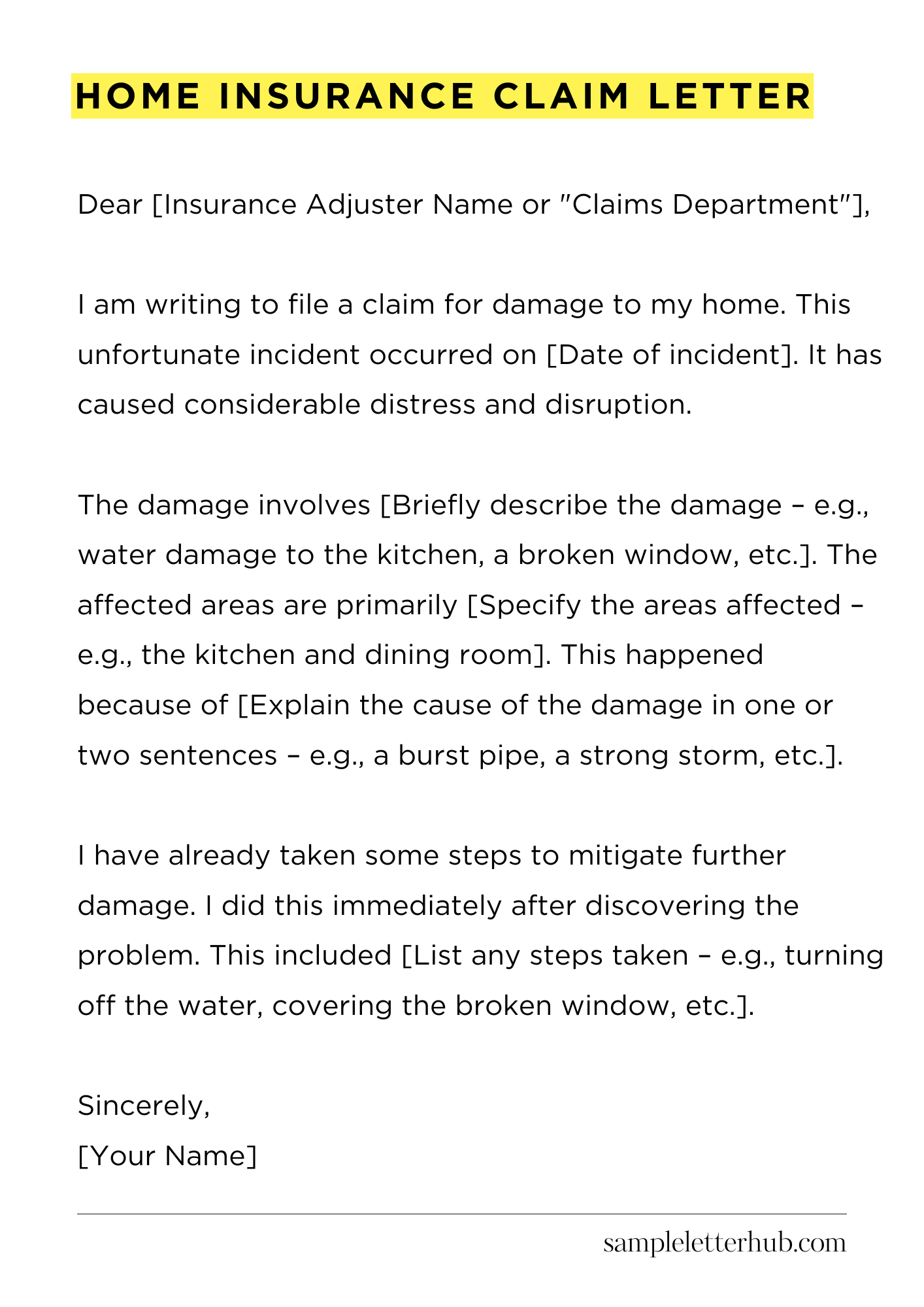
Dear [Insurance Adjuster Name or “Claims Department”],
I am writing to file a claim for damage to my home. This unfortunate incident occurred on [Date of incident]. It has caused considerable distress and disruption.
The damage involves [Briefly describe the damage – e.g., water damage to the kitchen, a broken window, etc.]. The affected areas are primarily [Specify the areas affected – e.g., the kitchen and dining room]. This happened because of [Explain the cause of the damage in one or two sentences – e.g., a burst pipe, a strong storm, etc.].
I have already taken some steps to mitigate further damage. I did this immediately after discovering the problem. This included [List any steps taken – e.g., turning off the water, covering the broken window, etc.].
To support my claim, I have enclosed the following documents: [List the documents – e.g., photographs of the damage, repair estimates, a police report (if applicable), etc.]. The photos accurately show the extent of the harm done. The repair estimates provide a clear breakdown of the costs needed.
I believe this damage is covered under my home insurance policy, policy number [Your Policy Number]. I have maintained my policy payments diligently. The terms of my policy, I am fairly certain, apply in this situation.
I would appreciate it if you could begin the claims process as soon as possible. Please let me know what further information you might require from me. Contact me by email or phone at your earliest convenience to discuss this matter further.
Thank you for your prompt attention to this important matter. I look forward to hearing from you soon.
Sincerely,
[Your Name]
How to Write Home Insurance Claim Letter
Filing an insurance claim can feel like navigating a complex labyrinth. A well-crafted letter, however, serves as your compass. This document is your official formal notification to your insurer of the incident, and it initiates the claims process. Your success in getting your claim approved will significantly depend on its clarity and completeness.
1. Commence with Proper Salutation and Identification
Begin with a formal salutation. Address the letter to the appropriate claims department or the designated claims adjuster. Always use “Dear Mr./Ms./Mx. [Last Name]” if possible. Immediately follow the salutation with a clear statement identifying yourself.
Provide your full name, address, phone number, policy number, and the date the incident occurred. This introductory section lays the foundation for your narrative; it establishes your identity and confirms your insured status.
2. The Art of Precise Incident Description
This is where you weave your narrative. Detail the event with meticulous accuracy. The crux of your claim hinges on a precise and vivid account of the incident. Describe what happened, when it happened, and where it happened.
Include specific details – the type of damage sustained, the visible extent of the damage, and any contributing factors you can identify. Avoid ambiguous language. Use factual, verifiable statements and stick to the unvarnished truth; any hint of obfuscation will undermine your credibility.
3. Enumerating the Requisite Documentation
The success of your claim hinges on supporting evidence. List every piece of documentation you are including with the letter. This could encompass photographs, videos, repair estimates, police reports (if applicable), and any other supporting evidence.
Categorize each document meticulously. Clearly indicate the purpose of each exhibit and what it purports to show. This systematic approach ensures your insurer understands the scope of your loss and the validity of your claim.
4. Itemizing the Damages: A Detailed Inventory
Compile a detailed inventory of the damages. Break down each item or area damaged, providing accurate descriptions. This can include the room, a furniture item, or a wall. Include the estimated cost of repair or replacement for each. Where possible, attach estimates from reputable contractors to support your valuations.
This detailed listing provides the insurer with the information they require to assess and adjudicate your claim justly.
5. Deciphering the Policy Terms and Conditions
Familiarize yourself with your insurance policy’s language. Specifically, identify the clauses pertaining to the type of incident you’re claiming for. Highlight the sections you believe are applicable to your situation.
This demonstrates your comprehension of the policy terms and proactively strengthens your case. If you’re unsure about the interpretations of a specific clause, indicate that and seek clarification from your insurer. This proactive approach underscores your due diligence.
6. The Concluding Polished Closure
Close your letter with a polite and professional closing. Express your desire for a prompt resolution to the claim. Reiterate your contact information and indicate your availability to answer any questions the adjuster may have.
Offer to provide additional documentation if required. Thank the adjuster for their time and consideration. This courteous ending leaves a positive lasting impression.
7. Proofreading and Perfection: The Final Check
Before submitting your letter, perform a rigorous proofread. Scrutinize your writing for any grammatical errors, spelling mistakes, or factual inaccuracies. Ensure the letter is clear, concise, and easy to understand.
Consider asking a friend or family member to review the letter. Multiple sets of eyes can catch mistakes you might overlook. A polished and error-free letter signifies attention to detail and a commitment to accuracy, which significantly enhances the credibility of your claim.
FAQs about Home Insurance Claim Letter
What is a home insurance claim letter, and why is it important?
A home insurance claim letter is a formal written document submitted to your insurance provider to initiate the claims process after experiencing a loss or damage to your property covered by your home insurance policy. It’s crucial because it serves as the official record of your claim, outlining the specifics of the incident and the damages incurred.
This letter provides the insurance company with the necessary information to assess your claim, determine the validity of the damages, and ultimately, issue compensation for covered losses. A well-written claim letter is essential for a smooth and efficient claims process.
What information should be included in a home insurance claim letter?
A comprehensive home insurance claim letter should include several key pieces of information.
This includes your policy number, the date and time of the incident that caused the damage, a detailed description of the event (e.g., fire, storm damage, theft), a clear description of the damage sustained to your property, a list of the damaged items, and any evidence you have (e.g., photos, videos, police reports).
Additionally, your contact information, the estimated cost of repairs or replacements, and any supporting documentation you can provide should be included to support your claim.
How do I write a home insurance claim letter effectively?
To write an effective home insurance claim letter, clarity, accuracy, and completeness are paramount. Start by clearly stating that you are filing a claim under your policy.
Provide specific details about the incident, avoiding vague language. Be sure to be as specific as possible when describing the damage and listing the affected items.
Back up your claim with evidence such as photographs, videos, and repair estimates. Include all required documents. Finally, keep a copy of the letter and all supporting documentation for your records, and send the letter via certified mail or another method that provides proof of delivery.
What happens after I submit a home insurance claim letter?
After you submit your home insurance claim letter, the insurance company will initiate an investigation. They may contact you to gather additional information, inspect the damage, and assess the claim.
An adjuster will likely be assigned to your case and will evaluate the information provided, including the claim letter, supporting documentation, and the results of the investigation.
The insurance company will then determine whether your claim is covered under your policy and, if so, the amount of compensation you are eligible to receive. You will receive a decision in writing, detailing the outcome of the claim.
What if my home insurance claim is denied?
If your home insurance claim is denied, the insurance company will provide a written explanation for the denial, outlining the reasons for the decision. You have the right to appeal this decision.
First, carefully review the denial letter and understand the reasons for denial. You can then gather additional evidence or documentation to challenge the denial, addressing the insurance company’s concerns.
Submit a formal appeal letter, providing any supporting evidence and explaining why you believe the denial is incorrect. If the appeal is unsuccessful, you may have the option to pursue further action, such as mediation or legal action, depending on your policy and local regulations.
Related:
Resignation letter due to rude boss
Resignation letter moving to another state
Resignation letter due to illness of family member
Resignation letter due to study