


Dealing with a car accident is stressful. Filing an insurance claim is often necessary. A car accident insurance claim letter is your official way to start the process. It tells the insurance company about the accident. It requests compensation for damages.
This article simplifies things. We will provide car accident claim letter templates. You’ll find examples and samples here. Writing your own letter becomes much easier. Need a sample claim letter? We have you covered.
Our aim is to help you. These letter samples can be a lifesaver. Navigate the car insurance claim process smoothly. Get the help you deserve. Your car accident claim will be handled efficiently.
[Your Name]
[Your Address]
[Your Phone Number]
[Your Email Address]
[Date]
[Insurance Company Name]
[Insurance Company Address]
Dear [Insurance Adjuster Name or “Claims Department”],
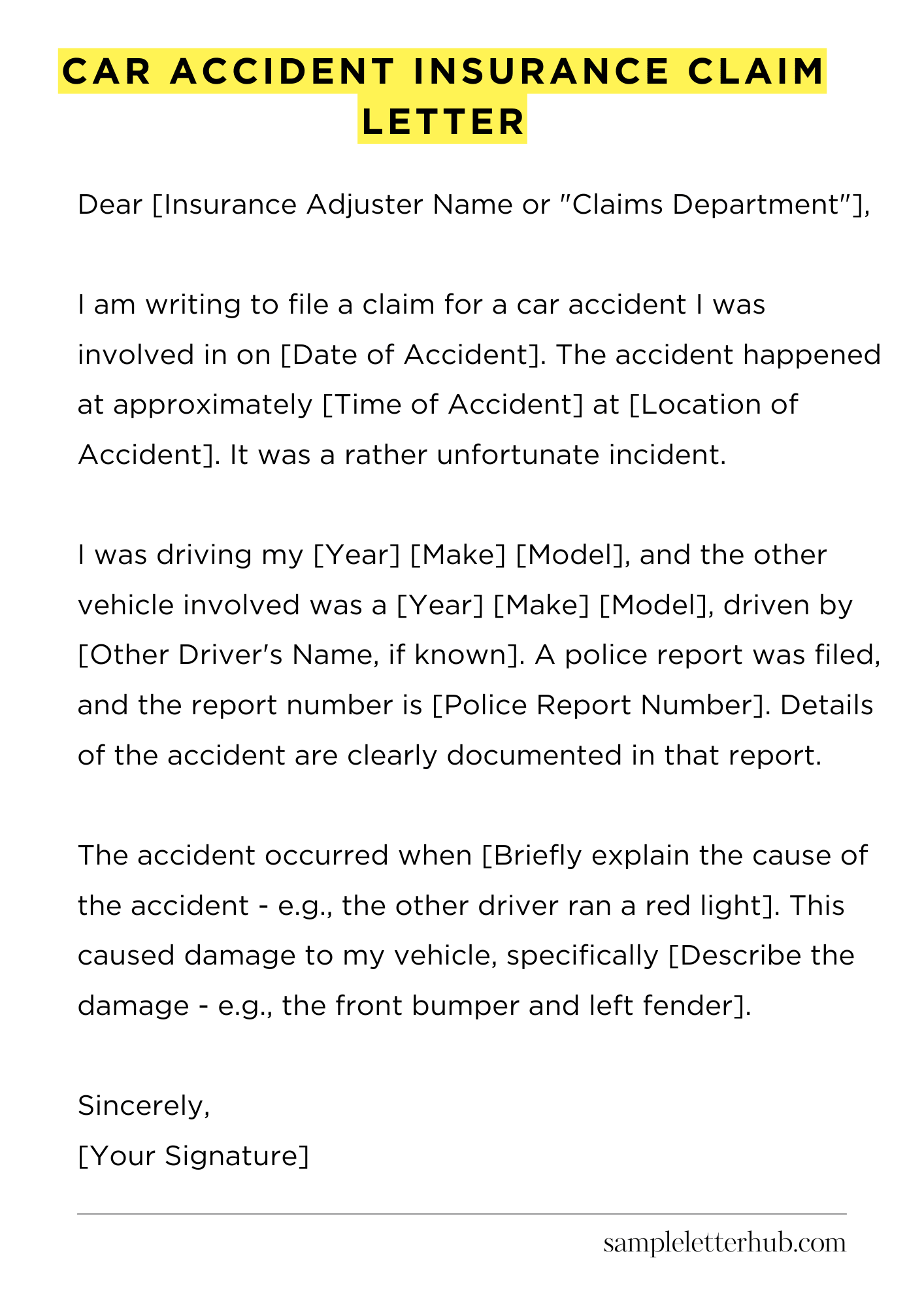
I am writing to file a claim for a car accident I was involved in on [Date of Accident]. The accident happened at approximately [Time of Accident] at [Location of Accident]. It was a rather unfortunate incident.
I was driving my [Year] [Make] [Model], and the other vehicle involved was a [Year] [Make] [Model], driven by [Other Driver’s Name, if known]. A police report was filed, and the report number is [Police Report Number]. Details of the accident are clearly documented in that report.
The accident occurred when [Briefly explain the cause of the accident – e.g., the other driver ran a red light]. This caused damage to my vehicle, specifically [Describe the damage – e.g., the front bumper and left fender]. The damage seems quite extensive.
I have already taken the following steps: [List any steps taken, e.g., contacted the police, exchanged information with the other driver, had my car towed]. The car is currently located at [Location of Vehicle]. I have some receipts.
I am including the following documents with this letter: [List the enclosed documents – e.g., a copy of the police report, photographs of the damage, contact information for witnesses, if any]. I have more.
I have a valid driver’s license, and my insurance policy number is [Your Policy Number]. I request that you initiate the claims process as quickly as possible.
Please let me know what further information you require. I would appreciate updates on the status of my claim, and you can reach me at the phone number listed above. I look forward to hearing from you soon.
Thank you for your prompt attention to this matter.
Sincerely,
[Your Signature]
How to Write Car Accident Insurance Claim Letter
A car accident can be a harrowing experience, and navigating the aftermath, particularly the insurance claim process, can feel overwhelming. This guide will meticulously dissect the creation of an effective car accident insurance claim letter, ensuring your missive is comprehensive and persuasive.
1. Commence with a Salutation: Addressing the Recipient
Your opening gambit sets the tone. Use a formal salutation. If you know the adjuster’s name, utilize “Dear Mr./Ms. [Last Name]”. If unknown, opt for “To Whom It May Concern” or “Dear Claims Department.” This initial civility demonstrates respect and professionalism, crucial for a favorable reception.
2. Declarative Opening: The Incident’s Genesis
Immediately declare the letter’s purpose: to initiate a claim. Concisely state the date, time, and precise location of the vehicular mishap. Include a succinct synopsis of the event.
Be factual and avoid emotionally charged language. Focus on the salient details; who, what, when, and where. Remember the maxim: brevity is the soul of wit.
3. Detail the Cast of Characters: Parties Involved
Clearly identify all parties involved. Include the names, addresses, and contact information of the other driver(s), any witnesses, and their respective insurance providers. Provide the policy number of all the involved parties including your own. This diligent approach facilitates a seamless investigation and minimizes ambiguity.
4. A Cadre of Damage: Elucidating the Damages
Elaborate on the damages. This requires meticulous detail. Specify the damage to your vehicle, any injuries sustained, and any other pertinent losses. Itemize the expenses meticulously. Include repair estimates, medical bills, and any documentation supporting your claims. Transparency is key to a successful claim.
5. Evidentiary Embellishments: Supporting Documentation
Bolster your case with supporting documentation. Attach copies of the police report, photographs of the accident scene and vehicle damage, medical records, and any witness statements.
This provides concrete evidence that reinforces your claims. The more supporting documentation you provide, the stronger your position becomes. Remember, a picture speaks a thousand words.
6. The Call to Action: Formally Submitting the Claim
Conclude your letter with a clear request. Formally request that the insurance company process your claim and provide a timely resolution. State your desired outcome—whether for vehicle repairs, medical expenses, or other damages.
Provide your contact information and indicate your availability for further inquiries. Make it easy for them to respond.
7. The Final Flourish: Formal Closure
Sign off professionally. Use “Sincerely,” “Yours truly,” or a similar closing salutation. Type your full name and include your contact information beneath your signature. Send the letter via certified mail with return receipt requested.
This provides proof of delivery and serves as a formal acknowledgment of receipt. This gives you peace of mind and ensures accountability throughout the process.
FAQs about Car Accident Insurance Claim Letter
What information should I include in a car accident insurance claim letter?
Your car accident insurance claim letter should contain key details, including the date, time, and location of the accident. You must also include a clear description of the incident, names and contact information of all parties involved (including witnesses), vehicle information (make, model, license plate), and details of any injuries or property damage.
Additionally, include your insurance policy number and any relevant police report information.
How do I write a car accident insurance claim letter?
Begin by identifying yourself and your policy information. Concisely describe the accident, being factual and avoiding speculation. Detail the damages to your vehicle and any injuries sustained.
Provide supporting documentation such as photos, police reports, and medical records. Clearly state what compensation you are seeking and keep a copy for your records. Consider using a template as a starting point, but always customize it to your specific situation.
What supporting documents should I attach to my car accident insurance claim letter?
When submitting a car accident insurance claim letter, include as many supporting documents as possible to strengthen your claim. This may include a copy of the police report, photographs of the accident scene and vehicle damage, medical records and bills, repair estimates, witness statements, and any other relevant documentation that supports your claim and validates your damages.
When should I submit my car accident insurance claim letter?
You should submit your car accident insurance claim letter as soon as possible after the accident. Most insurance policies have a specific timeframe for filing claims, often within days or weeks of the incident.
Delaying the submission can potentially jeopardize your claim. It is important to review your insurance policy for specific deadlines and to ensure timely submission.
What happens after I submit my car accident insurance claim letter?
After you submit your car accident insurance claim letter, the insurance company will typically acknowledge receipt and assign a claims adjuster to your case. The adjuster will investigate the accident, gather evidence, review the information provided, and assess liability and damages.
They may contact you for additional information or clarification. Eventually, the insurance company will make a decision on your claim, which could include approval, denial, or a settlement offer. If you disagree with the decision, you have the right to appeal.
Related:
Resignation letter due to rude boss
Resignation letter moving to another state
Resignation letter due to illness of family member
Resignation letter due to study