

Dealing with health insurance can be tricky. Sometimes, you pay upfront for medical services. You then need to get that money back. This is where a Health Insurance Reimbursement Request Letter comes in. It’s a formal way to ask your insurance company for a refund. Its purpose is to claim back the money you spent on medical expenses.
Are you stuck on writing a reimbursement letter? Don’t worry! We’ve got you covered. We’ll share several Health Insurance Reimbursement Request Letter templates. These are helpful samples. They will guide you through the process. Our examples make it easy to craft the perfect letter.
We’ll provide examples for different situations. Use them to create your own letter. This will help you get your reimbursement quickly. Good luck with your health insurance claim!
[Your Name]
[Your Address]
[Your Phone Number]
[Your Email Address]
[Date]
[Insurance Company Name]
[Insurance Company Address]
Subject: Health Insurance Reimbursement Request
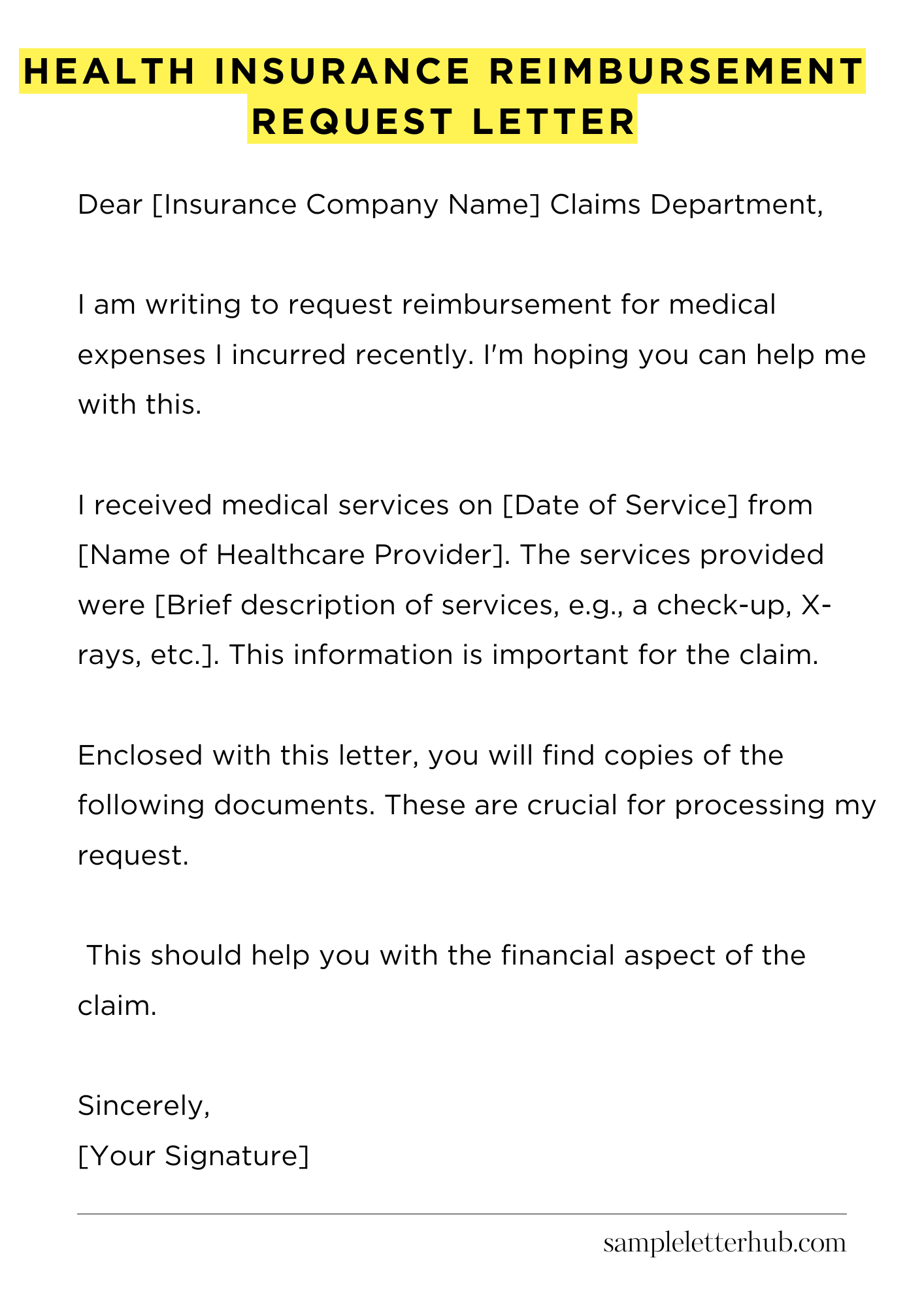
Dear [Insurance Company Name] Claims Department,
I am writing to request reimbursement for medical expenses I incurred recently. I’m hoping you can help me with this.
I received medical services on [Date of Service] from [Name of Healthcare Provider]. The services provided were [Brief description of services, e.g., a check-up, X-rays, etc.]. This information is important for the claim.
Enclosed with this letter, you will find copies of the following documents. These are crucial for processing my request. I am providing my itemized bill from the healthcare provider, detailing the specific charges. I am also including any receipts that show proof of payment. This should help you with the financial aspect of the claim.
My insurance policy number is [Your Policy Number]. I have kept the number handy for your easy reference. Please use this number when processing my claim.
The total amount I am seeking reimbursement for is [Dollar Amount]. I carefully added up all the expenses. I believe this amount is accurate based on my records.
I would appreciate it if you could process my reimbursement request as quickly as possible. Time is of the essence when it comes to these matters. Please let me know if you require any further information from my side. I am ready to assist. You can reach me by phone or email, which are included above.
Thank you for your time and attention to this matter. I appreciate your prompt assistance. I look forward to your response and a resolution.
Sincerely,
[Your Signature]
How to Write Health Insurance Reimbursement Request Letter
Submitting a health insurance reimbursement request letter can feel like navigating a bureaucratic labyrinth. But, fear not! With a strategic approach and meticulous attention to detail, you can significantly enhance your chances of a successful claim. Follow these steps to craft a compelling letter that gets you reimbursed.
1. Commence with a Cogent Header
Your letter’s commencement sets the tone. At the apex, provide your full name, address, phone number, and email. Then, meticulously include the date. Immediately beneath, address the letter to the appropriate entity.
Ascertain the precise name and address of your insurance provider’s claims department. Omitting this seemingly trivial detail can precipitate delays or even rejection of your claim.
2. Subject Line: The Crucible of Clarity
A concise, perspicuous subject line is paramount. It immediately alerts the recipient to the letter’s purpose. Something along the lines of “Health Insurance Reimbursement Request – [Your Policy Number]” is ideal.
This immediate identification streamlines the processing and ensures your claim is routed to the correct department without any unnecessary detour.
3. Articulate the Core: The Salutation and Introductory Paragraph
Begin with a formal salutation, such as “Dear [Claims Department Name]”. Your introductory paragraph should state your intent clearly. Briefly mention the date of service, the medical provider’s name, and the specific service for which you are seeking reimbursement. Keep it simple and focused; excessive verbiage can obfuscate your key message.
For instance, “This letter is a formal request for reimbursement for medical services rendered on [Date of Service] at [Provider’s Name] for [Type of Service].”
4. The Body: Detailing the Disbursement
This is where you provide the substantive information. Start with a numbered list of all the services you are claiming, with the dates. Accompany each service with the corresponding cost. State the total amount you are seeking reimbursement for. Ensure you clearly state your policy number, as this is essential for them to locate your account.
5. Supporting Documentation: The Sine Qua Non
This section is crucial. Enclose all necessary supporting documentation. Photocopies of itemized bills, receipts, Explanation of Benefits (EOB) statements, and any other relevant medical records are mandatory. Remember to list each attachment at the end of this section within your letter. This assures the claims adjuster knows what is included.
6. The Concluding Section: Formalities and Follow-up
In the concluding paragraph, reiterate your request for reimbursement. Express your gratitude for their consideration. Include a concise statement about your expectations and a polite request for confirmation. Finally, state how you want to be contacted and provide your preferred contact information, such as your phone number or email address.
7. Finalization: Review and Refinement
Before dispatching your letter, proofread it diligently. Examine for grammatical errors, spelling mistakes, and inconsistencies in the data. Make certain that all the documents are easily readable and clearly labeled. Sign and date your letter. Make a copy of everything for your records.
Consider sending your letter via certified mail with return receipt requested to confirm it was received.
FAQs about Health Insurance Reimbursement Request Letter
What information should I include in my health insurance reimbursement request letter?
Your letter should include your full name, address, policy number, date of service, detailed information about the medical services received (e.g., doctor’s name, type of service, and relevant codes), and the amount you are seeking reimbursement for.
You must also include the necessary supporting documentation, such as itemized bills (with the provider’s information and your name), receipts for payments made, and any explanation of benefits (EOB) forms you received. Include your contact information to make it easier for the insurance company to reach you with questions.
What supporting documents are typically required with a reimbursement request?
The supporting documents commonly needed are itemized bills from healthcare providers, receipts showing proof of payment (if you paid upfront), and any relevant medical records or diagnostic reports that help justify the services or expenses.
These documents verify the services rendered and the cost, as well as providing the necessary information for the insurance company to process your request.
How do I submit my reimbursement request letter and supporting documents?
Typically, you can submit your request by mail or electronically. Check your insurance plan’s guidelines for the preferred method. For mail, send the letter and all documents to the address provided by your insurance company.
Many insurance providers also offer online portals or mobile apps where you can upload documents and submit your request electronically. Always keep copies of everything you submit for your records.
How long does it typically take to receive reimbursement?
The processing time for reimbursement requests varies, but generally, it can take anywhere from a few weeks to a couple of months. The timeframe depends on your insurance company’s processing efficiency, the complexity of your claim, and how quickly all the required information can be verified.
You can usually check the status of your claim online through your insurance provider’s website or by contacting their customer service.
What should I do if my reimbursement request is denied?
If your reimbursement request is denied, carefully review the denial letter to understand the reason for the denial. Contact your insurance company for clarification if needed.
You typically have the right to appeal the decision. In your appeal, provide any additional information or documentation that might support your claim. Include a clear explanation of why you believe the denial was incorrect. Adhere to the deadlines given for appealing to ensure your case is reconsidered.
Related:
Resignation letter due to rude boss
Resignation letter moving to another state
Resignation letter due to illness of family member
Resignation letter due to study