


A travel insurance claim letter is a formal document. It is a request for financial reimbursement. Travelers send it to their insurance provider. The purpose is to claim expenses for covered events. These events might be trip cancellations, medical emergencies, or lost luggage.
Feeling overwhelmed by claim letters? We get it. Writing these can be tricky. This article will help! We have compiled helpful templates. Find sample travel insurance claim letter examples here. They cover various scenarios you might face.
Need inspiration for your claim letter? We offer diverse samples. These include letters for flight delays and medical needs. You can easily adapt these claim letter samples. They will make your writing process smoother.
[Your Name]
[Your Address]
[Your Phone Number]
[Your Email Address]
[Date]
[Insurance Company Name]
[Insurance Company Address]
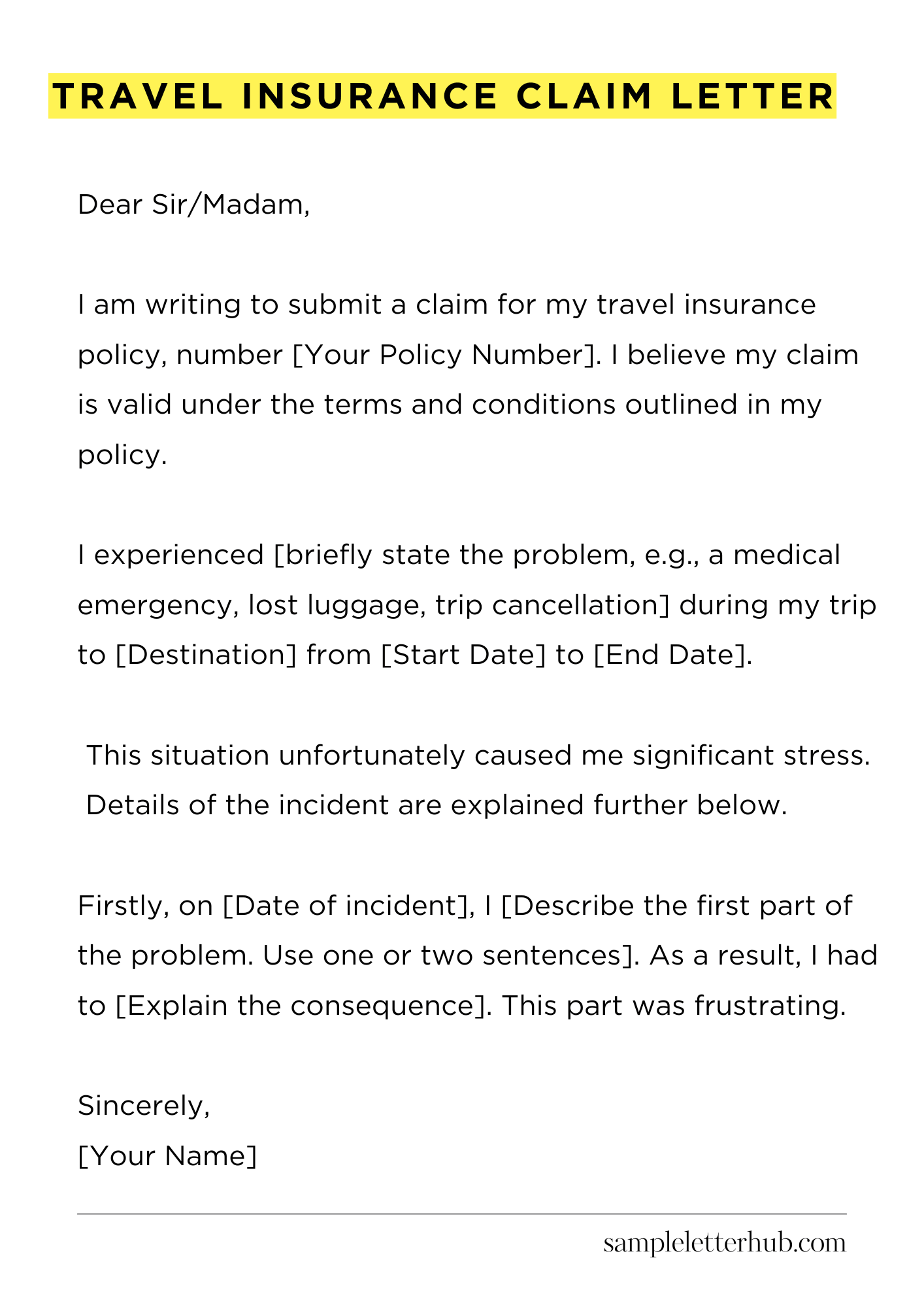
Dear Sir/Madam,
I am writing to submit a claim for my travel insurance policy, number [Your Policy Number]. I believe my claim is valid under the terms and conditions outlined in my policy.
I experienced [briefly state the problem, e.g., a medical emergency, lost luggage, trip cancellation] during my trip to [Destination] from [Start Date] to [End Date]. This situation unfortunately caused me significant stress. Details of the incident are explained further below.
Firstly, on [Date of incident], I [Describe the first part of the problem. Use one or two sentences]. As a result, I had to [Explain the consequence]. This part was frustrating.
Secondly, the incident then led to [Describe the second part of the problem. Include dates if relevant]. This added to my already difficult situation. I had to pay for [Explain what you paid for, e.g., medical treatment, replacement items, alternative transport].
Attached to this letter, you will find supporting documentation. I have included copies of [List the documents, e.g., medical bills, police report, receipts for lost items, booking confirmation, cancellation notice]. These should help you process my claim as quickly as possible.
I have incurred a total of [Amount] in expenses due to this unforeseen event. This is a substantial amount. I kindly request that you review my claim and process it promptly.
I would appreciate it if you could confirm receipt of this letter and let me know the expected timeframe for a decision. I look forward to hearing from you soon. I hope you give this matter your immediate attention.
Thank you for your time and consideration.
Sincerely,
[Your Name]
How to Write Travel Insurance Claim Letter
Embarking on a journey, whether for leisure or exigency, often entails acquiring travel insurance. But the real test commences when you need to file a claim. Let’s traverse the intricate landscape of crafting a compelling travel insurance claim letter. This is your comprehensive guide.
1. Initiate with Precision: The Salutation and Introductory Paragraph
Begin your letter with a formal salutation. Address the letter to the designated claims department or a specific claims adjuster, if known. An error-free salutation displays professionalism.
Then, construct an introductory paragraph. It should be concise and direct. State the purpose of your letter: to file a claim. Provide your policy number, the period of coverage, and a succinct overview of the incident or circumstances precipitating the claim. This sets the stage for a well-organized narrative.
2. Chronicles of Calamity: Detailing the Event
Here’s where you articulate the sequence of events. Detail the specific circumstances that led to your claim. Be candid. The recounting must be clear, chronological, and devoid of ambiguity.
Include all pertinent dates, times, and locations associated with the event. If relevant, mention any witnesses present. Use vivid language. Avoid embellishment, as candor bolsters your credibility. The more descriptive, the better.
3. Financial Requisitions: Itemizing Your Losses
This is arguably the most crucial section. Meticulously itemize your losses. List all expenses for which you are seeking reimbursement. Provide specific figures, supported by documentation.
This documentation is crucial; include copies of receipts, bills, medical reports, flight confirmations, and any other evidence that validates your expenditures. Organize the financial information into a clear, easy-to-understand format, such as a bullet-pointed list. Always maintain copies of everything you submit.
4. Corroborative Artifacts: Assembling Supporting Documentation
The strength of your claim rests on the supporting documentation. This is the cornerstone. Assemble every piece of evidence that substantiates your claim. This includes (but is not limited to) medical reports, police reports (if applicable), airline cancellation notices, hotel confirmations, and itemized receipts for all expenses.
Ensure each document is legible and clearly linked to the specific claims you are making. The more comprehensive your supporting documents, the stronger your case.
5. Rectifying the Situation: Explaining the Consequences
In this section, articulate how the event impacted your trip and any ensuing difficulties. Did you experience a disruption to your travel itinerary? Did you incur additional expenses due to the event?
Detail these ramifications. Explain how the incident caused you distress and the consequences you faced. This narrative helps the adjuster understand the gravity of your situation and the legitimacy of your claim.
6. The Formal Closure: Conclusion and Request
Conclude your letter with a formal closing. Briefly restate your claim and express your expectation of a favorable resolution. Reiterate your contact information, including your full name, address, phone number, and email address.
Politely request that the claims adjuster contact you if they require further information or clarification. Include a phrase expressing your gratitude for their consideration. A well-crafted conclusion leaves a lasting positive impression.
7. Polishing the Parchment: Proofreading and Submission
Before dispatching your letter, meticulously proofread it for any grammatical errors or typos. Errors detract from credibility. Ensure all information is accurate and consistent. Then, make a final check.
Do you have all the necessary supporting documents? Prepare to submit your claim. Send it via certified mail with return receipt requested, or submit it electronically (if accepted). This provides you with proof of delivery and maintains a record of your submission. Following these steps greatly improves your chances of a successful outcome.
FAQs about Travel Insurance Claim Letter
What information should I include in my travel insurance claim letter?
Your travel insurance claim letter should comprehensively outline the incident, providing key details. This includes the date, location, and nature of the event (e.g., lost luggage, medical emergency, trip cancellation).
Clearly state your policy number and the specific coverage you are claiming under. Include supporting documentation, such as receipts, medical reports, police reports, and any other evidence that substantiates your claim.
Be sure to specify the amount of your claim, itemizing any expenses incurred. Provide your contact information, including your address, phone number, and email address for easy communication.
What supporting documents are typically required with a travel insurance claim letter?
Supporting documentation is crucial for a successful claim. Common requirements include copies of your travel itinerary, booking confirmations (flights, hotels), and the travel insurance policy itself.
For medical claims, you’ll need medical reports, doctor’s notes, and itemized bills. For lost or damaged luggage, a property irregularity report (PIR) from the airline or a police report is essential.
If claiming for trip cancellation or interruption, you’ll need documentation that substantiates the reason for cancellation (e.g., a doctor’s note for illness, a death certificate, or official documentation related to unforeseen circumstances such as natural disasters). For theft, a police report is also a must.
How do I write a compelling travel insurance claim letter to increase my chances of approval?
To write a compelling letter, be clear, concise, and factual. Begin by stating the purpose of your letter and your policy number. Provide a detailed account of the incident, including dates, times, and locations.
Explain the impact of the event on your trip and the expenses you incurred.
Ensure you include all relevant details, avoid ambiguity, and maintain a professional tone. Organize your letter logically, making it easy for the insurance provider to understand the claim. Ensure all your documentation is well-organized and clearly labeled. Finally, review your letter for accuracy before submission.
Where should I send my travel insurance claim letter?
The correct address or method of submission for your claim letter will be specified in your travel insurance policy documents. Usually, the policy will provide a dedicated claims email address, a postal address, or a link to an online claims portal.
It’s crucial to refer to your policy documents for these details, as sending your letter to the wrong place can delay processing. Always keep a copy of your claim letter and all supporting documentation for your records.
How long does it typically take to process a travel insurance claim?
The processing time for travel insurance claims varies depending on the complexity of the claim and the insurance provider. Generally, you can expect the process to take anywhere from a few weeks to a couple of months.
Factors that can influence processing time include the completeness of your claim, the availability of supporting documentation, and the provider’s workload. To expedite the process, ensure you submit a complete claim with all required documents and respond promptly to any requests for further information from the insurance company.
Related:
Resignation letter due to rude boss
Resignation letter moving to another state
Resignation letter due to illness of family member
Resignation letter due to study