

An accident claim request letter is a formal document. It is used to request compensation. The letter is for damages. These damages are due to an accident. Its purpose is to officially notify someone. You are requesting accident-related costs to be covered.
Dealing with accident aftermath can be overwhelming. Writing the right words can be tough. Don’t worry! We understand. This article provides accident claim request letter samples. We’ve got templates to make the process easy. Find various letter examples.
You’ll find helpful letter examples here. Choose the right letter example. Customize it to your accident situation. We aim to ease your burden. Get the compensation you deserve. Navigate the accident claim process smoothly.
[Your Name/Your Company Name]
[Your Address]
[Your Phone Number]
[Your Email Address]
[Date]
[Insurance Company Name]
[Insurance Company Address]
Subject: Accident Claim – Policy Number [Your Policy Number]
Dear [Claims Department/Name of Claims Adjuster, if known],
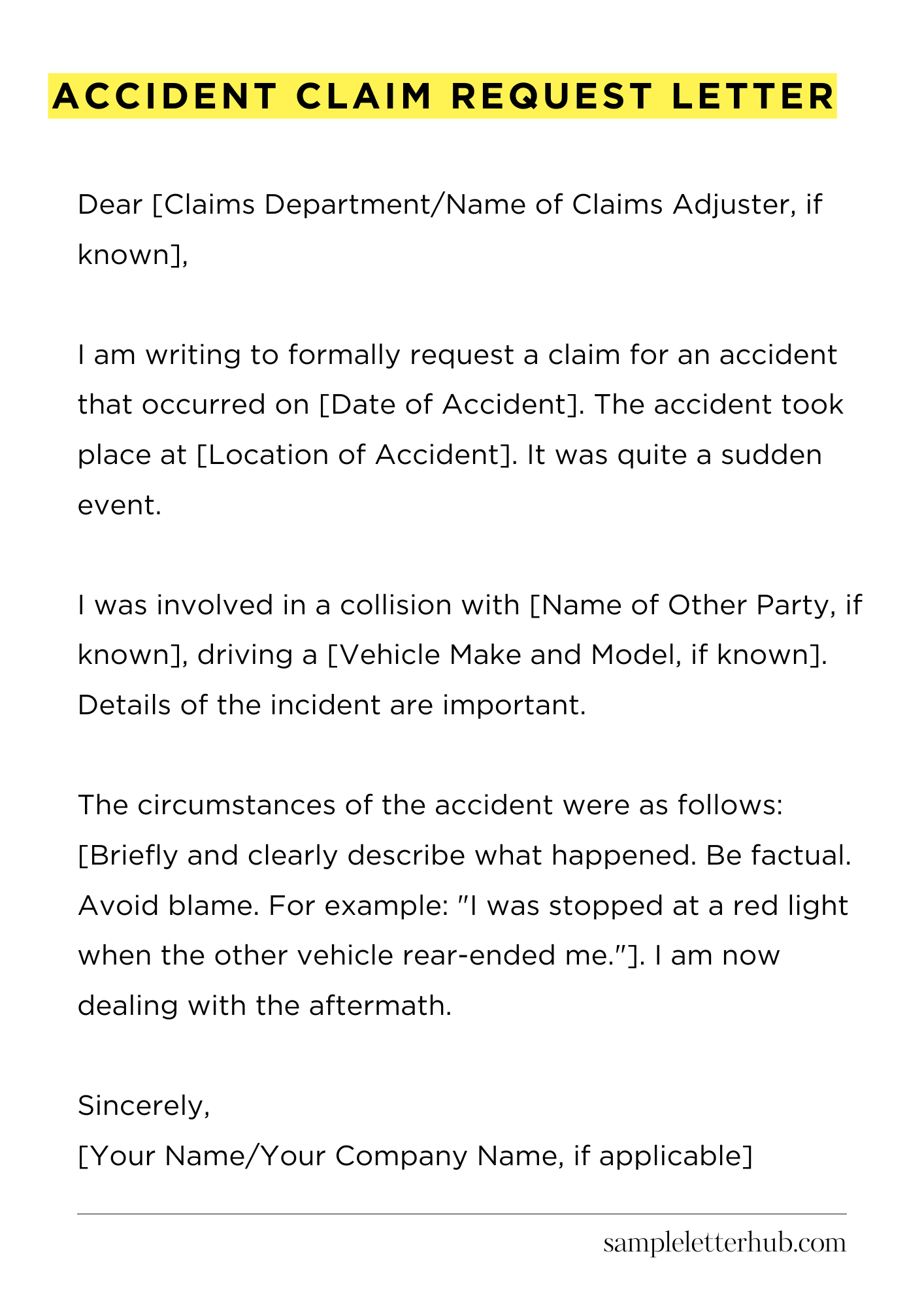
I am writing to formally request a claim for an accident that occurred on [Date of Accident]. The accident took place at [Location of Accident]. It was quite a sudden event.
I was involved in a collision with [Name of Other Party, if known], driving a [Vehicle Make and Model, if known]. Details of the incident are important.
The circumstances of the accident were as follows: [Briefly and clearly describe what happened. Be factual. Avoid blame. For example: “I was stopped at a red light when the other vehicle rear-ended me.”]. I am now dealing with the aftermath.
As a result of the accident, my vehicle, a [Your Vehicle Make and Model], sustained [Describe the damage, e.g., “damage to the rear bumper and trunk”]. I also sustained [Describe any injuries you sustained, e.g., “minor whiplash”].
I have attached the following documentation to support my claim:
- A copy of the police report (if applicable)
- Photographs of the damage to my vehicle
- Photographs of the accident scene
- Medical reports (if applicable)
- [Any other relevant documentation]
I would appreciate it if you could begin processing my claim as soon as possible. Processing can take time, so please be patient. I am available to answer any questions you may have. You can reach me by phone at [Your Phone Number] or by email at [Your Email Address].
Thank you for your time and attention to this matter. I look forward to hearing from you soon regarding the status of my claim.
Sincerely,
[Your Name/Your Company Name, if applicable]
How to Write an Accident Claim Request Letter
An accident, however minor, can unleash a torrent of administrative obligations. One of the most critical is crafting an accident claim request letter. This missive serves as your official declaration to the responsible party’s insurance carrier, initiating the process of compensation for damages sustained.
A meticulously composed letter is your vanguard in securing the reparations you deserve. Let’s delve into the crucial steps for composing an effective accident claim request.
1. Commence with Comprehensive Information
The genesis of a compelling claim letter lies in the meticulous relaying of facts. Begin with your full name, current mailing address, phone number, and email address. Immediately thereafter, provide the date on which the letter is being penned.
Beneath this, insert the complete name and address of the insurance company or individual to whom the letter is addressed. Don’t omit the policy number associated with the insured individual or entity, as this streamlines the insurer’s initial assessment. This granular level of detail is paramount.
2. Narrate the Incident with Precision
The core of your letter should be a cogent and unambiguous account of the accident itself. Employ a chronological approach, commencing with the precise time and location. Furnish a concise description of what transpired.
Be scrupulous in detailing the sequence of events. Specify the involved vehicles, including their make, model, and license plate numbers. Don’t embellish or deviate from verifiable facts; the essence of this section is objective truth. State precisely what happened.
3. Detail the Damages and Injuries Sustained
This is where you expound upon the tangible consequences of the accident. Itemize all damages, be it vehicular, personal property (like clothing or phones), or any other affected item.
For each item, provide a detailed description of the damage. Include estimated costs for repairs or replacements, ideally supported by quotations or receipts. If applicable, specify any bodily injuries sustained, noting the nature and severity of these injuries. State any medical treatment received, including the names of doctors and hospitals involved.
The insurer must understand the full breadth of the impact.
4. Include Supporting Documentation
Your letter is significantly fortified by the inclusion of supplementary documentation. Enclose copies of essential evidence, such as the police report, photographs of the accident scene and any damages, medical reports, repair estimates, and witness statements, if available. Never submit original documents; always retain copies for your records.
This substantiation buttresses your claims and mitigates the potential for disputes. Support your claims with hard data.
5. Articulate Your Claim and Demand for Remedy
Clearly articulate the nature of your claim, specifying the type of compensation you are seeking. This could encompass vehicle repairs, medical expenses, lost wages, and pain and suffering.
State the exact amount of monetary compensation you are requesting. If you’ve been working with legal counsel, explicitly mention their involvement and provide their contact information. A clear and direct demand is essential for clarity. State exactly what you expect.
6. The Letter’s Concluding Salutations and Delivery Protocol
Conclude your letter with a formal and professional closing, such as “Sincerely” or “Respectfully.” Sign your name above your typed name. Before dispatching the letter, make at least two copies – one for your records and another to share with your legal representatives, if any.
Send the letter via certified mail, return receipt requested. This ensures verifiable proof of delivery. This is your insurance against loss.
7. What to do if the Claim is Rejected or Undervalued
Should the insurance company deny your claim or proffer a settlement that seems inadequate, it’s judicious to consult with a legal professional. An attorney specializing in personal injury law can evaluate your case, advise you on your legal options, and potentially negotiate a more favorable settlement.
They possess the wherewithal to navigate the intricate labyrinth of insurance claims. They are indispensable advocates during times of adversity.
FAQs about Accident Claim Request Letter
What is an Accident Claim Request Letter?
An accident claim request letter, also known as a demand letter or a letter of claim, is a formal document sent to an insurance company or the at-fault party after an accident. Its primary purpose is to outline the details of the accident, the resulting damages (personal injury, property damage), and the compensation you are seeking.
What Information Should be Included in an Accident Claim Request Letter?
A comprehensive accident claim request letter typically includes the following information:
- Your full name, contact information, and policy number (if applicable).
- Date, time, and location of the accident.
- A detailed description of how the accident occurred, including the actions of all parties involved.
- Information about any witnesses.
- Descriptions of the injuries sustained and any medical treatment received.
- Documentation of property damage (photos, repair estimates, etc.).
- A clear statement of the compensation you are seeking, including medical expenses, lost wages, vehicle repairs, and pain and suffering.
When Should I Send an Accident Claim Request Letter?
You should send an accident claim request letter as soon as possible after the accident, preferably after receiving medical attention and gathering necessary documentation.
However, it’s crucial to be mindful of the statute of limitations, which varies by state and determines the deadline for filing a claim. It’s often advisable to consult with a legal professional to ensure timely filing.
Who Should I Send the Accident Claim Request Letter To?
The letter should be sent to the appropriate party or parties. This typically includes the insurance company of the at-fault driver (if known), your own insurance company (if you’re filing a claim under your policy, such as uninsured/underinsured motorist coverage), or potentially the at-fault driver themselves if you’re pursuing a claim without involving insurance.
How Can I Ensure My Accident Claim Request Letter is Effective?
To maximize the effectiveness of your accident claim request letter:
- Be clear, concise, and factual.
- Provide detailed information and supporting documentation (police reports, medical records, photos, etc.).
- Maintain a professional tone throughout the letter.
- Specify the exact amount of compensation you are seeking.
- Send the letter via certified mail with return receipt requested to provide proof of delivery.
- Consider consulting with an attorney to review the letter before sending it.
Related:
Resignation letter due to rude boss
Resignation letter moving to another state
Resignation letter due to illness of family member
Resignation letter due to study