


Dealing with property damage can be stressful. A property damage claim letter is your formal way of requesting compensation. It outlines the damage and your financial losses. This letter is crucial for initiating an insurance claim or seeking reimbursement from the responsible party.
Do you need to file a property damage claim? Writing these letters can be tough. Don’t worry. We’ve got you covered. We’re sharing examples and samples of different property damage claim letter templates. Use these as a guide.
Our goal is to make things easy. Need a template for car damage? Home damage? We have something for you. We provide simple, fill-in-the-blank claim letter formats. Craft your perfect letter with ease.
[Your Name]
[Your Address]
[Your Phone Number]
[Your Email Address]
[Date]
[Insurance Company Name]
[Insurance Company Address]
Subject: Property Damage Claim – [Your Address]
Dear [Insurance Adjuster Name or “Claims Department”],
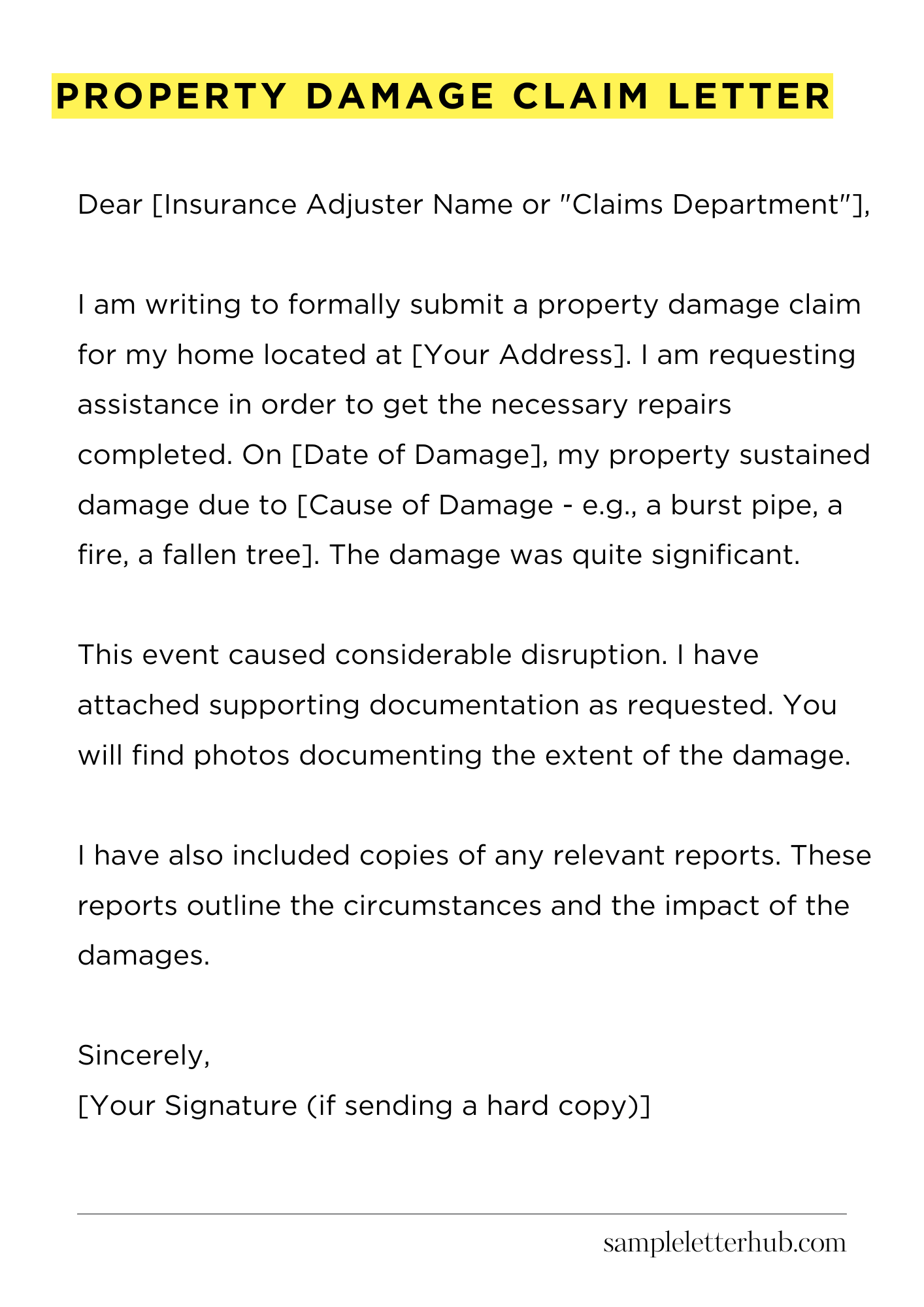
I am writing to formally submit a property damage claim for my home located at [Your Address]. I am requesting assistance in order to get the necessary repairs completed. On [Date of Damage], my property sustained damage due to [Cause of Damage – e.g., a burst pipe, a fire, a fallen tree]. The damage was quite significant.
This event caused considerable disruption. I have attached supporting documentation as requested. You will find photos documenting the extent of the damage.
I have also included copies of any relevant reports. These reports outline the circumstances and the impact of the damages. The damage includes [Briefly list the damaged items/areas – e.g., water damage to the living room ceiling, broken windows, damage to the roof]. I have already begun to take steps to mitigate further damage.
I would appreciate it if you could start processing this claim as quickly as possible. Please let me know the next steps required from my end. I am available to speak at your convenience. You can reach me by phone or email.
I look forward to hearing from you soon. I hope we can resolve this matter swiftly.
Sincerely,
[Your Signature (if sending a hard copy)]
How to Write Property Damage Claim Letter
1. Initiate the Process: Preliminary Notifications
Before you even begin to draft your claim letter, a proactive initial step is paramount. Promptly notify the responsible party or their insurer about the property damage.
This notification serves as a crucial starting point. You will want to formally establish a record of the incident. This initial communication often takes the form of a phone call or, even better, an email.
2. Ascertain the Intended Recipient: Targeting the Right Entity
Knowing where to send your letter is pivotal. Identify the specific entity responsible for handling the claim. Is it the property owner, a management company, or the insurance provider?
This might entail some preliminary investigative work. Ensure you address the letter to the appropriate department or claims adjuster. This circumvents delays and steers your claim directly towards the relevant personnel.
3. Crafting the Salutation and Introductory Paragraph: Setting the Tone
The salutation is your first formal interaction, so it should be precise. “Dear Mr./Ms. [Last Name]” is generally appropriate. The introduction then needs to be clear, concise, and to the point. Start by stating the purpose of the letter: to formally lodge a property damage claim. Provide essential details about the incident.
4. Detailing the Incident: A Factual Recount
This section calls for a comprehensive, but unambiguous, account of the event. Offer a blow-by-blow description of what transpired. When and where the damage occurred, be specific. Include supporting documentation or information, such as photos, videos, or witness statements. This documentation is your corroborating evidence and can strengthen your claim significantly.
5. Specifying the Damages: Itemizing the Losses
This is where you clearly delineate the extent of the damage. List each item damaged or the areas affected. Provide meticulous descriptions of the damage. Include an estimate of repair costs or replacement value for each damaged item. This can be supported by quotes from qualified contractors. Include receipts where feasible.
6. The Formal Closure and Demand: Seeking Resolution
In your conclusion, state your desired outcome clearly. Explicitly outline what you’re seeking from the responsible party or their insurer. This could involve reimbursement for repairs or replacement costs. End with a polite, yet assertive, closing. Add a line indicating your availability for further discussion. Include your contact information.
7. Polishing and Dispatching the Letter: The Final Touches
Before dispatching your letter, proofread it thoroughly. Check for any grammatical errors or spelling mistakes. Ensure all the critical elements are included. Make a copy of the letter and any supporting documentation for your records. Consider sending the letter via certified mail with return receipt requested. This provides proof of delivery and acknowledgement.
FAQs about Property Damage Claim Letter
What is a property damage claim letter, and when is it necessary?
A property damage claim letter is a formal written document submitted to an insurance company or the responsible party to request compensation for damages to your property.
It is necessary when your property has been damaged due to an event covered by your insurance policy (e.g., fire, flood, theft) or caused by the negligence of another party. The letter initiates the claims process, providing details of the damage and the compensation sought.
What essential information should be included in a property damage claim letter?
A comprehensive property damage claim letter should include: your name and contact information, the date of the incident, a clear description of the damaged property, a detailed account of how the damage occurred, the estimated cost of repairs or replacement (often supported by estimates).
How do I determine the appropriate format and tone for a property damage claim letter?
The format of the letter should be professional and clear, with a formal tone. Use a business letter format. Start with a clear subject line indicating the nature of the claim. Clearly state the facts without emotional language. Stick to the details and facts. Maintain a polite and assertive tone throughout. Be factual and objective.
What supporting documents should I include with my property damage claim letter?
Supporting documents are crucial to strengthen your claim. Include photographs of the damage, repair estimates from reputable contractors, police reports (if applicable), any evidence of the responsible party’s negligence, proof of ownership (e.g., deed, lease), and any previous communications with the insurance company or responsible party.
The more documentation you provide, the better your chances of a successful claim.
What steps should I take after sending a property damage claim letter?
After sending the letter, keep a copy for your records. Follow up with the insurance company or the responsible party within a reasonable timeframe (e.g., a week or two) to confirm receipt and inquire about the status of your claim. Be prepared to provide additional information or documentation if requested.
Keep a detailed record of all communications, including dates, times, and the names of individuals you spoke with. Be prepared for negotiations and if necessary, contact legal professionals.
Related:
Resignation letter due to rude boss
Resignation letter moving to another state
Resignation letter due to illness of family member
Resignation letter due to study