

An employee resignation letter is a formal notice. It tells your employer you are leaving your job. Its main purpose is to officially communicate your departure. It also states your last day of employment.
Writing a resignation letter can be tricky. You want to be professional and clear. Finding the right words can be tough. We’ve got you covered with examples.
We will provide you with different letter templates. These will help you craft your own letter. You can easily adapt them to your specific situation. Consider them your helpful guides.
Employee Resignation Letter
Below is a sample of a Employee Resignation Letter:
[Your Name]
[Your Address]
[Your Phone Number]
[Your Email Address]
[Date]
[Recipient’s Name]
[Recipient’s Title]
[Company Name]
[Company Address]
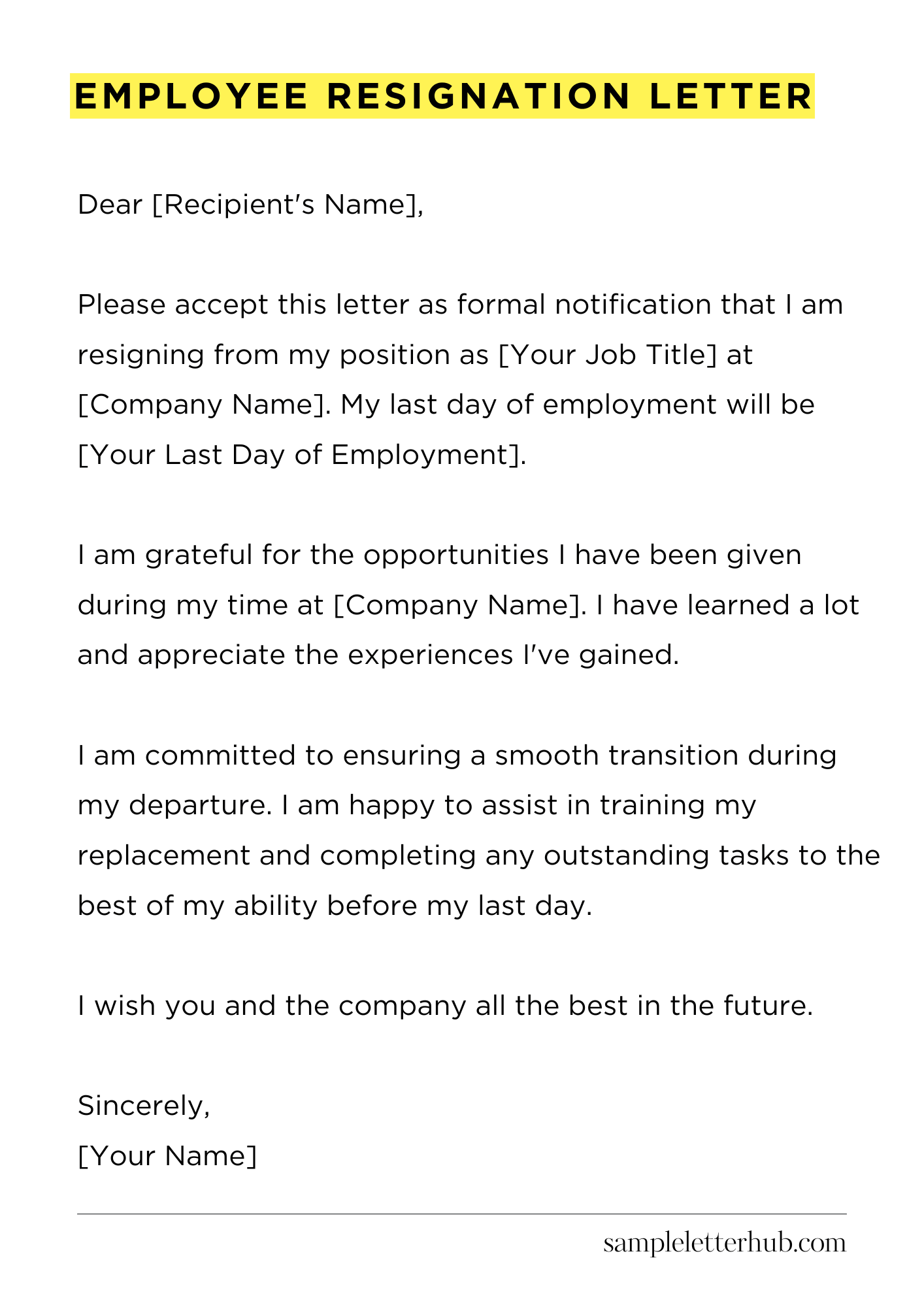
Dear [Recipient’s Name],
Please accept this letter as formal notification that I am resigning from my position as [Your Job Title] at [Company Name]. My last day of employment will be [Your Last Day of Employment].
I am grateful for the opportunities I have been given during my time at [Company Name]. I have learned a lot and appreciate the experiences I’ve gained.
I am committed to ensuring a smooth transition during my departure. I am happy to assist in training my replacement and completing any outstanding tasks to the best of my ability before my last day.
I wish you and the company all the best in the future.
Sincerely,
[Your Name]
How to Write an Employee Resignation Letter
Leaving a job is a big decision. It’s a moment filled with various emotions, from excitement about what’s next to perhaps a bit of sadness about saying goodbye.
While the future is calling, there’s a vital, final step to take: the resignation letter. This isn’t just a formality; it’s a crucial document. You want to make a good impression as you leave. Let’s delve into how to write a resignation letter that’s both professional and effective.
1. Keep it Clear and Concise
The primary goal is to clearly and directly state your intention to resign. Avoid beating around the bush. Your letter should begin with a clear statement.
State your resignation, and when your last day of employment will be. This part should be brief and to the point. Include the date. Keep it straightforward so there are no misunderstandings. It is critical to adhere to the core function of the document.
2. Express Your Gratitude (with a caveat)
Show appreciation for the opportunities and experiences you’ve gained. This is a chance to thank your employer. Consider mentioning specific things you learned or enjoyed. While it’s important to be positive, avoid overdoing it. Don’t feel obligated to list every single thing.
A general acknowledgement usually does the job perfectly. The tone should remain professional and sincere, without being overly effusive or insincere.
3. Provide Necessary Details
Your letter should include information that helps the transition. Make sure your letter gives an offer of assistance in the transition. This will assist the company while you are leaving. Are you willing to train your replacement? Do you want to compile notes on ongoing projects?
These kinds of offers are appreciated. Include your contact information. Make sure it is current. Provide an email address and a phone number.
4. Maintain Professionalism
Avoid any negativity or complaints about your job. Even if you’ve had a negative experience, your resignation letter isn’t the place to air grievances. Keep the tone positive and focused on the future. Remember that this letter is a reflection of you. Keep your tone neutral to professional.
5. Finalize and Proofread
Before sending, review everything carefully. Proofread your letter for any errors in grammar or spelling. Ensure that the date, your name, and your supervisor’s name are correct.
Consider getting a second opinion from a friend or family member. A fresh pair of eyes can often catch mistakes you might have missed. Make sure you maintain professionalism. Once you are sure that it’s perfect, you can send it with confidence.
Writing a resignation letter might seem simple, but it is actually really important. A well-written letter is very important. By following these guidelines, you can leave your job on a good note. It leaves a positive and lasting impression. This will help you secure future opportunities.
FAQs about Employee Resignation Letter
What is the primary purpose of an employee resignation letter?
The primary purpose of an employee resignation letter is to formally notify an employer of an employee’s intent to leave their position. It serves as an official record of the resignation, the employee’s last day of employment, and often, the reason for leaving. It also helps to ensure a smooth transition and fulfills any contractual obligations.
What key elements should be included in a resignation letter?
A well-crafted resignation letter should include: a clear statement of resignation, the effective date of departure, a brief and professional expression of gratitude, and, optionally, a reason for leaving (though this is not always required). It should also include a professional closing and the employee’s signature.
How much notice should I give when submitting a resignation letter?
The amount of notice required typically depends on the employee’s contract, company policy, and local labor laws. Common practices involve giving two weeks’ notice, but it’s crucial to consult the employment contract or employee handbook to determine the specific requirement. Providing adequate notice is crucial for a positive departure.
Can I withdraw my resignation after submitting a letter?
Whether an employee can withdraw their resignation depends on the circumstances. If the employer has not yet accepted the resignation, there may be room for negotiation.
However, once the resignation has been accepted and the employer has made plans for the employee’s departure, it may be difficult or impossible to retract the resignation. It is best to discuss the situation immediately with the employer.
Should I include a reason for leaving in my resignation letter?
Including a reason for leaving is optional. While it’s not always necessary, providing a brief, professional reason can be beneficial. It can offer clarity to the employer and help with the exit process. The reason can be as simple as “pursuing a new opportunity” or “seeking a career change.”
Avoid negativity or personal complaints. If you have any concerns that you want to share with the employer, you can ask for a separate discussion.
Related:
Resignation letter due to rude boss
Resignation letter moving to another state
Resignation letter due to illness of family member
Resignation letter due to study