

A media resignation letter is a formal document. It is written when an employee quits a job in the media industry. The purpose is to officially notify your employer of your departure. It also states your last day of work.
Planning your exit can feel overwhelming. Don’t worry, you are not alone. We’ve got your back. We will share a variety of templates. These templates include examples and samples.
Writing a letter should be easy. Our goal is to make it simple. We provide ready-to-use options. You can adapt them to fit your specific needs. Create the perfect letter.
Media Resignation Letter
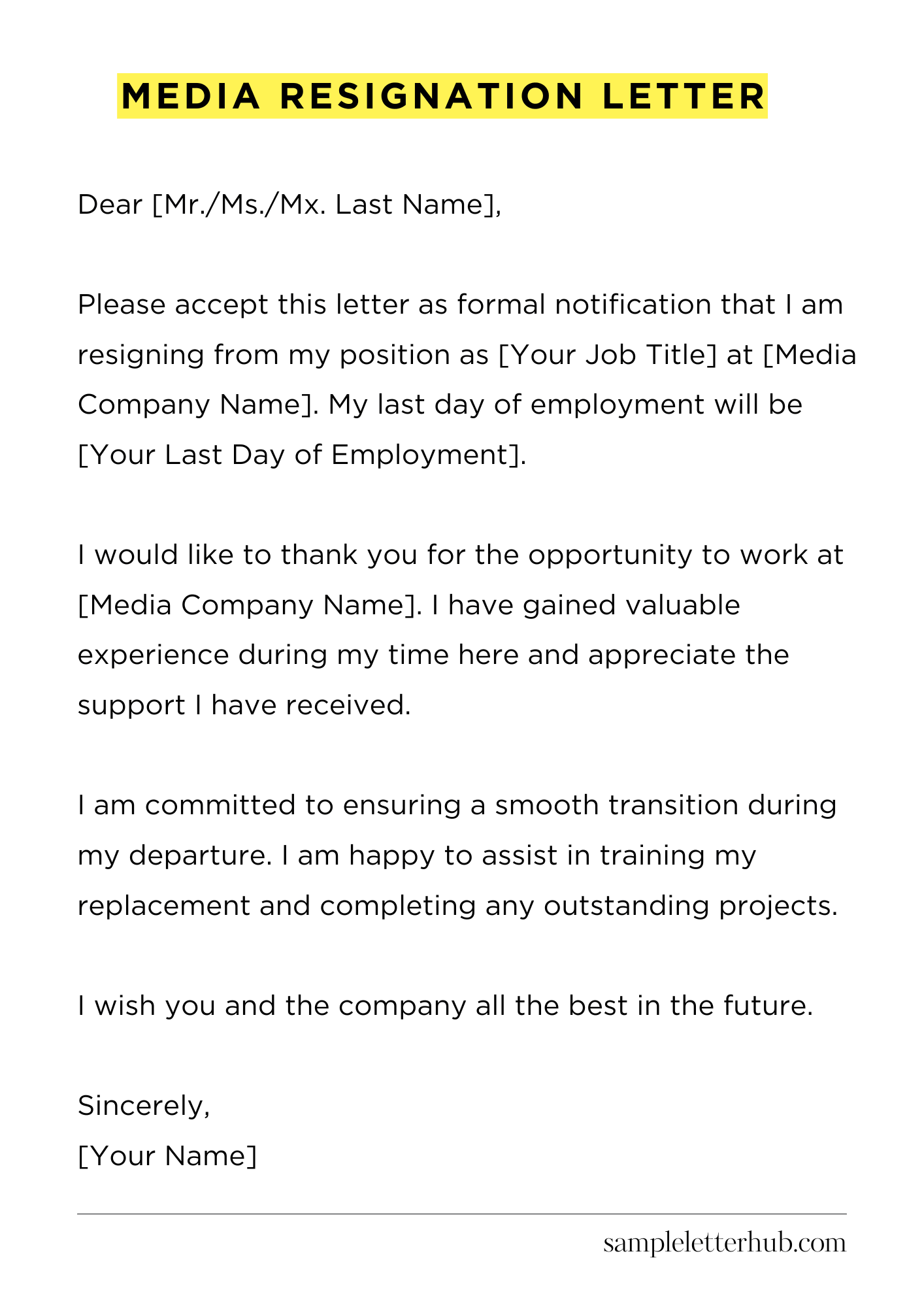
Below is a sample of a Media Resignation Letter:
[Your Name]
[Your Address]
[Your Phone Number]
[Your Email Address]
[Date]
[Recipient Name]
[Recipient Title]
[Media Company Name]
[Media Company Address]
Dear [Mr./Ms./Mx. Last Name],
Please accept this letter as formal notification that I am resigning from my position as [Your Job Title] at [Media Company Name]. My last day of employment will be [Your Last Day of Employment].
I would like to thank you for the opportunity to work at [Media Company Name]. I have gained valuable experience during my time here and appreciate the support I have received.
I am committed to ensuring a smooth transition during my departure. I am happy to assist in training my replacement and completing any outstanding projects.
I wish you and the company all the best in the future.
Sincerely,
[Your Name]
How to Write a Media Resignation Letter
Know the Basics Before You Start
Resigning from a media role can be tricky. However, crafting a professional resignation letter is essential. This is your formal farewell and can impact future opportunities. Think of it as a bridge, not a scorched earth policy.
Before you even begin typing, consider your reasons for leaving. Are you moving to a new role? Pursuing a different career path? Or perhaps you need a change of pace?
Whatever the motivation, clarity is key. Also, know your company’s policy on resignations. Check your employment contract and/or employee handbook for guidelines regarding notice periods, which can vary.
Crafting the Perfect Introduction
The introduction should be straightforward and to the point. Start by clearly stating your intention to resign. Include your name, the date, and the specific role you are resigning from. Keep it concise.
For example, you might write: “Dear [Manager’s Name], Please accept this letter as formal notification that I am resigning from my position as [Your Job Title] at [Media Company Name], effective [Your Last Day of Employment].” Remember: formality matters.
Expressing Gratitude and Professionalism
Even if you’re leaving due to negative circumstances, maintaining professionalism is crucial. Express your gratitude for the opportunities you’ve been given. Mention any positive experiences or skills you’ve gained during your time at the company.
This shows you are gracious. A simple “I am grateful for the opportunities I have been provided while working at [Media Company Name]” can work wonders. Then you can touch upon some of your achievements. Show, don’t just tell.
Addressing Your Departure and Notice Period
Next, clearly state your last day of employment. Make sure this aligns with the notice period outlined in your employment agreement. A standard notice period is typically two weeks, but it can be more, depending on your contract and company policy. Double-check your offer letter.
Also, express your willingness to assist with the transition. Offer to help train your replacement, complete any ongoing projects, or provide documentation. This demonstrates your commitment to a smooth handover.
The Conclusion and Final Thoughts
The conclusion should be brief and positive. Reiterate your gratitude. Include your contact information in case your employer needs to reach you.
Finally, sign off professionally. Use “Sincerely,” or “Best regards,” followed by your full name. Proofread your letter carefully before sending it. Make sure there are no typos or grammatical errors. Keep it simple, clear, and focused on the future. Remember, it is better to leave on good terms!
FAQs about Media Resignation Letter
What is the primary purpose of a media resignation letter?
The primary purpose of a media resignation letter is to formally notify your employer, typically a media organization, of your intention to leave your position. It serves as a written record of your resignation, the effective date, and often includes a statement of gratitude or explanation for leaving. It is a crucial document for legal and professional purposes.
What key information should be included in a media resignation letter?
A comprehensive media resignation letter should include your formal announcement of resignation, the specific date your employment will end (your last day), your name and job title, and the name of the recipient (usually your supervisor or HR representative).
It’s also advisable to express your gratitude for the opportunity, and to briefly state your reason for leaving, if you wish to. You should also provide your contact information and any details regarding the return of company property, such as equipment or credentials.
How should the tone of a media resignation letter be structured?
The tone of a media resignation letter should be professional and polite, regardless of your reasons for leaving. It is generally recommended to maintain a neutral or positive tone, even if you are leaving due to negative circumstances.
The letter should clearly and concisely convey your message without being overly emotional or accusatory. Gratitude for the opportunity to have worked there is very important.
Is it necessary to provide a reason for resignation in a media resignation letter?
While not strictly required, providing a brief and general reason for your resignation is often considered courteous. You are not obligated to disclose detailed reasons, especially if they are personal or sensitive. Some common, neutral reasons include: pursuing a new opportunity, relocating, or seeking a change in career direction. It is appropriate to keep it brief and positive.
How should I deliver a media resignation letter, and when is the best time?
It’s best to deliver your media resignation letter in writing to your supervisor, or Human Resources, usually by handing it to them in person or by email. The timing depends on your employment agreement or any company policy on giving notice.
A good practice would be to ensure you adhere to the notice period specified in your employment contract, which is typically two weeks. Consider what may work for your company culture and the relationship with your supervisor.
Related:
Resignation letter due to rude boss
Resignation letter moving to another state
Resignation letter due to illness of family member
Resignation letter due to study