

A Tech Lead resignation letter is a formal document. It announces your departure from a Tech Lead role. Its main purpose is to officially inform your employer. It also communicates your last day of employment.
This article can make things easier. We’ve got you covered. We’ll share templates and examples. Need a simple letter? We have it. Want something more detailed? We have that too.
You can customize these samples. They will help you write your own. Writing your letter shouldn’t be hard. Let’s make this process simple.
Tech Lead Resignation Letter
Below is a sample of a Tech Lead Resignation Letter:
[Your Name]
[Your Address]
[Your Phone Number]
[Your Email Address]
[Date]
[Recipient Name]
[Recipient Title]
[Company Name]
[Company Address]
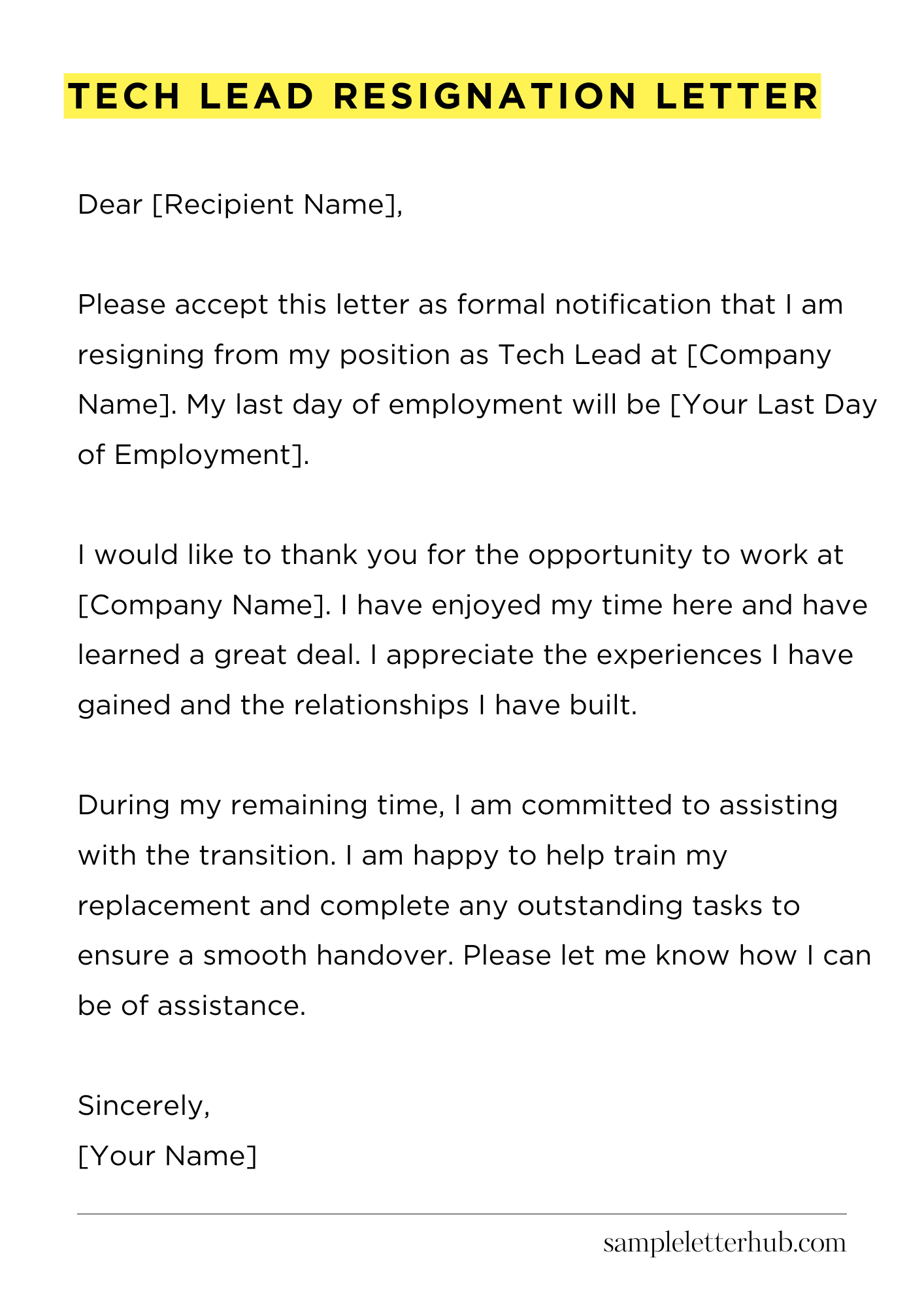
Dear [Recipient Name],
Please accept this letter as formal notification that I am resigning from my position as Tech Lead at [Company Name]. My last day of employment will be [Your Last Day of Employment].
I would like to thank you for the opportunity to work at [Company Name]. I have enjoyed my time here and have learned a great deal. I appreciate the experiences I have gained and the relationships I have built.
During my remaining time, I am committed to assisting with the transition. I am happy to help train my replacement and complete any outstanding tasks to ensure a smooth handover. Please let me know how I can be of assistance.
I wish [Company Name] continued success in the future.
Sincerely,
[Your Name]
How to Write a Tech Lead Resignation Letter
1. Preparation is Key
So, you’re moving on. That’s fantastic! Before you do anything else, take a breath. Writing a resignation letter, especially as a Tech Lead, requires careful thought.
You’re not just quitting; you’re leaving a crucial role. First, consider the impact of your departure. Are there ongoing projects? Are there team dependencies? Think about the handover process and potential team disruption. This will help frame your letter appropriately.
Next, check your employment contract. Understand your notice period. This is the minimum amount of time you need to give your employer before leaving. Missing this could have legal and financial implications. Make a note of any specific clauses about confidentiality or intellectual property too. Knowledge is power, right?
2. Structure and Content: The Essentials
A good resignation letter is concise and professional. Keep it short and to the point. Here’s a basic structure you can follow:
- Formal Opening: Start with a polite greeting, addressing your manager or HR by name.
- Clear Statement of Resignation: State your intention to resign, specifying your last day of employment.
- Gratitude: Express thanks for the opportunity to work at the company. Mention something positive you learned or experienced. Keep it genuine.
- Handover Plan (Optional): Briefly mention your willingness to assist with the transition. If your role requires significant handover, this is crucial.
- Closing: Reiterate your thanks and offer to help during the notice period.
- Formal Closing: End with a professional closing, like “Sincerely” or “Best Regards,” followed by your name and title.
That is the best structure to use. Stick to these rules for best results.
3. What to Include (and What to Avoid)
The content of your letter is incredibly important. You should be clear and concise. Provide your resignation date, adhering to your contract’s requirements. Avoid negativity. Don’t use your letter to vent about your frustrations or to air grievances. Keep the tone professional, even if you are not happy.
A brief mention of your willingness to assist with the handover is generally a good idea. Offer to help with training, documentation, or knowledge transfer. Provide a smooth transition. This is not the time to burn bridges! Remember, you might need a reference from this company in the future.
4. Tailoring Your Letter: Tech Lead Specifics
As a Tech Lead, your resignation impacts more than just your individual role. You have responsibilities to your team and the projects you lead. When it comes to handing over responsibilities to other team members, it’s necessary to be clear on what is needed.
Your letter can reflect your leadership role by briefly mentioning your commitment to assisting with the transition of your technical responsibilities. Consider these additional points:
- Project Status: Briefly summarize the status of ongoing projects and any critical deadlines.
- Team Communication: Express your willingness to support team members during the handover period.
- Documentation: Mention your readiness to create or update any essential technical documentation.
By addressing these points, you demonstrate your professionalism and commitment to ensuring a seamless transition.
5. Proofreading and Submission: The Final Steps
You’ve poured your heart into it. Now, it’s time for the final checks. Proofread your letter carefully. Check for any grammatical errors or typos. Ensure your dates are accurate. Ask a trusted colleague or friend to review your letter as well. Another pair of eyes can often catch mistakes you might have missed.
Before submitting, consider the method. Check company policy for the preferred way to submit a resignation letter. Some companies prefer a hard copy, while others accept it via email.
If submitting by email, use a professional subject line (e.g., “Resignation – [Your Name]”). Keep a copy of the letter for your records. Once submitted, that is it!
FAQs about Tech Lead Resignation Letter
What information should I include in my Tech Lead resignation letter?
Your resignation letter should include your formal resignation, stating your intent to leave the position of Tech Lead. Specify the effective date of your resignation, ensuring it aligns with your employment agreement and any company policies regarding notice periods. Briefly express gratitude for the opportunities you’ve been given.
It is also good to list any relevant handover plans or support you’re prepared to offer during the transition, like team handover plan.
What is the appropriate notice period for a Tech Lead resignation?
The appropriate notice period is typically outlined in your employment contract or company handbook. It is often between two weeks and one month, or longer depending on the company policies.
It is essential to review these documents to ensure you comply with the requirements. Giving adequate notice helps facilitate a smooth transition for your team and the company.
How should I deliver my Tech Lead resignation letter?
The most professional way to deliver your resignation letter is in writing. It’s often best to submit a physical copy to your manager or HR department. You might also follow up with an email to ensure the letter has been received. Ensure you keep a copy for your records.
Should I provide a reason for resigning in my Tech Lead resignation letter?
You are not always required to give a reason for resigning, and your letter can be brief and professional. However, it is always a good gesture to provide a brief, general statement of your reason for leaving, such as pursuing new opportunities, relocating, or personal reasons. It’s best to keep it concise and positive, focusing on your future endeavors.
What should I do after submitting my Tech Lead resignation letter?
After submitting your letter, discuss your departure with your manager and HR. Cooperate with any requests to facilitate the transition, such as documenting processes, training your replacement, and handing over ongoing projects. Maintain a positive attitude and remain professional until your last day. Be ready to answer questions and offer support.
Related:
Resignation letter due to rude boss
Resignation letter moving to another state
Resignation letter due to illness of family member
Resignation letter due to study