

A “Field Representative Resignation Letter” is a formal document. Its purpose is simple. It informs your employer of your intention to leave your job. It marks the official end of your employment as a field representative.
Ready to move on? Writing this letter can feel tricky. Don’t worry, we’re here to help. We’ve got you covered. This article offers helpful templates. You’ll also find some great examples.
We aim to make things easy. Our samples provide a solid starting point. Customize them to fit your situation. Get ready to craft your perfect resignation letter.
Field Representative Resignation Letter
Below is a sample of a Field Representative Resignation Letter:
[Your Name]
[Your Address]
[Your Phone Number]
[Your Email Address]
[Date]
[Hiring Manager Name] (If known, otherwise use title)
[Hiring Manager Title]
[Company Name]
[Company Address]
Dear [Mr./Ms./Mx. Last Name],
Please accept this letter as formal notification that I am resigning from my position as Field Representative at [Company Name]. My last day of employment will be [Your Last Day of Employment].
I would like to thank you for the opportunity to work at [Company Name]. I have enjoyed my time here and appreciate the experiences I have gained during my employment.
I am committed to ensuring a smooth transition during my departure. I am available to assist in training my replacement and completing any outstanding tasks to the best of my ability. Please let me know how I can be of assistance.
I wish [Company Name] continued success in the future.
Sincerely,
[Your Signature]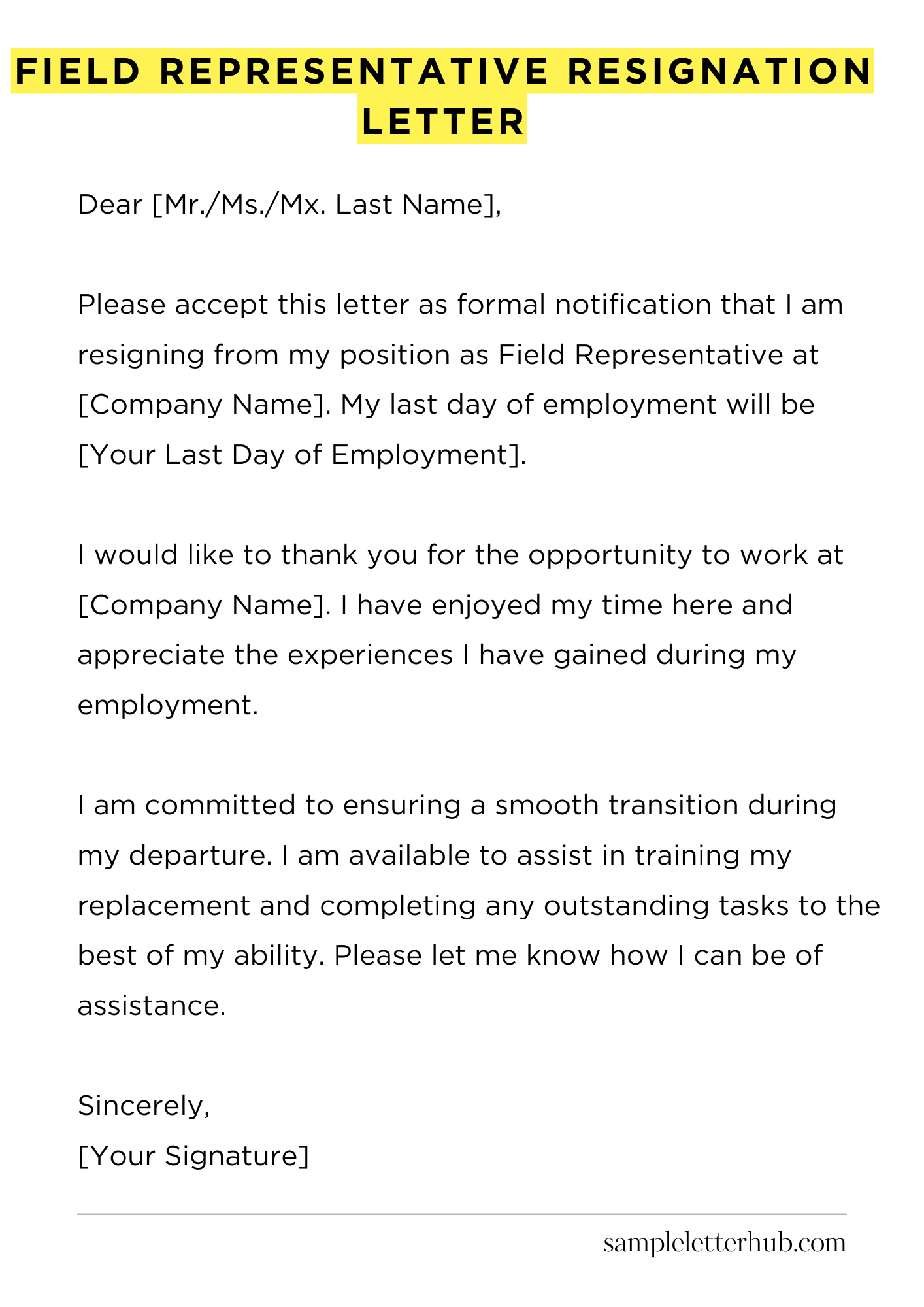
How to Write a Field Representative Resignation Letter
1. Grasping the Basics: Why Your Letter Matters
Leaving a job is a big deal, and the field representative role is no exception. A well-crafted resignation letter is more than just a formality; it’s your final professional statement.
Think of it as your last chance to make a positive impression. You want to leave on good terms, paving the way for future opportunities. The letter also serves as an official record of your departure, protecting both you and your employer.
It sounds simple, but many people don’t get it right.
2. Essential Elements: What to Include
Okay, let’s break down the must-haves. First, the date. Always. Next, a clear and concise statement of your resignation. State your name and the date your employment will end.
Be sure to address it to the appropriate person, usually your direct supervisor or HR. Keep it professional. Keep it short. Avoid unnecessary details or negativity.
A sincere expression of gratitude for the opportunity is also key. Consider mentioning a specific positive experience or skill you gained during your time there.
Finally, your signature! Don’t forget that.
3. Structure for Success: Crafting the Perfect Letter
The structure is straightforward. Begin with a formal salutation, like “Dear [Supervisor’s Name]”. Then, in the first paragraph, clearly state your intention to resign and your last day of employment.
The second paragraph should express your gratitude and appreciation for your time with the company. Keep it brief. If you wish to offer assistance during the transition, include it in a separate sentence.
Consider offering to train your replacement. You might add a sentence wishing the company continued success in the final paragraph. Close with a professional closing, such as “Sincerely” or “Best Regards,” followed by your typed name and then your signature.
This is crucial; it’s about making it look like you know what you are doing.
4. Tailoring Your Letter: Examples and Customization
Every situation is unique, so your letter should reflect that. For instance, if you’re leaving for a better opportunity, you might briefly acknowledge it without going into excessive detail.
If you are going back to school, say that simply and politely. You want to make it look like a smooth transition, but this is entirely up to you. Customize your letter to the specific company culture and the relationship you have with your supervisor. A general template is a good starting point, but always personalize it.
Search online for a few samples but don’t copy them directly. Be original. Make it personal.
Ensure that it sounds like you.
5. Proofreading and Polishing: The Finishing Touches
Before hitting “send,” proofread your letter meticulously. Check for grammar and spelling errors. Double-check the recipient’s name and title. Read the letter aloud to ensure the tone is professional and respectful. Ask a friend or colleague to review it for a second opinion. This step is critically important.
A poorly written letter can damage your professional reputation. Take the time to make sure your letter reflects the best version of yourself, your professionalism. Once you are sure, and only then, submit the letter. Then, you can move on to the next chapter.
The ultimate goal is to make a positive impression.
FAQs about Field Representative Resignation Letter
What is the primary purpose of a Field Representative resignation letter?
The primary purpose of a Field Representative resignation letter is to formally notify your employer of your intention to leave your position. It serves as an official record of your departure and provides essential details regarding the end of your employment.
What key information should be included in a Field Representative resignation letter?
A well-crafted resignation letter should include your formal announcement of resignation, the effective date of your last day of employment, a brief expression of gratitude for the opportunity, and any necessary information for a smooth transition, such as your willingness to assist in training a replacement.
How much notice should a Field Representative give when resigning?
The amount of notice required varies depending on your employment contract, company policy, and local labor laws. However, a common practice is to provide at least two weeks’ notice. Always review your employment agreement to understand the specific requirements.
Should a Field Representative provide a reason for resigning in the letter?
While not mandatory, you can briefly mention your reason for leaving in your letter. Keep it concise, professional, and focus on future opportunities or personal circumstances. Examples include pursuing a new career, relocating, or personal reasons.
How should a Field Representative deliver the resignation letter?
Ideally, you should deliver the letter in person to your direct supervisor or HR department. If a physical hand-off isn’t feasible, sending it via email is acceptable, but ensure you also follow up with a phone call to confirm its receipt.
Related:
Resignation letter due to rude boss
Resignation letter moving to another state
Resignation letter due to illness of family member
Resignation letter due to study