

An Administrative Supervisor resignation letter is a formal document. Its purpose is to officially announce your departure. It informs your employer of your decision to leave your position. It typically states your last day of employment.
Feeling overwhelmed about writing it? Don’t worry, we’ve got you covered. We’ll share several templates. You’ll find different examples and samples. Use them as a starting point.
Crafting your letter just got easier. Customize these examples to fit your situation. Whether you need a simple or detailed letter, we have options. Get ready to write your perfect resignation.
Administrative Supervisor Resignation Letter
Below is a sample of a Administrative Supervisor Resignation Letter:
[Your Name]
[Your Address]
[Your Phone Number]
[Your Email Address]
[Date]
[Supervisor’s Name]
[Supervisor’s Title]
[Company Name]
[Company Address]
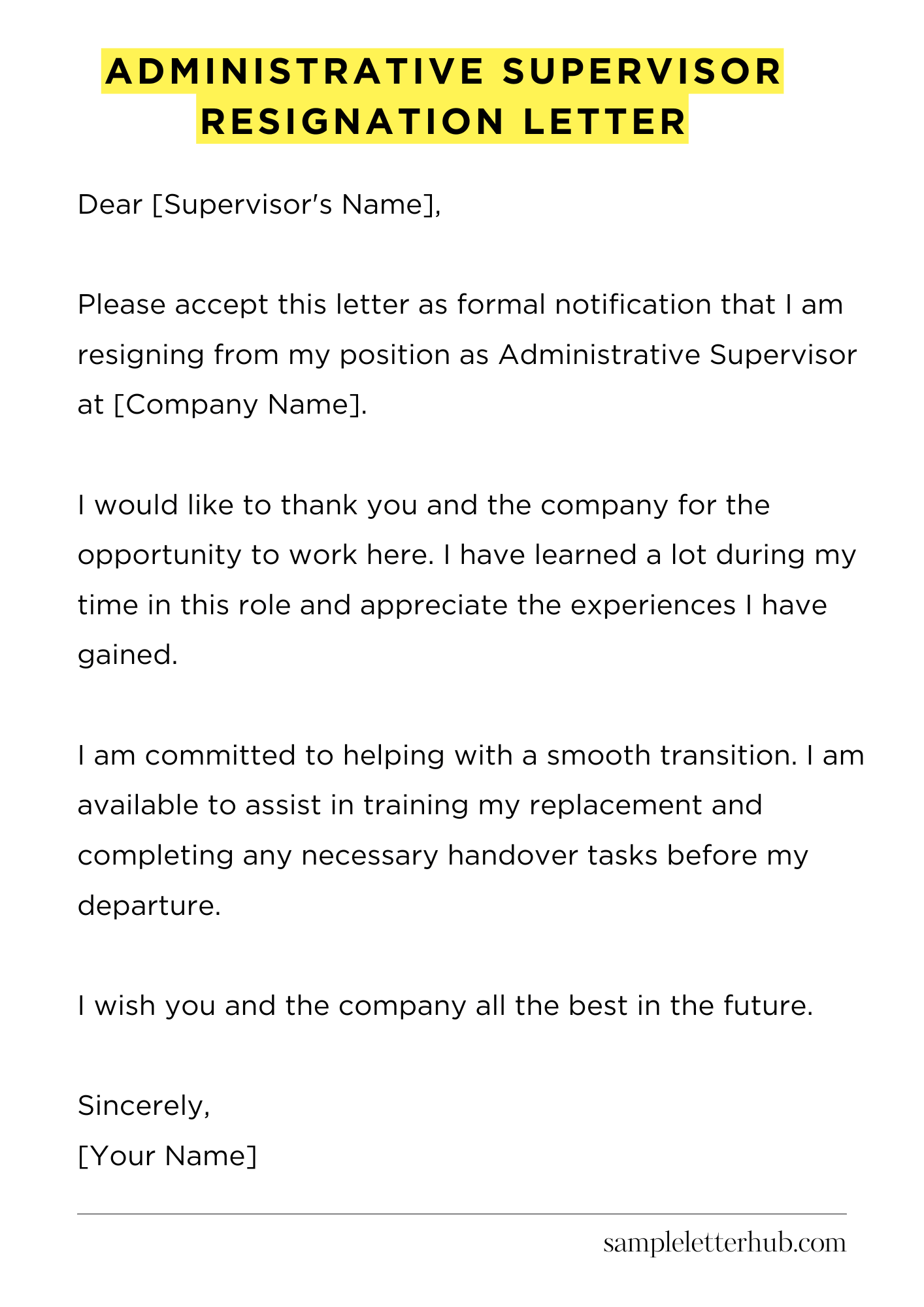
Dear [Supervisor’s Name],
Please accept this letter as formal notification that I am resigning from my position as Administrative Supervisor at [Company Name]. My last day of employment will be [Your Last Day of Employment].
I would like to thank you and the company for the opportunity to work here. I have learned a lot during my time in this role and appreciate the experiences I have gained.
I am committed to helping with a smooth transition. I am available to assist in training my replacement and completing any necessary handover tasks before my departure.
I wish you and the company all the best in the future.
Sincerely,
[Your Name]
How to Write Administrative Supervisor Resignation Letter
Getting Started: The Essentials
Resigning from a job, especially a supervisory one, requires careful planning and execution. A well-crafted resignation letter is crucial. It’s the official document that informs your employer of your departure.
First and foremost, you need to think about the basics. This includes a clear, concise format, professional language, and a positive tone. Avoid negativity, even if your reasons for leaving are less than ideal. This is about ensuring a smooth transition.
Crafting the Core: Key Elements
Your letter should include specific pieces of information. Begin with a formal salutation, like “Dear [Manager’s Name]”. Next, clearly state your intention to resign and your last day of employment.
This is where you declare your intent. Be precise, stating the date you’ll be leaving. Briefly express gratitude for the opportunity to work there, even if it feels forced. Consider acknowledging any valuable experiences. Mentioning your willingness to assist with the transition is also key. This demonstrates professionalism.
Detailing the Transition: Your Responsibilities
A good resignation letter doesn’t just announce your departure. It outlines your commitment to a smooth handover. Offer to help train your replacement, if possible.
List any ongoing projects you’re involved in, and suggest ways to ensure their continuation. Include contact information for follow-up questions. This demonstrates your dedication, even as you are departing. This shows you are a team player.
Maintaining Professionalism: Dos and Don’ts
Professionalism is paramount. Keep your language formal and avoid personal grievances. Do not list every complaint you have ever had. Steer clear of gossip. Always proofread your letter carefully for any errors in grammar or spelling. Before submitting, review it once more to check if all aspects are appropriate.
Consider seeking a second opinion from a trusted colleague. Remember that your letter is a reflection of your work ethic.
Final Touches: Formatting and Submission
Use a standard business letter format. Include your contact information (name, address, email, phone number) at the top. The date should follow. Address your letter to your manager or HR department. Sign your letter with your name. Keep a copy for your records. Submit your letter according to company policy.
Whether it is hard copy or email, follow the appropriate protocols. After submitting, prepare for the exit interview, and finish up any last-minute tasks.
FAQs about Administrative Supervisor resignation letter
How do I start a resignation letter as an Administrative Supervisor?
Begin your resignation letter professionally. Start with a clear and concise statement of your intent to resign, including your name, the position you’re leaving (Administrative Supervisor), and the effective date of your resignation. Be sure to address the letter to the appropriate person, usually your direct supervisor or the Human Resources department.
What key information should be included in an Administrative Supervisor resignation letter?
The core elements of your resignation letter include: your intention to resign, the specific date your resignation takes effect, a brief and professional expression of gratitude for the opportunity to work at the company, and, if you choose, a brief reason for your departure. Consider mentioning your willingness to assist with the transition. It is helpful to mention the last working day too.
Should I provide a reason for resigning in my letter?
While not mandatory, providing a reason for your resignation can be helpful. You can keep the reason brief and neutral. Examples include “to pursue other opportunities,” “for personal reasons,” or “to relocate.” Avoid negative comments about the company or colleagues, as this can affect your future references. However, some companies would like you to be honest.
How should I format the letter and ensure it looks professional?
Use a standard business letter format. This includes your contact information (name, address, phone number, and email) at the top, the date, the recipient’s information (name, title, company, and address), a formal salutation (“Dear [Recipient’s Name]:”), the body of the letter, a closing (“Sincerely,” or “Regards,”), and your typed name.
Keep the letter concise (one page is usually sufficient). Proofread carefully for any errors in grammar and spelling before submitting.
What should I do after submitting my resignation letter?
After submitting your letter, follow up with your supervisor to discuss the transition process. Be prepared to assist in training your replacement and completing any outstanding tasks.
Maintain a professional demeanor throughout your remaining time at the company. If you’ve been asked for an exit interview, participate honestly and constructively. Ensure all company property, such as keys, laptops, etc, is returned to the company.
Related:
Resignation letter due to rude boss
Resignation letter moving to another state
Resignation letter due to illness of family member
Resignation letter due to study