

A banking resignation letter is a formal document. It is how you officially announce your departure. It informs your employer of your decision to leave. The letter also states your last day of employment.
Leaving a banking job requires professionalism. It also demands clear communication. You want to leave on good terms. We will help you write the perfect letter.
We have compiled various banking resignation letter templates. These templates cater to diverse situations. They make crafting your own letter simple. Find samples that suit your needs.
Banking Resignation Letter
Below is a sample of a Banking Resignation Letter:
[Your Name]
[Your Address]
[Your Phone Number]
[Your Email Address]
[Date]
[Recipient Name] (Manager’s Name or HR Department)
[Bank Name]
[Bank Address]
Dear [Mr./Ms./Mx. Last Name],
Please accept this letter as formal notification that I am resigning from my position as [Your Job Title] at [Bank Name]. My last day of employment will be [Your Last Day of Employment].
I would like to thank you for the opportunity to work at [Bank Name]. I have learned a great deal during my time here and appreciate the experiences I’ve gained.
I am committed to ensuring a smooth transition during my departure. I am happy to assist in training my replacement and completing any outstanding tasks.
I wish you and the bank continued success in the future.
Sincerely,
[Your Signature]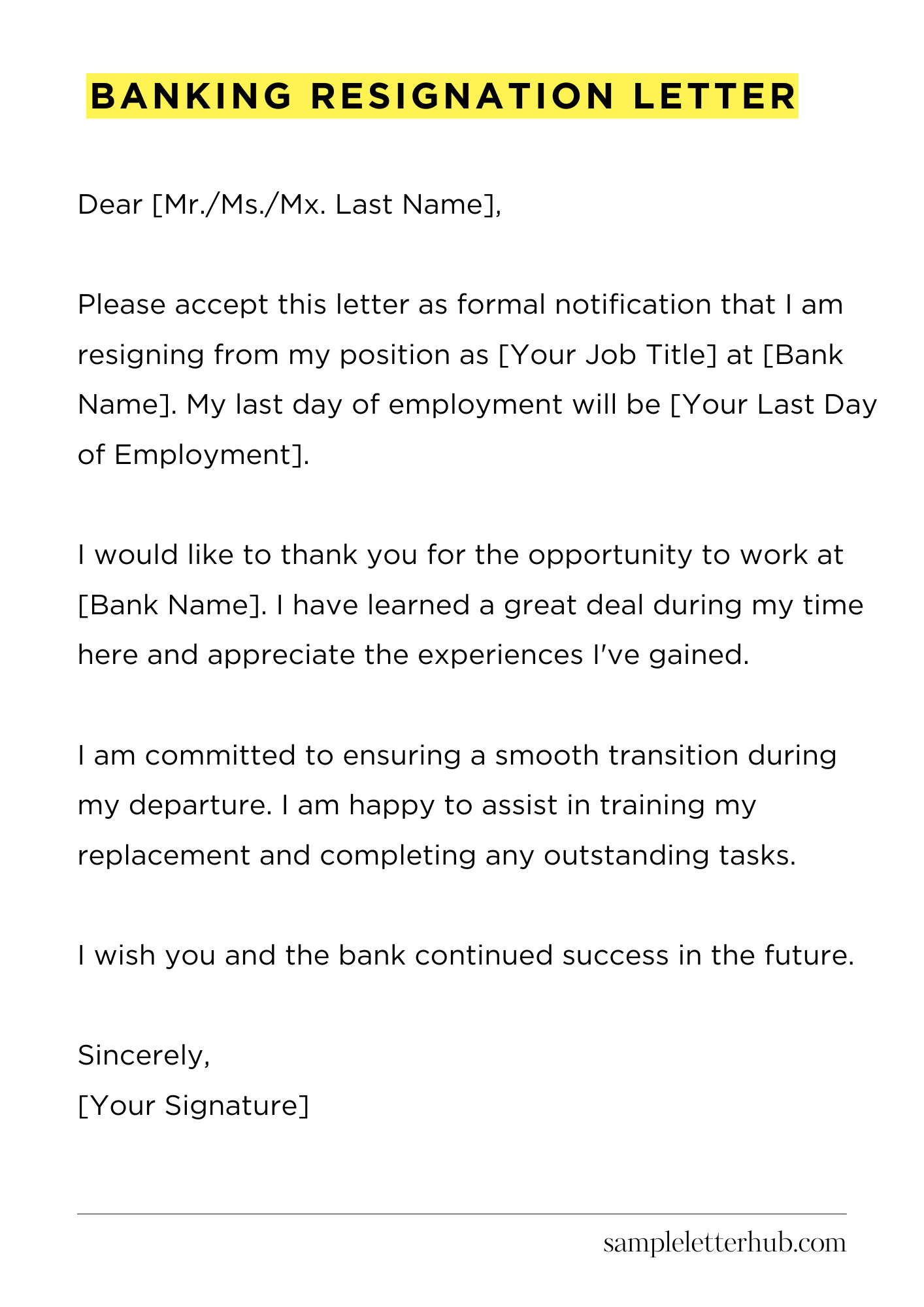
How to Write a Banking Resignation Letter
Understanding the Basics
Leaving a job is a big decision. And when you decide to resign from your position in banking, you’ll need to do it professionally. The cornerstone of a smooth transition is a well-crafted resignation letter.
This isn’t just about saying goodbye; it’s about preserving relationships and setting the stage for future opportunities. Remember to always be respectful, even if your reasons for leaving are less than positive.
Your letter serves several key purposes. It formally announces your departure. It outlines your last day of employment. It may also provide a brief, professional explanation for your decision, if you choose to include one. Moreover, it’s a chance to express gratitude for your time at the bank.
Crafting a Professional Format
Format matters, especially in a banking environment. A standard business letter format is best. Start with your contact information, followed by the date, and then your supervisor’s name and title and bank’s address. Use a formal tone throughout the letter.
Keep it concise, focused, and free of emotional language. You want this to be viewed as a serious piece of communication.
Consider this structure: Start with a clear statement of your resignation. State your last day of employment. Acknowledge your experience with the company and a sentence or two of gratitude. Finally, close with a professional sign-off and your typed name.
What to Include: Key Elements
Certain elements are essential. First and foremost, clearly state your intention to resign. Specify the date of your last day. This is crucial for payroll and administrative purposes. Next, express your appreciation for the opportunities you’ve been given during your time there.
While not mandatory, you might offer a brief, general reason for your departure. “To pursue another opportunity” or “to focus on personal goals” are acceptable. Avoid negative comments about your experience or colleagues. Do not burn any bridges.
Tone and Language
The tone is paramount. Maintain a professional and courteous demeanor. Avoid slang or overly casual language. Even if you’re leaving due to negative experiences, avoid sounding resentful or bitter. Expressing appreciation shows you’re a professional.
Keep your language neutral and straightforward. Focus on the facts. It is critical to proofread the letter carefully for any grammatical errors or typos. A polished, well-written letter reflects positively on you and your professionalism.
Before You Send
Once your letter is ready, review it thoroughly. Ask a trusted friend or colleague to read it over as a second set of eyes. Ensure the information is accurate and the tone is appropriate.
Typically, you will submit the letter to your direct supervisor or the Human Resources department, according to your company’s policies. Keep a copy for your records. Remember, a well-written resignation letter can leave a lasting positive impression, benefiting your future career endeavors. Good luck!
FAQs about Banking resignation letter
What are the essential elements of a banking resignation letter?
A well-structured banking resignation letter should include: your formal resignation statement (e.g., “I hereby resign from my position as…”), the effective date of your resignation, a concise and professional statement of gratitude for the opportunity (optional), and your signature. It’s also advisable to include your contact information for any follow-up.
How much notice should I give when resigning from a banking position?
The standard notice period in the banking industry is typically two weeks, although it can vary depending on your employment contract, your seniority, and company policy.
Review your employment agreement to confirm the required notice period. Senior-level positions often require a longer notice, such as one month or more. It is always best to adhere to any stated notice requirements to maintain a positive relationship with your employer.
What should I avoid including in my banking resignation letter?
Refrain from including negative comments about your employer, colleagues, or the company culture. Avoid overly detailed explanations of your reasons for leaving, unless necessary for contractual or legal purposes. Keep the tone professional and positive. It’s also best to avoid burning bridges, as you may need references in the future.
Should I provide a reason for my resignation in my banking resignation letter?
While not mandatory, it’s generally a good practice to briefly state your reason for leaving. You can keep it simple and generic, such as “to pursue other opportunities,” “for personal reasons,” or “to accept a new position.” Avoid providing sensitive or negative information. Remember to maintain a professional demeanor throughout your letter.
How should I submit my banking resignation letter?
Submit your resignation letter in writing to your direct supervisor or the appropriate Human Resources representative. It’s generally best to submit a hard copy, if possible, along with an electronic version via email. Ensure you keep a copy of the signed resignation letter for your records. Following up with your supervisor to confirm receipt is also a good practice.
Related:
Resignation letter due to rude boss
Resignation letter moving to another state
Resignation letter due to illness of family member
Resignation letter due to study