

You’re a Commis Chef. You’ve decided to move on. You need to resign from your job. A Commis resignation letter is the formal way to do this. It officially informs your employer of your departure. It is a crucial step in ending your employment professionally.
Crafting the perfect resignation letter can be tricky. Don’t worry. We’ve got you covered. We’ll share various templates and examples. These will help you compose your own letter.
Need a simple, straightforward letter? We have that. Looking for something more specific? We have a sample for you. Let’s make this process easy.
Commis Resignation Letter
Below is a sample of a Commis Resignation Letter:
[Your Name]
[Your Address]
[Your Phone Number]
[Your Email Address]
[Date]
[Employer’s Name]
[Employer’s Job Title]
[Company Name]
[Company Address]
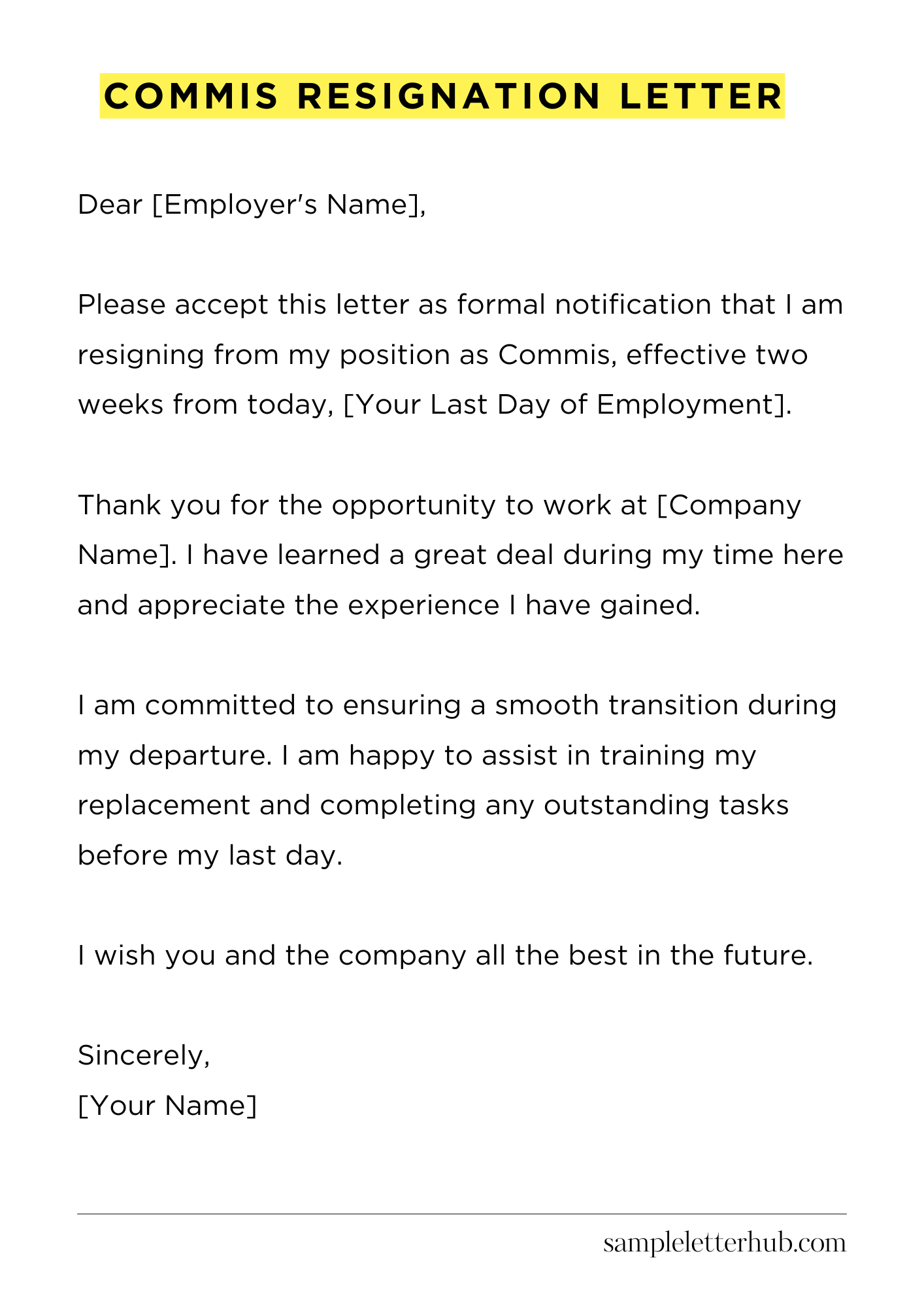
Dear [Employer’s Name],
Please accept this letter as formal notification that I am resigning from my position as Commis, effective two weeks from today, [Your Last Day of Employment].
Thank you for the opportunity to work at [Company Name]. I have learned a great deal during my time here and appreciate the experience I have gained.
I am committed to ensuring a smooth transition during my departure. I am happy to assist in training my replacement and completing any outstanding tasks before my last day.
I wish you and the company all the best in the future.
Sincerely,
[Your Name]
How to Write a Commis Resignation Letter
So, you’re moving on from your role as a Commis in the culinary world? Congratulations! That’s a big step. Leaving a job requires a well-crafted resignation letter, one that is professional, respectful, and leaves a good impression. Let’s delve into how to write one that achieves these goals.
1. Keep it Short and Sweet (and Clear!)
Your resignation letter isn’t a novel. It doesn’t need to be. The primary goal is to formally notify your employer of your departure. Get straight to the point.
Start by stating your intention to resign and the date of your last day of employment. This is crucial for their records and your transition. Avoid unnecessary details or lengthy explanations, unless explicitly requested.
Here’s a basic structure: “Dear [Manager’s Name], please accept this letter as formal notification that I am resigning from my position as Commis at [Restaurant Name], effective [Your Last Day of Employment].” Keep it clean and easy to read. This clarity is paramount.
2. Show Appreciation (and Gratitude)
Even if you’re leaving for better opportunities or a less-stressful environment, expressing gratitude is vital. It’s professional. Acknowledge your time at the restaurant and any positive experiences you’ve had.
This shows respect for your employer and colleagues. Furthermore, it helps maintain a positive relationship for the future, potentially opening doors down the line.
Consider adding a sentence like: “I am grateful for the opportunities I’ve had to learn and grow during my time here” or “Thank you for the training and experience I’ve gained.” This adds a touch of class to your departure.
3. Consider the Tone (and Avoid Negativity)
Your tone is very important. Even if you’ve had disagreements or frustrations, a resignation letter is not the place to air them. Stick to a professional and polite tone throughout. This is not the time to burn bridges. Avoid negativity, complaints, or making demands.
Focus on the positive aspects of your experience or your future plans. Refrain from making personal attacks or criticizing the management or other staff members. Keep your language measured and neutral.
4. Offer Assistance with the Transition
A good resignation letter isn’t just about you. It’s also about making the transition as smooth as possible for your employer. Offering to assist with the handover process demonstrates professionalism and consideration. It shows that you value your current place of work.
This could include offering to train your replacement, complete any outstanding tasks, or provide documentation. Include a simple statement like: “I am happy to assist in the transition process to ensure a smooth handover of my responsibilities.” A thoughtful offer to help will be appreciated.
5. Proofread, Proofread, Proofread! (and then Proofread Again!)
This is extremely important. Before sending your letter, thoroughly proofread it for any grammatical errors, typos, or spelling mistakes. A polished letter reflects well on you. Errors can undermine your credibility and make you appear unprofessional.
Ask a friend or colleague to read it over for you. A fresh pair of eyes can often catch mistakes you might have missed. Check the formatting, too, ensuring it looks clean and organized.
Make sure your dates, names, and titles are correct. A well-written and error-free letter is a sign of respect and attention to detail. This final step is crucial.
FAQs about Commis Resignation Letter
What is a Commis Resignation Letter?
A Commis resignation letter is a formal written document submitted by a Commis chef to their employer, formally announcing their decision to leave their position. It serves as an official record of the employee’s intent to resign and the date their employment will end.
It typically includes the employee’s name, the date of the letter, the recipient’s name and title, a clear statement of resignation, the last day of employment, and a brief expression of gratitude.
What should be included in a Commis Resignation Letter?
A well-structured Commis resignation letter should include: your full name and contact information, the date of the letter, the name and title of your supervisor or the appropriate recipient within the organization, a clear and concise statement of your resignation (e.g., “I am writing to inform you of my resignation from my position as Commis Chef”).
How much notice should a Commis Chef give when resigning?
The standard notice period for a Commis Chef, or any employee, typically depends on the employment contract or local labor laws. However, a minimum of two weeks’ notice is generally considered a professional courtesy.
Always refer to your employment contract or any company policies to determine the required notice period. Providing adequate notice allows the employer time to find a replacement and ensures a smooth transition.
Can I provide a reason for resigning in my letter?
While not mandatory, you can briefly state the reason for your resignation in your letter. Keep it concise and professional. Common reasons might include pursuing a new career opportunity, personal reasons, or a desire for better work-life balance.
Avoid negative comments or complaints about your current employer. If you choose to offer a reason, keep it positive and focus on the future.
What happens after I submit my resignation letter?
After submitting your resignation letter, your employer will typically acknowledge receipt and may schedule an exit interview. During the exit interview, they may ask about your reasons for leaving and discuss the transition process. Ensure you complete any handover tasks, return company property, and follow all established company procedures.
After your last day, you should receive your final paycheck, which should include any accrued vacation time or other benefits, according to your employment agreement.
Related:
Resignation letter due to rude boss
Resignation letter moving to another state
Resignation letter due to illness of family member
Resignation letter due to study