


So, you’re moving on? A “Sr. Business Analyst resignation letter” is your formal goodbye. It signals your departure from a Senior Business Analyst role. Its purpose? To officially notify your employer of your intention to leave. This also includes your last day of employment.
Writing this letter can feel tricky. You want to be professional and leave a good impression. We’re here to help ease the process. We’ve compiled some helpful resources to assist you.
We will provide you with different examples and templates. These samples cover various scenarios. They are designed to make it simple. Pick one that suits your needs.
Sr Business Analyst Resignation Letter
Below is a sample of a Sr Business Analyst Resignation Letter:
[Your Name]
[Your Address]
[Your Phone Number]
[Your Email Address]
[Date]
[Hiring Manager Name] (If known, otherwise use title)
[Hiring Manager Title]
[Company Name]
[Company Address]
Dear [Mr./Ms./Mx. Last Name],
Please accept this letter as formal notification that I am resigning from my position as Senior Business Analyst at [Company Name]. My last day of employment will be [Your Last Day of Employment].
I would like to express my gratitude for the opportunities I have been given during my time here. I have learned a great deal and appreciate the experience I have gained.
I am committed to ensuring a smooth transition during my departure. I am happy to assist in any way possible to train my replacement or complete any ongoing projects. Please let me know how I can be of assistance.
I wish you and [Company Name] all the best in the future.
Sincerely,
[Your Signature]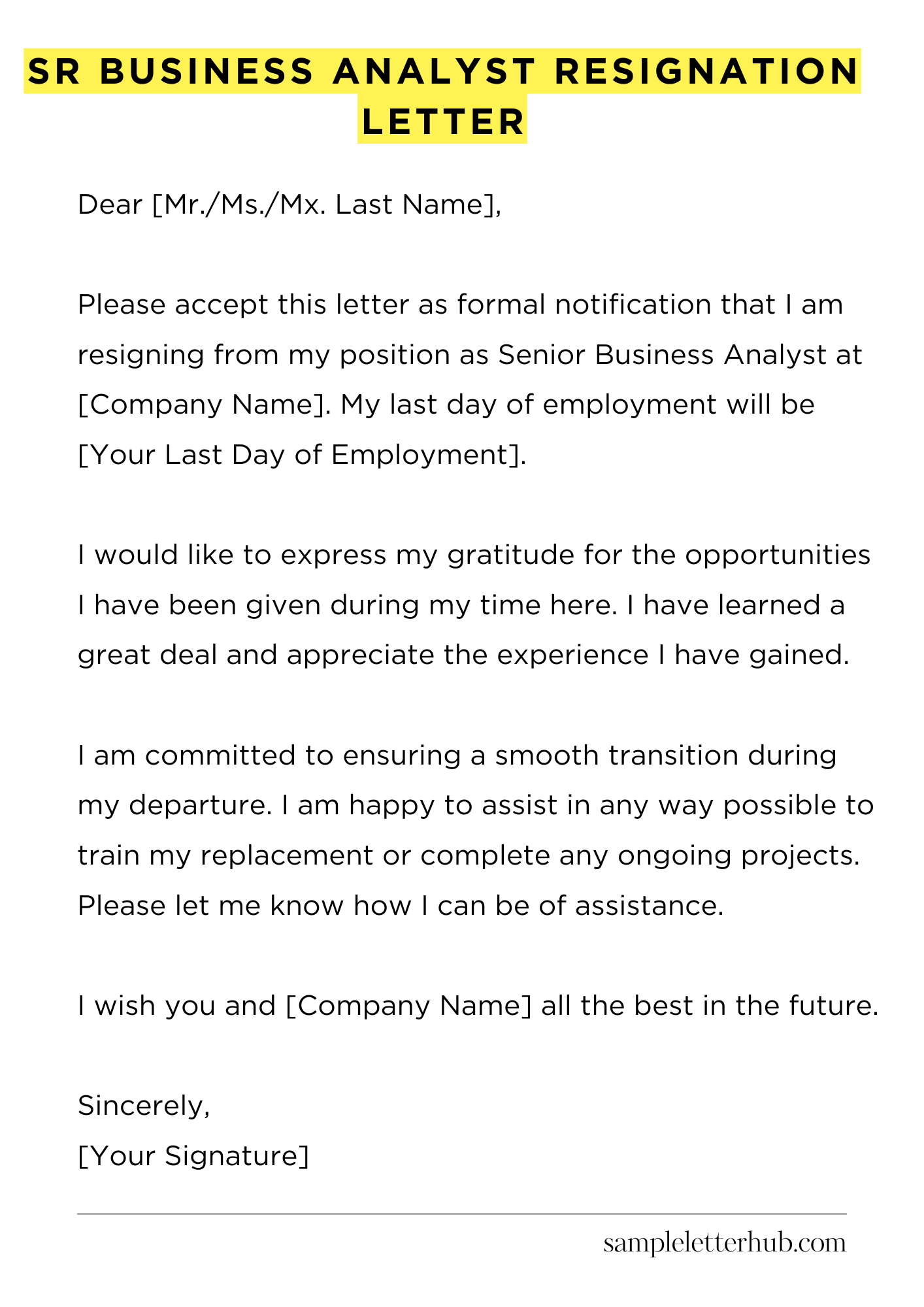
How to Write a Sr. Business Analyst Resignation Letter
1. Why a Good Resignation Letter Matters
Leaving a job is a big decision. Your resignation letter is a crucial part of the process. It’s not just about saying “I quit”. It is a formal declaration and your last official communication.
This document reflects your professionalism. It also sets the stage for a positive final impression. Even if you are not happy, you should stay professional, that is the most important thing.
A well-crafted letter can help you in the future. You may need a reference, or the business might grow. Think of it as a final bridge to your former employer. Burning bridges is never smart. So, let’s ensure that your resignation letter is on point.
2. Key Elements to Include
Several elements are essential to a solid resignation letter. First, you need a clear and concise opening. Start by stating your intent to resign, and the effective date of your departure. Next, express your gratitude for the opportunity. Mention any specific positive experiences or skills gained. Keep the tone appreciative.
Keep your language simple and easy to understand. Briefly list your duties, and the project if you want. A good rule of thumb is to avoid negative language. Provide a brief offer to assist with the transition. Include your contact information. And don’t forget the proper closing: “Sincerely” or “Best regards” will do fine.
3. Structuring Your Letter: The Practical Approach
Let’s make this real. Use a standard business letter format. Start with your contact information. After, include the date and then the hiring manager’s information. Now, comes the body of your letter. Begin with your clear statement of resignation, and the last day of employment.
Next, express your thanks for the opportunity. Briefly mention what you liked during your tenure. Then offer to help with the transition. Keep this section short. Finally, sign off with a professional closing. Make it neat. Proofread it very well.
4. Dos and Don’ts: Tips for Success
Avoid negativity at all costs. Never mention grievances, issues, or disputes. Keep it positive. Never include details about your new job. This is not the place for that kind of discussion. Be specific. Don’t be too vague.
Do offer help with the transition. Try to keep it concise. If you are uncertain, consult a template to help you. Remember to proofread your letter. Check for typos and grammatical errors. It is also good to proofread to make sure the right message is delivered.
5. Sample Letter and Customization
Here’s an example:
[Your Name]
[Your Address]
[Your Phone Number]
[Your Email]
[Date]
[Hiring Manager Name]
[Hiring Manager Title]
[Company Name]
[Company Address]
Dear [Hiring Manager Name],
Please accept this letter as formal notification that I am resigning from my position as Sr. Business Analyst at [Company Name], effective [Your Last Day of Employment].
I am grateful for the opportunities I have been given during my time here. I have particularly enjoyed [mention something positive].
I am happy to assist in the transition process in any way I can to ensure a smooth handover of my responsibilities.
Thank you again for the experience. I wish you and the company all the best in the future.
Sincerely,
[Your Signature]
[Your Typed Name]
Remember to replace the bracketed information. This is a basic template. Modify it to reflect your specific experience and the company culture. That will make a good impression.
FAQs about Sr Business Analyst Resignation Letter
What is the recommended format for a Sr. Business Analyst resignation letter?
The recommended format generally follows a formal business letter structure. It should begin with your contact information and the date, followed by the recipient’s information (typically your manager and/or HR).
The body should clearly state your intention to resign, your last day of employment, and express gratitude for the opportunities you’ve been given. You may also include a brief statement about your reason for leaving (optional). Keep the tone professional and positive.
What key information must be included in a Sr. Business Analyst resignation letter?
Essential elements include a clear statement of resignation, your last day of employment (typically based on your employment contract or company policy, often with two weeks’ notice), and your signature.
It’s also advisable to state your position (Sr. Business Analyst) to avoid any ambiguity. Consider including a brief, polite thank you for your experience.
Should I provide a reason for my resignation in the letter?
Providing a reason is optional. If you choose to, keep it brief and professional. You might state that you are pursuing another opportunity or that it’s a personal decision. Avoid negative comments about the company or colleagues. The primary purpose of the letter is to formally announce your departure, not to air grievances.
How should I handle outstanding projects or tasks in my resignation letter?
While not a requirement, it is professional to briefly mention your willingness to assist with the handover of your responsibilities. You could offer to help with the transition, train your replacement, or document your ongoing projects.
This demonstrates your commitment to a smooth transition and leaves a positive impression. Avoid over-committing, and always adhere to your notice period.
What are the best practices for delivering the resignation letter?
Deliver the resignation letter in person to your manager, if possible. Follow company protocol for submitting the letter. Keep a copy for your records. Be prepared to discuss your resignation in a follow-up conversation with your manager. Remain professional and positive throughout the process.
Related:
Resignation letter due to rude boss
Resignation letter moving to another state
Resignation letter due to illness of family member
Resignation letter due to study