

A chef resignation letter is a formal document. It informs an employer about a chef’s decision to leave their job. The purpose is to officially communicate the departure. It also serves as a record of the resignation.
Writing this letter can be tricky. You want to be professional and clear. That’s where we come in. We have created helpful templates.
We’ll share various chef resignation letter examples. These will cover different situations. Use these samples to create your own letter. This will save you time and effort.
Chef Resignation Letter
Below is a sample of a Chef Resignation Letter:
[Your Name]
[Your Address]
[Your Phone Number]
[Your Email Address]
[Date]
[Employer’s Name]
[Restaurant Name]
[Restaurant Address]
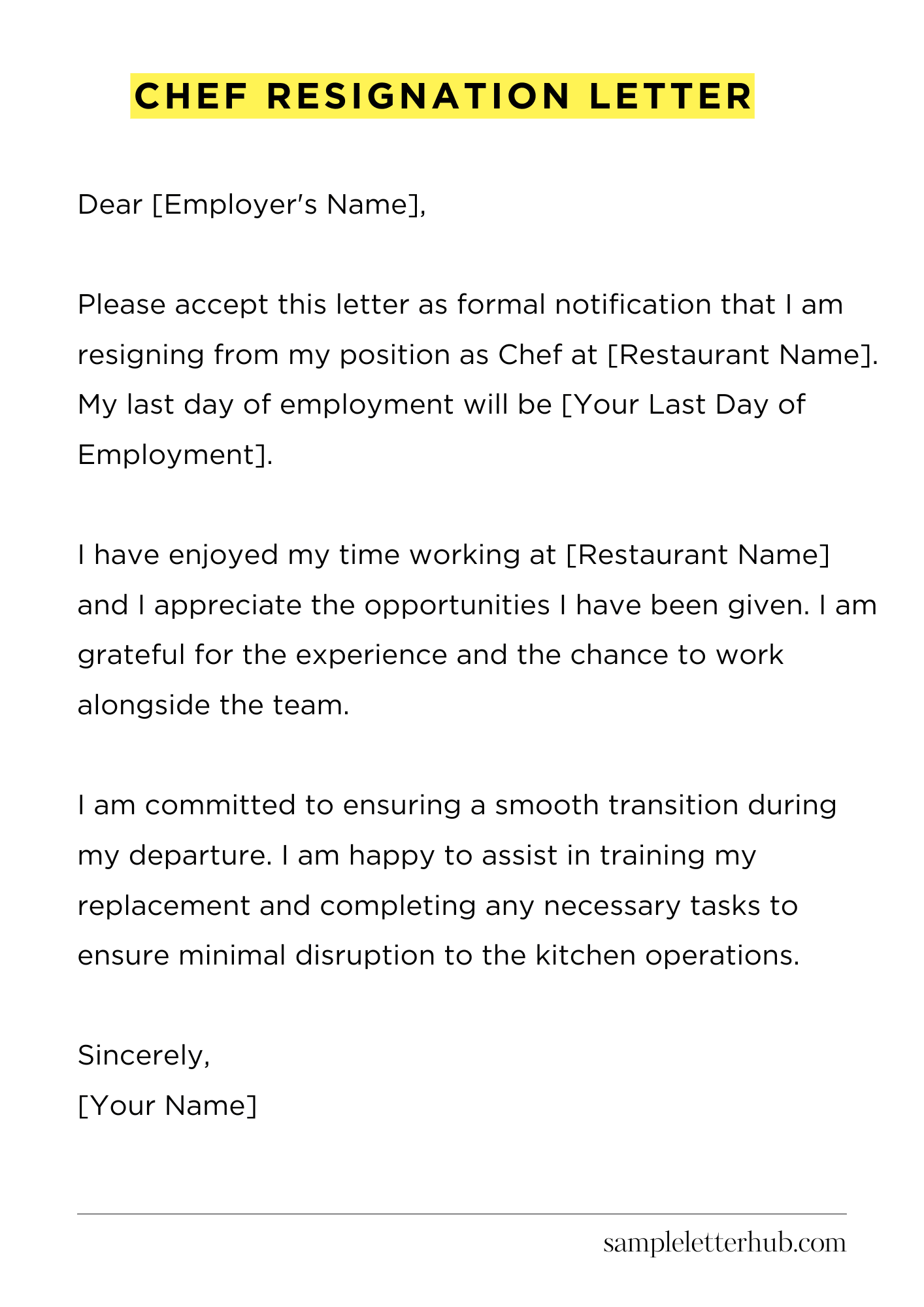
Dear [Employer’s Name],
Please accept this letter as formal notification that I am resigning from my position as Chef at [Restaurant Name]. My last day of employment will be [Your Last Day of Employment].
I have enjoyed my time working at [Restaurant Name] and I appreciate the opportunities I have been given. I am grateful for the experience and the chance to work alongside the team.
I am committed to ensuring a smooth transition during my departure. I am happy to assist in training my replacement and completing any necessary tasks to ensure minimal disruption to the kitchen operations.
I wish you and [Restaurant Name] all the best in the future.
Sincerely,
[Your Name]
How to Write a Chef Resignation Letter
Leaving a job as a chef requires professionalism, even when you’re moving on. Your resignation letter is a formal document. It is your final written impression. Getting it right is crucial.
Whether you’re moving to a new restaurant, starting your own venture, or simply seeking a change, a well-crafted letter can ensure a smooth transition and maintain positive relationships.
1. Start with a Clear and Direct Statement
The very first paragraph should state your intention clearly. Be upfront. Avoid ambiguity. Indicate the date of your last day of employment. This is critical for HR and management to process your departure. A vague statement can cause confusion. Keep it simple and to the point.
For example, you could start with something like: “Please accept this letter as formal notification that I am resigning from my position as Chef at [Restaurant Name], effective [Your Last Day of Employment].” This leaves no room for misinterpretation. It is a matter of respect. It sets the tone for the rest of your letter.
2. Express Gratitude and Acknowledge Your Experience
Even if you’re leaving due to negative experiences, express gratitude. Acknowledge the opportunity you were given. You can mention specific positive aspects of your time at the restaurant.
Mentioning skills gained or experiences had will go a long way. This is not about being fake; it’s about maintaining a professional demeanor. This demonstrates your professionalism.
You might write: “I am grateful for the opportunity to have worked at [Restaurant Name] for the past [Duration]. I appreciate the experience I have gained in [Mention Specific Skills or Areas].” This shows that you value your time there. This makes a better impression.
3. Provide a Reason (If You Choose To)
You’re not obligated to give a detailed explanation for your departure. However, you might choose to offer a brief, general reason. Keep it positive or neutral. Avoid negativity or personal complaints. If you have a legitimate reason, you can briefly mention it without being overly specific.
Consider something like: “I am pursuing a new opportunity that aligns with my long-term career goals.” Or, “I have decided to focus on personal and professional development.”
These are vague, but respectful. They don’t open the door for counterarguments or negativity. Keep in mind that you don’t want to burn bridges. Professionalism is vital.
4. Offer Assistance with Transition
Show your commitment. Demonstrate your professionalism. Offer to assist with the transition. This includes training a replacement or completing ongoing projects. This demonstrates your dedication. It reinforces your professionalism. This is highly regarded.
You could add: “I am available to assist with the transition process and to train my replacement during my remaining time here.” This offers practical help. It shows you’re committed to a smooth handover. This is the mark of a valuable employee.
5. End with a Professional Closing and Contact Information
Conclude your letter professionally. Reiterate your gratitude. Restate your last day. Include your contact information. This ensures easy communication. This reinforces a positive impression. Ensure the tone is warm but formal. Consider it a handshake, the final statement.
An example of a final paragraph could be: “Thank you again for the opportunity. I wish you and [Restaurant Name] continued success. Please feel free to contact me at [Your Email Address] or [Your Phone Number] if you need assistance. My last day of employment will be [Your Last Day].” Make sure to sign the letter.
FAQs about Chef resignation letter
How do I write a chef resignation letter?
A chef resignation letter should be professional and concise. Start by formally stating your resignation and the effective date. Express gratitude for the opportunity to work there and briefly mention any positive experiences. It’s often helpful to avoid negative comments.
You can keep it simple by providing your contact information and offering assistance with the transition. Proofread your letter carefully for any errors.
What should I include in a chef resignation letter?
The key elements of a chef resignation letter are: a clear statement of your resignation, the date your resignation becomes effective, a brief expression of gratitude to the employer (for opportunities or training), and the signature with your name. You can also include your contact information.
You may want to offer to help with the transition. However, avoid going into the details about why you are leaving.
What is the appropriate notice period for a chef?
The standard notice period for a chef is typically two to four weeks. However, this may vary depending on your employment contract or local labor laws. Check your contract and any employee handbook for specific requirements. If nothing is specified, a two-week notice is generally acceptable.
More senior chefs or those in management positions may be expected to give longer notice periods.
Can I provide a reason for leaving in my resignation letter?
While you can provide a brief reason for leaving, it is not always necessary. Keeping the letter positive is usually best. If you choose to give a reason, keep it brief and professional. Common reasons include accepting a new job, pursuing personal goals, or seeking a better work-life balance. Avoid negative comments about your current employer.
How can I ensure my chef resignation letter is professional?
To ensure your resignation letter is professional, use formal language and maintain a respectful tone. Avoid making complaints or criticisms. Proofread your letter carefully for grammar and spelling errors. Keep it concise and to the point. Deliver the letter in person if possible and follow up with your manager to confirm receipt.
Related:
Resignation letter due to rude boss
Resignation letter moving to another state
Resignation letter due to illness of family member
Resignation letter due to study