

Sometimes, an Electrical Engineer needs to resign from their job. A resignation letter makes this official. It formally communicates their departure to their employer. This letter is a professional way to end employment.
We understand writing these letters can be tricky. That’s why we’re here to help. This article offers several templates. They cover various scenarios you might face.
Ready to get started? We’ve got samples for different situations. Use these examples to craft your perfect resignation letter. Make your exit smooth and professional.
Electrical Engineer Resignation Letter
Below is a sample of a Electrical Engineer Resignation Letter:
[Your Name]
[Your Address]
[Your Phone Number]
[Your Email Address]
[Date]
[Employer’s Name]
[Company Name]
[Company Address]
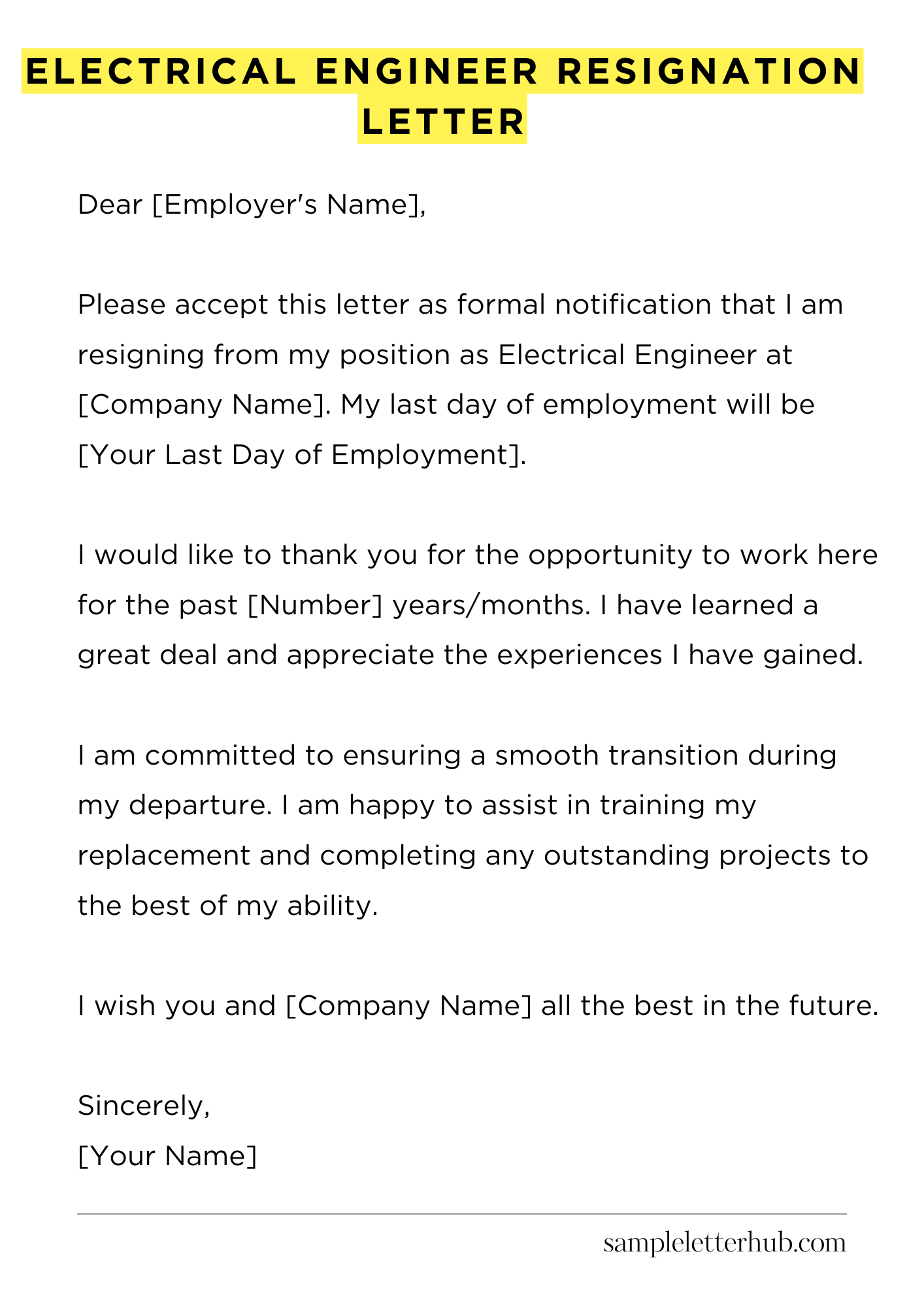
Dear [Employer’s Name],
Please accept this letter as formal notification that I am resigning from my position as Electrical Engineer at [Company Name]. My last day of employment will be [Your Last Day of Employment].
I would like to thank you for the opportunity to work here for the past [Number] years/months. I have learned a great deal and appreciate the experiences I have gained.
I am committed to ensuring a smooth transition during my departure. I am happy to assist in training my replacement and completing any outstanding projects to the best of my ability.
I wish you and [Company Name] all the best in the future.
Sincerely,
[Your Name]
How to Write Electrical Engineer Resignation Letter
Resigning from a job, especially as an Electrical Engineer, can feel daunting. You’ve invested time and effort. You’ve built relationships. But sometimes, it’s time to move on. Writing a clear, professional resignation letter is crucial. It’s more than just a formality; it sets the tone for your departure and can influence future opportunities.
1. Keep it Concise and Clear
Get straight to the point. State your intention to resign from your position as an Electrical Engineer. Clearly mention your last day of employment. Avoid unnecessary fluff or lengthy explanations. A simple, direct approach demonstrates professionalism. Your employer needs a straightforward message.
For example: “Please accept this letter as formal notification that I am resigning from my position as Electrical Engineer, effective [Your Last Day of Employment].” This is effective.
2. Express Gratitude (It’s Important!)
Even if the job wasn’t perfect, showing appreciation is key. Thank your employer for the opportunity to work there. Mention any specific experiences you found valuable, or skills you’ve developed. A little gratitude goes a long way. It’s a sign of maturity and leaves a positive lasting impression.
Consider something like: “I am grateful for the opportunities I’ve been given at [Company Name] over the past [Number] years/months. I have particularly valued my experience on the [Project Name] project and the skills I’ve gained.”
3. Address Handover and Transition
Offer your assistance in the transition process. This demonstrates commitment and responsibility. Offer to help train your replacement, complete any outstanding tasks, or provide any necessary documentation. This makes the process smoother for everyone involved. Your willingness to help reflects well on your character.
You could add a line like: “I am committed to ensuring a smooth transition. I am happy to assist in training my replacement and completing any outstanding projects before my departure.” It shows you’re a team player.
4. Maintain a Professional Tone
Refrain from negativity. Don’t dwell on any frustrations or grievances you may have had. Even if you’re leaving due to negative circumstances, keep your tone positive and professional. Remember, you want to leave a good impression. Your resignation letter is a reflection of you.
Focus on the positives: your growth and the value you gained. This helps you build bridges, not burn them.
5. Review and Proofread Carefully
Before submitting, proofread your letter meticulously. Check for any grammatical errors, spelling mistakes, and punctuation issues. Errors can undermine your professionalism. Have someone else read it over for a fresh perspective. Accuracy is vital. A polished letter shows that you care about the details.
Ensure it’s properly formatted, with a clear heading (your name, address, date, and the recipient’s information) and a professional closing (e.g., “Sincerely,” or “Best Regards,”). Get this right!
FAQs about Electrical Engineer Resignation Letter
What essential information should be included in an Electrical Engineer’s resignation letter?
An effective resignation letter should include your formal resignation, stating your last day of employment. It’s crucial to state your role clearly and specify the date you intend to depart.
A brief expression of gratitude for the opportunity is a polite and professional touch. It’s also advisable to state your willingness to assist in the transition of your responsibilities. Finally, ensure you sign and date the letter.
How much notice should an Electrical Engineer typically give when resigning?
The standard notice period is usually two weeks, but this can vary depending on your employment contract or company policy. Check your employment agreement for specific requirements. Larger organizations or senior roles might require a longer notice period, often 30 days or more. Providing as much notice as possible is generally considered professional.
Should an Electrical Engineer’s resignation letter include the reason for leaving?
While not strictly required, you can briefly state the reason for leaving, but it’s not compulsory. Reasons can be general, such as “pursuing a new opportunity” or “seeking career advancement.” Avoid overly detailed negative comments. If you have a positive reason, like starting your own venture, you can mention it. Keep it concise and professional.
What is the best way to deliver an Electrical Engineer’s resignation letter?
Typically, the best approach is to hand deliver a physical copy of the letter to your direct supervisor or HR department. It’s a good practice to follow up with an email confirmation as well. Always keep a copy of your resignation letter for your records. This ensures you have a record of your official communication and its content.
Can an Electrical Engineer’s resignation letter be used as a reference for future job applications?
Generally, a resignation letter is not used as a direct reference. It’s a formal notification of your departure, not a recommendation. However, the professionalism and clarity of your letter can indirectly reflect on you.
Employers typically request references from previous supervisors or colleagues, separate from your resignation. The tone you set in your letter can still influence how your former employer views your departure.
Related:
Resignation letter due to rude boss
Resignation letter moving to another state
Resignation letter due to illness of family member
Resignation letter due to study