

A Senior Research Associate resignation letter is a formal document. It is used to inform an employer about leaving a job. The letter officially states your intention to resign. It also typically includes the last day of employment.
This article is designed to help. We’ve compiled various templates. You’ll find different examples of resignation letters. These samples can make your writing easier. Crafting a professional letter becomes simple.
We believe in making things straightforward. Our goal is to provide useful, ready-to-use options. Whether you need a simple or detailed letter, we have examples. Explore our collection and get started!
Senior Research Associate Resignation Letter
Below is a sample of a Senior Research Associate Resignation Letter:
[Your Name]
[Your Address]
[Your Phone Number]
[Your Email Address]
[Date]
[Hiring Manager Name] (If known, otherwise use title)
[Hiring Manager Title]
[Company Name]
[Company Address]
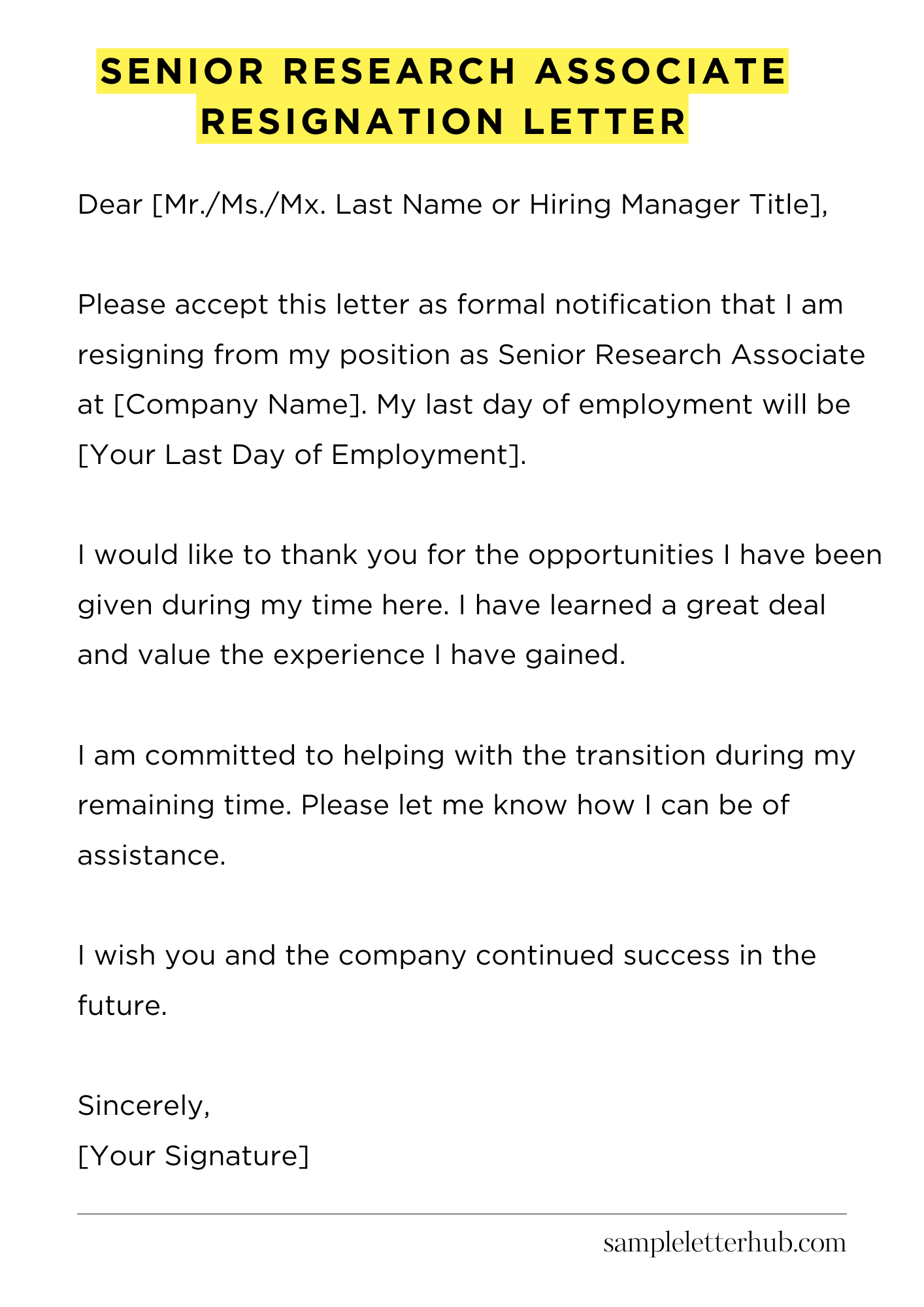
Dear [Mr./Ms./Mx. Last Name or Hiring Manager Title],
Please accept this letter as formal notification that I am resigning from my position as Senior Research Associate at [Company Name]. My last day of employment will be [Your Last Day of Employment].
I would like to thank you for the opportunities I have been given during my time here. I have learned a great deal and value the experience I have gained.
I am committed to helping with the transition during my remaining time. Please let me know how I can be of assistance.
I wish you and the company continued success in the future.
Sincerely,
[Your Signature]
How to Write a Senior Research Associate Resignation Letter
So, you’re moving on. Leaving the world of senior research behind for a new chapter. That’s great! It’s time to craft a resignation letter that is both professional and leaves a positive lasting impression.
This is important. You want to maintain good relationships with your former colleagues, potentially for future collaborations or references. Let’s get started, shall we?
1. Keep it Short and Sweet (and Formal!)
Your resignation letter isn’t the place for a novel. Get straight to the point. State your intent to resign, your position (Senior Research Associate), and your last day of employment.
This is crucial information right up front. Use a formal tone. This isn’t a casual email to a friend. Begin with a polite salutation, such as “Dear [Manager’s Name],” and close with a professional sign-off, like “Sincerely,” or “Respectfully,” followed by your full name. Remember to keep the tone positive and focused on the future.
Think about it: brevity and clarity are key.
2. Express Your Gratitude (with Specifics!)
While you’re leaving, show your appreciation for the opportunity. Mention specific experiences or skills you gained during your tenure. Did you enjoy a particular project? Did a colleague offer guidance? A little bit of personalization goes a long way. This demonstrates professionalism.
This highlights that you value the experience. Generic statements like “Thank you for the opportunity” can feel impersonal. Concrete examples are much stronger. Try to make it impactful!
This shows gratitude and is incredibly thoughtful.
3. Be Helpful in the Transition
Offer your assistance during the transition period. Are you willing to help train your replacement? Are you available to answer questions? Providing a helping hand is a mark of a good employee.
This makes the transition smoother for your colleagues. It reflects positively on you and solidifies that you are professional and considerate. Be realistic about what you can offer, of course.
Consider what you can realistically do in the time you have left.
4. Address Any Outstanding Obligations
Don’t leave loose ends. Briefly mention the status of any ongoing projects or responsibilities. Will you complete specific tasks before your departure? Acknowledge any deadlines or deliverables.
This demonstrates responsibility and ensures a seamless handover. This shows your commitment to your current position, even on your way out the door. It makes your final departure easier.
Properly wrapping up your current responsibilities will save trouble for others.
5. Proofread, Proofread, Proofread!
This is extremely important. Before you hit send or print, carefully proofread your letter. Check for grammatical errors, typos, and formatting inconsistencies.
Ensure the tone is appropriate for a formal communication. Have a colleague review it too. A polished letter reflects professionalism. It is not difficult to spell check and review your work.
One final look-over will make it perfect!
FAQs about Senior Research Associate resignation letter
How should I start my Senior Research Associate resignation letter?
Begin with a professional and direct approach. State your intention to resign from your position as Senior Research Associate clearly in the first paragraph. Include the effective date of your resignation. Also, it’s customary to address the letter to your immediate supervisor or the appropriate HR representative.
What key information must be included in the letter?
The most crucial details are your formal resignation, the last day of your employment, and a brief expression of gratitude for the opportunity. You may also state your reason for leaving, though this isn’t mandatory. Ensure all dates and job titles are accurate. Proofread carefully before submission.
Should I provide a reason for my resignation in the letter?
While providing a reason isn’t always required, it can be beneficial. Briefly mentioning your reason (e.g., pursuing a new opportunity, personal reasons, career advancement) can help your employer understand your decision. Keep it concise and professional.
How do I express gratitude in my resignation letter?
Expressing gratitude is an important aspect of your resignation. Acknowledge the opportunities you’ve been given, the skills you’ve developed, and the relationships you’ve built. Thank your supervisor, colleagues, and the organization for the experience and support.
What should I do after submitting my resignation letter?
After submitting your letter, follow up with your supervisor to discuss the transition plan. Offer your assistance in training a replacement or completing ongoing projects. Adhere to your employer’s offboarding procedures and maintain a professional demeanor throughout the notice period.
Related:
Resignation letter due to rude boss
Resignation letter moving to another state
Resignation letter due to illness of family member
Resignation letter due to study