

An executive resignation letter is a formal document. It announces an executive’s departure from a company. The letter officially communicates the resignation. It typically outlines the effective date of leaving.
This can be a tricky thing to do. We understand. That’s why we’re here to help. We’ve compiled various templates. We’ll share a range of samples. This will guide you.
Use these examples as a starting point. Adapt them to fit your specific situation. Writing your resignation letter will be much easier.
Executive Resignation Letter
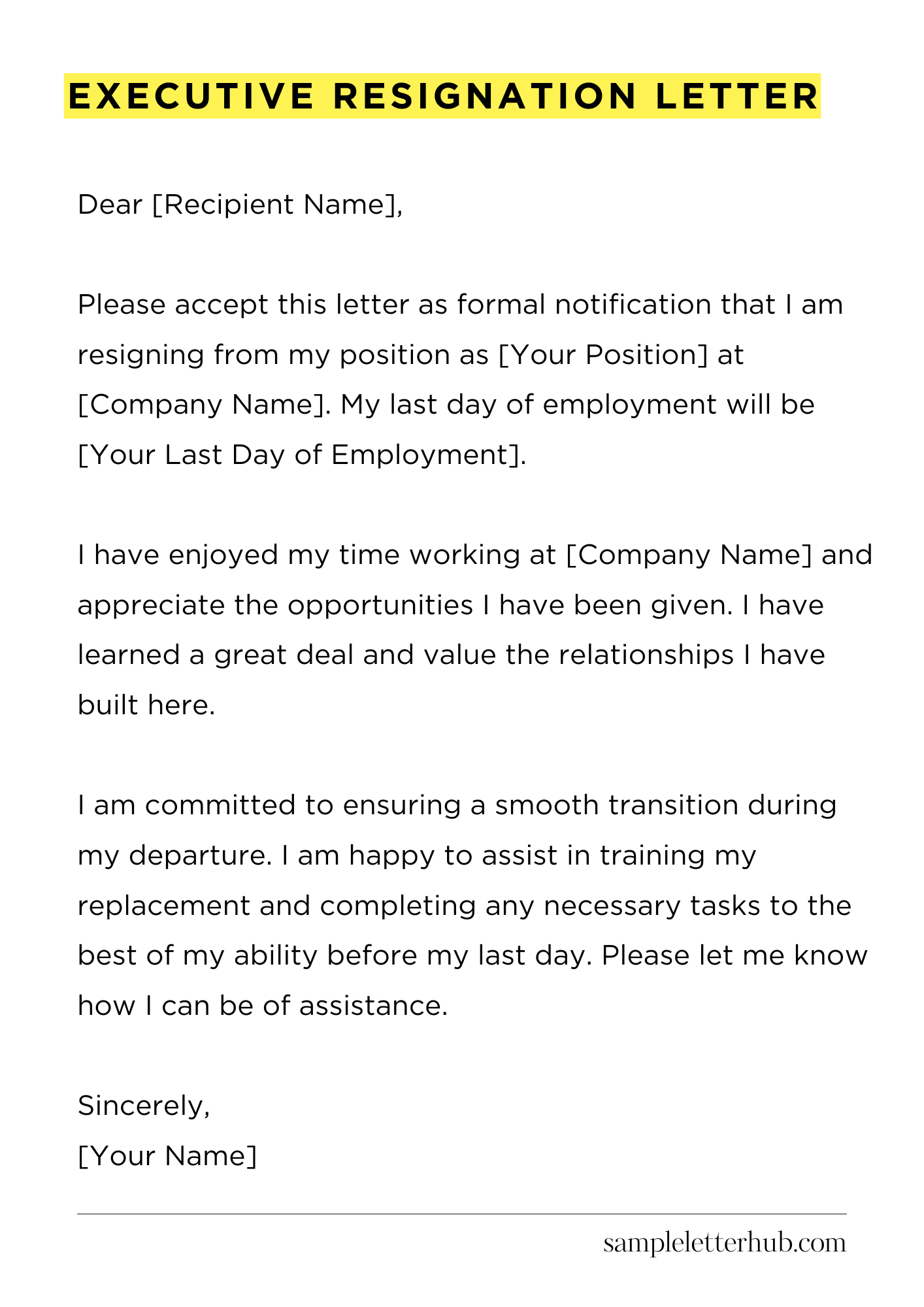
Below is a sample of a Executive Resignation Letter:
[Your Name]
[Your Address]
[Your Phone Number]
[Your Email Address]
[Date]
[Recipient Name]
[Recipient Title]
[Company Name]
[Company Address]
Dear [Recipient Name],
Please accept this letter as formal notification that I am resigning from my position as [Your Position] at [Company Name]. My last day of employment will be [Your Last Day of Employment].
I have enjoyed my time working at [Company Name] and appreciate the opportunities I have been given. I have learned a great deal and value the relationships I have built here.
I am committed to ensuring a smooth transition during my departure. I am happy to assist in training my replacement and completing any necessary tasks to the best of my ability before my last day. Please let me know how I can be of assistance.
I wish you and [Company Name] continued success in the future.
Sincerely,
[Your Name]
How to Write an Executive Resignation Letter
Resigning from an executive position is a significant step. It’s a high-stakes moment that requires careful consideration and, most importantly, a well-crafted resignation letter.
This isn’t just about saying “I quit.” It’s about maintaining professionalism, protecting your reputation, and setting the stage for a smooth transition. Done right, your letter can open doors for you. Do it wrong, and it could slam them shut.
1. Keep it Concise and Clear
Your executive resignation letter isn’t the place for a novel. Keep it brief, usually one page. Focus on the essentials. State your intention to resign. Specify the effective date of your resignation.
That’s the core of it. Avoid unnecessary emotional language or lengthy explanations that aren’t vital to the departure itself. Clarity is key. Make sure your message is crystal clear to the reader.
2. Express Gratitude and Professionalism
Even if your time at the company hasn’t been perfect, your letter should reflect gratitude. Acknowledge the opportunities you’ve been given. Thank the individuals who have supported you, mentored you, or contributed to your professional growth.
This shows respect, and it’s simply good business etiquette. Keep your tone professional, even if you are leaving under less-than-ideal circumstances. Burning bridges never looks good in the long run. Professionalism will always serve you well.
3. Address the Transition Plan
As an executive, you understand the need for a smooth transition. Your letter is the place to signal your willingness to assist with that process. Offer your help in training your successor, completing outstanding projects, or transferring knowledge.
Be specific about the kind of support you can provide during your notice period. This helps demonstrate your commitment and respect for the company, as well as minimizing disruption during your departure. Consider your notice period. Have all the details planned in advance.
4. Maintain Confidentiality and Avoid Negativity
This is not the moment to air grievances or spill company secrets. Avoid mentioning any sensitive information or confidential data. Refrain from making negative comments about the company, your colleagues, or the leadership.
This behavior is unprofessional and can damage your reputation. Keep your letter positive and future-focused. Focus on what you are leaving for, not what you are leaving from.
5. Review and Proofread Meticulously
Before you send your letter, review it with a critical eye. Ensure the tone is appropriate for your role, that all the information is accurate, and that there are no grammatical errors or typos.
Consider having a trusted colleague or friend read it over as well. A second pair of eyes can often catch mistakes you might have missed. Proofreading is very important. A polished letter shows that you put your best foot forward at all times.
FAQs about Executive Resignation Letter
What is the primary purpose of an executive resignation letter?
The primary purpose of an executive resignation letter is to formally communicate an executive’s intent to leave their position with an organization. It serves as a legal document that officially begins the separation process and provides a clear record of the departure date and any associated terms, such as notice period or handover arrangements.
What key elements should always be included in an executive resignation letter?
Essential elements include a clear and concise statement of resignation, the effective date of resignation, and a professional tone. It is also wise to include a brief statement of gratitude for the opportunity, and to mention any assistance you will provide during the transition period. Avoid any negativity or criticism of the company or its employees.
How much notice period is typically required for an executive resignation?
The required notice period for an executive resignation is typically specified in the employment contract. It’s often longer than that required for non-executive employees, potentially ranging from one month to six months or even longer, depending on the role, the company’s needs, and the contract terms.
It is essential to refer to the employment agreement to determine the exact notice period.
What are some of the potential consequences of not providing adequate notice or following the proper resignation procedures?
Failure to provide the required notice period or adhere to the resignation procedures outlined in the employment contract can lead to several consequences.
These may include forfeiture of any remaining bonuses or unvested stock options, potential legal action by the company for breach of contract, or damage to your professional reputation. Also, it might impact future job prospects.
Should an executive resignation letter be reviewed by a legal professional?
Yes, it’s highly recommended that an executive resignation letter be reviewed by a legal professional, particularly given the implications of the role.
An attorney can review the letter to ensure compliance with the employment contract, applicable laws, and to help protect the executive’s interests. They can also advise on any potential liabilities or risks associated with the resignation.
Related:
Resignation letter due to rude boss
Resignation letter moving to another state
Resignation letter due to illness of family member
Resignation letter due to study