

An artist resignation letter is a formal notice. It tells your employer you are leaving your job. Its main purpose is to officially communicate your departure. It also helps in a smooth transition.
Preparing to leave a creative role can be tough. Crafting the right words can feel overwhelming. We understand this. That’s why we’ve compiled a collection of templates.
You’ll find sample resignation letters here. These can serve as starting points. Adapt them to fit your specific situation. Writing your own letter just got easier!
Artist Resignation Letter
Below is a sample of a Artist Resignation Letter:
[Your Name]
[Your Address]
[Your Phone Number]
[Your Email Address]
[Date]
[Employer’s Name]
[Company Name]
[Company Address]
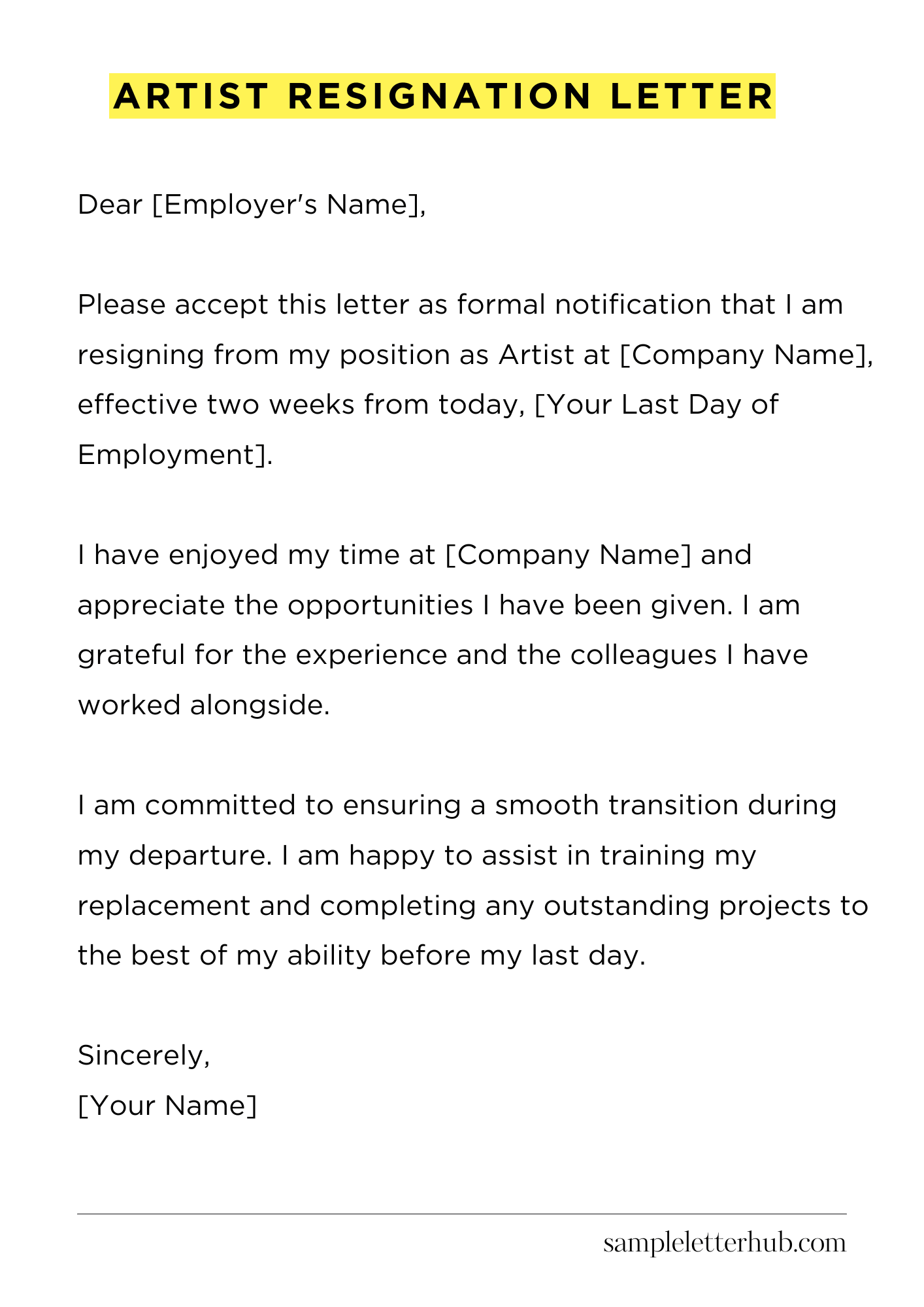
Dear [Employer’s Name],
Please accept this letter as formal notification that I am resigning from my position as Artist at [Company Name], effective two weeks from today, [Your Last Day of Employment].
I have enjoyed my time at [Company Name] and appreciate the opportunities I have been given. I am grateful for the experience and the colleagues I have worked alongside.
I am committed to ensuring a smooth transition during my departure. I am happy to assist in training my replacement and completing any outstanding projects to the best of my ability before my last day.
Thank you for your understanding. I wish you and the company all the best in the future.
Sincerely,
[Your Name]
How to Write an Artist Resignation Letter
Getting Started: Why a Proper Letter Matters
You’ve decided it’s time to move on. That’s a big step! Leaving a role as an artist, whether it’s in a gallery, studio, or a larger company, requires professionalism.
This is something that should be done respectfully. Writing a proper resignation letter isn’t just about fulfilling a formality. It’s about protecting your reputation and ensuring a smooth transition. Think of it as a bridge, not a burnt one.
A well-crafted letter demonstrates your consideration for those you’re leaving behind. It shows you appreciate your time at the company, and maintains a positive relationship for the future. Consider your industry; it’s often a small world. You don’t want to burn any bridges. Trust me on this one. It’s really that simple.
What to Include: The Essential Ingredients
So, what should you put in your letter? It boils down to a few key elements. First, and foremost, state your intention to resign clearly. Be direct. Don’t beat around the bush; specify the date your resignation will be effective. Include your name, title, and the date of the letter. This is pretty important.
Express gratitude for the opportunity. Mention something specific you enjoyed about your time at the job. This shows you’re not just leaving because you dislike everything.
Briefly explain why you are leaving. Keep it short and neutral if you are not very happy. Avoid overly critical language! Finally, offer to assist with the transition. Offer help in training your replacement. They’ll probably appreciate the offer.
Structuring Your Letter: A Template to Follow
Here’s a basic framework to get you started. Begin with a formal salutation, like “Dear [Manager’s Name]”. Then, state your resignation clearly in the first paragraph. Something like, “Please accept this letter as formal notification that I am resigning from my position as [Your Job Title] at [Company Name], effective [Date].”
In the following paragraph, express your appreciation and mention a positive aspect of your experience. Then, provide a brief reason for leaving, or leave it vague. Finish with an offer to help with the transition.
Conclude with a professional closing, such as “Sincerely” or “Best Regards,” followed by your typed name and signature above it. This makes things easier.
Tone and Style: Keeping it Professional
Maintaining a professional tone is paramount. You are not writing a personal diary entry. Keep the language polite, respectful, and positive. Avoid negativity. Even if you’re unhappy with your job, there is no need to bad-mouth your former employers.
Proofread carefully. Check for any errors in spelling or grammar. Ensure clarity and conciseness. Your letter represents you. It’s your final impression. A well-written letter reflects positively on you and leaves a lasting impression.
After the Letter: What Comes Next
Once you’ve submitted your letter, be prepared for a response. Your manager might want to discuss your resignation. Be prepared to answer any questions honestly, but remain professional. During your remaining time, fulfill your duties to the best of your ability. A good attitude can go a long way.
Most importantly, don’t slack off in the remaining days. Demonstrate your commitment to completing your outstanding projects and helping with the transition. Maintaining a good reputation will greatly assist you in your next endeavor. This is really important to remember. Best of luck!
FAQs about Artist resignation letter
Why is it important to write a resignation letter as an artist?
Crafting a resignation letter is crucial for several reasons. Primarily, it serves as a formal and professional means of informing your employer or client about your decision to leave your position or project. It provides a clear and concise record of your departure, including the effective date of your resignation.
Furthermore, a well-written letter allows you to express your gratitude for the opportunity and maintain a positive relationship, which is essential for future references and networking within the art community.
What key elements should be included in an artist’s resignation letter?
A comprehensive resignation letter should include the following elements: a formal salutation, a clear statement of your intent to resign, the specific date your resignation is effective, a brief expression of gratitude for the opportunity, any necessary information regarding the handover of ongoing projects or responsibilities, your contact information, and a professional closing.
It’s often beneficial to keep the tone positive and avoid negative comments about the employer or situation.
How should an artist handle the handover process in their resignation letter?
When addressing the handover process, artists should be proactive. Indicate your willingness to assist in a smooth transition. Offer to provide necessary documentation, training, or support to ensure that your responsibilities are adequately covered.
Be specific about the tasks or projects you are currently working on and how you plan to complete or transition them. This demonstrates professionalism and a commitment to leaving the position on good terms.
What tone and language are best suited for an artist’s resignation letter?
The tone of your resignation letter should be professional, courteous, and appreciative. Use clear and concise language. Avoid overly emotional or accusatory statements, even if you are leaving due to negative experiences.
Expressing gratitude for the opportunity and highlighting any positive aspects of your time working in the role is usually preferable. Maintain a respectful tone, as the letter serves as a lasting record of your professional conduct.
Can an artist’s resignation letter be used as a reference for future opportunities?
While a resignation letter itself isn’t typically used as a direct reference, the professionalism and tone of your letter can influence your employer’s perception of you, indirectly affecting future reference requests.
Moreover, it’s generally a positive sign. By leaving on good terms and maintaining a respectful and appreciative tone, you increase the likelihood of receiving a positive recommendation from your former employer or client. Always retain a copy for your personal records.
Related:
Resignation letter due to rude boss
Resignation letter moving to another state
Resignation letter due to illness of family member
Resignation letter due to study