

A correspondent resignation letter is a formal document. Its purpose is to officially announce your departure. You communicate your intention to leave your current role. It’s a key step in ending your employment professionally.
Crafting the perfect resignation can be tricky. We’ve got you covered. We’re sharing different templates here. You’ll find examples for various situations. These samples will make the process easier.
Ready to resign with confidence? Explore the examples provided. Adapt them to your specific needs. Let’s make writing your letter a breeze.
Correspondent Resignation Letter
Below is a sample of a Correspondent Resignation Letter:
[Your Name]
[Your Address]
[Your Phone Number]
[Your Email Address]
[Date]
[Recipient Name]
[Recipient Title]
[Company Name]
[Company Address]
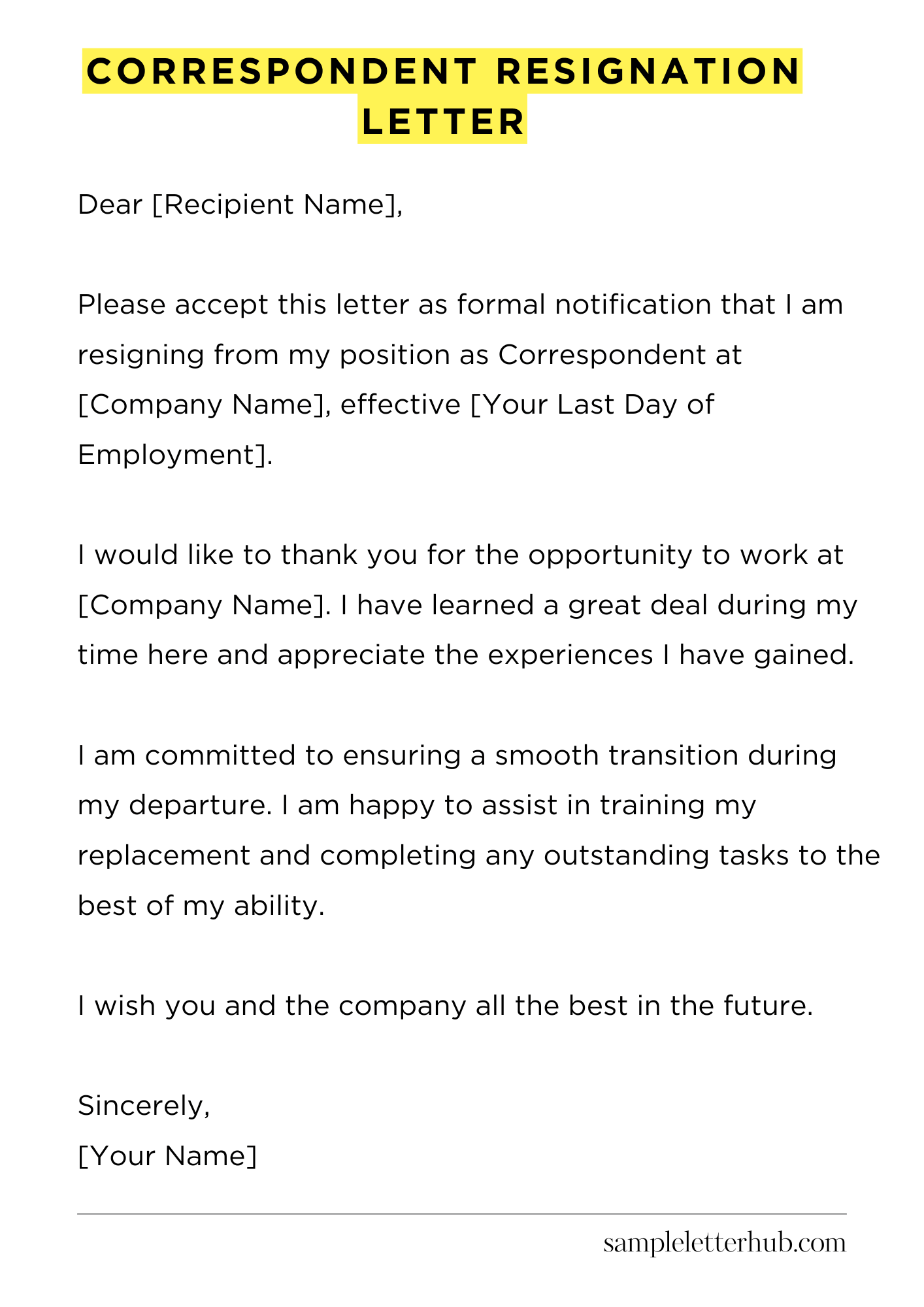
Dear [Recipient Name],
Please accept this letter as formal notification that I am resigning from my position as Correspondent at [Company Name], effective [Your Last Day of Employment].
I would like to thank you for the opportunity to work at [Company Name]. I have learned a great deal during my time here and appreciate the experiences I have gained.
I am committed to ensuring a smooth transition during my departure. I am happy to assist in training my replacement and completing any outstanding tasks to the best of my ability.
I wish you and the company all the best in the future.
Sincerely,
[Your Name]
How to Write a Correspondent Resignation Letter
Leaving a job is a big decision. It can be even tougher when that role involves a certain degree of public facing responsibility, like that of a correspondent.
One of the most important things to consider when you decide to move on is your resignation.
This is because it’s a professional document that will have an impact on your relationship with your employer and potentially your future career prospects. So, you need to get it right. Here’s a breakdown on how to craft a strong, effective correspondent resignation letter.
1. Formalities: The Basics You Can’t Skip
Your letter needs to look professional from the start. First, use a standard business letter format. Start with your contact information (address, phone number, email) in the top left corner, followed by the date. Next, include the recipient’s information (name, title, and address) below the date.
Addressing the letter correctly is critical; always use the correct name and title of the person you are sending it to, usually your direct supervisor or the head of the department. Avoid generic greetings. A simple “Dear Mr./Ms. [Last Name]” is perfect.
2. The Core: Stating Your Intent and the Essentials
This is where you clearly state your intention to resign. This should be concise and direct. Mention the specific position you’re leaving and the effective date of your resignation.
For example: “Please accept this letter as formal notification that I am resigning from my position as [Your Position] effective [Date].” That’s clear. That’s effective. That’s all you need initially.
Be sure the effective date aligns with any contractual obligations or company policies regarding notice periods. Ensure you adhere to the notice period that your employment contract stipulates.
3. Gratitude & Professionalism: Leaving on a Positive Note
Even if you’re leaving for negative reasons, keep things professional. Express gratitude for the opportunities you’ve been given. Briefly mention anything specific you’ve appreciated about your time there. This shows maturity and respect, and can leave a positive lasting impression.
Examples could be, “I am grateful for the opportunities I’ve had to develop my skills.” or “I’ve valued the experience gained during my time with the organization.” This will go a long way.
4. Transitions & Assistance: Helping a Smooth Handover
Offering assistance with the transition shows consideration and helps maintain a positive relationship. Briefly state your willingness to help with the handover process.
This might include training a replacement, completing outstanding tasks, or providing any necessary documentation. Think about what you need to do, and write it out. For example, “I am happy to assist with the transition of my responsibilities and am available to train my replacement, as needed.” Offer your support. This is crucial.
5. Sign Off & Delivery: Making it Official
Close your letter formally. Use “Sincerely” or “Respectfully” followed by your typed name. Then, sign the letter physically and, where possible, deliver it in person. If an in-person delivery is impossible, email is acceptable. Ensure you keep a copy of the letter for your records. Remember, a well-written resignation letter can be the final impression you make. Make it a good one.
FAQs about Correspondent resignation letter
What is a Correspondent Resignation Letter?
A Correspondent resignation letter is a formal document written by a correspondent (e.g., a journalist, reporter, or contributor) to officially notify their employer (e.g., a news organization, publication, or media outlet) of their decision to resign from their position. It serves as a record of the employee’s departure and typically includes the effective date of resignation.
What should be included in a Correspondent Resignation Letter?
A comprehensive correspondent resignation letter should include: your name and contact information, the date, the name and contact information of the recipient (e.g., your supervisor or HR department), a clear statement of resignation, the specific date of your last day of employment, a brief expression of gratitude (optional, but recommended), and your signature.
It’s often beneficial to confirm the return of company property and outline any handover plans for ongoing projects if possible.
How much notice should I give when submitting a Correspondent Resignation Letter?
The amount of notice to give typically depends on your employment contract, company policy, and local labor laws. However, a general standard is to provide at least two weeks’ notice.
This allows for a smooth transition, the completion of ongoing work, and the handover of responsibilities. Reviewing your employment contract will clarify the specific requirements for your situation.
What are some common mistakes to avoid in a Correspondent Resignation Letter?
Common mistakes to avoid include: being overly negative or critical of the employer or colleagues, failing to state the resignation date clearly, omitting your contact information, or not returning company property.
Avoid burning bridges by remaining professional and polite, even if your departure is due to negative circumstances. Ensure the letter is free of grammatical errors and typos.
Should I provide a reason for resigning in my Correspondent Resignation Letter?
While not strictly required, stating a brief reason for your resignation is often a good practice. However, it’s generally best to keep the reason concise and positive. You might simply state that you are pursuing other opportunities or making a career change. If the reason is sensitive, it’s perfectly acceptable to state that you prefer not to disclose it.
Related:
Resignation letter due to rude boss
Resignation letter moving to another state
Resignation letter due to illness of family member
Resignation letter due to study