

A Quality Assurance Manager resignation letter is a formal document. It informs the employer of your intent to leave. The letter officially ends your employment. It also provides a date for your departure.
This article is about writing a compelling resignation letter. We understand this can be a difficult task. We have compiled a collection of templates. You can use these examples as a starting point.
Our goal is simple. We aim to help you craft the perfect letter. We provide various samples. Each caters to different situations. Let’s get started.
Quality Assurance Manager Resignation Letter
Below is a sample of a Quality Assurance Manager Resignation Letter:
[Your Name]
[Your Address]
[Your Phone Number]
[Your Email Address]
[Date]
[Hiring Manager Name] (If known, otherwise use title)
[Hiring Manager Title]
[Company Name]
[Company Address]
Dear [Mr./Ms./Mx. Last Name or Hiring Manager],
Please accept this letter as formal notification that I am resigning from my position as Quality Assurance Manager at [Company Name]. My last day of employment will be [Your Last Day of Employment].
I would like to thank you for the opportunity to work at [Company Name]. I have enjoyed my time here and have learned a great deal. I appreciate the experience I have gained in this role.
I am committed to ensuring a smooth transition during my departure. I am happy to assist in training my replacement and completing any outstanding tasks to the best of my ability. Please let me know how I can be of help.
I wish you and [Company Name] all the best in the future.
Sincerely,
[Your Signature]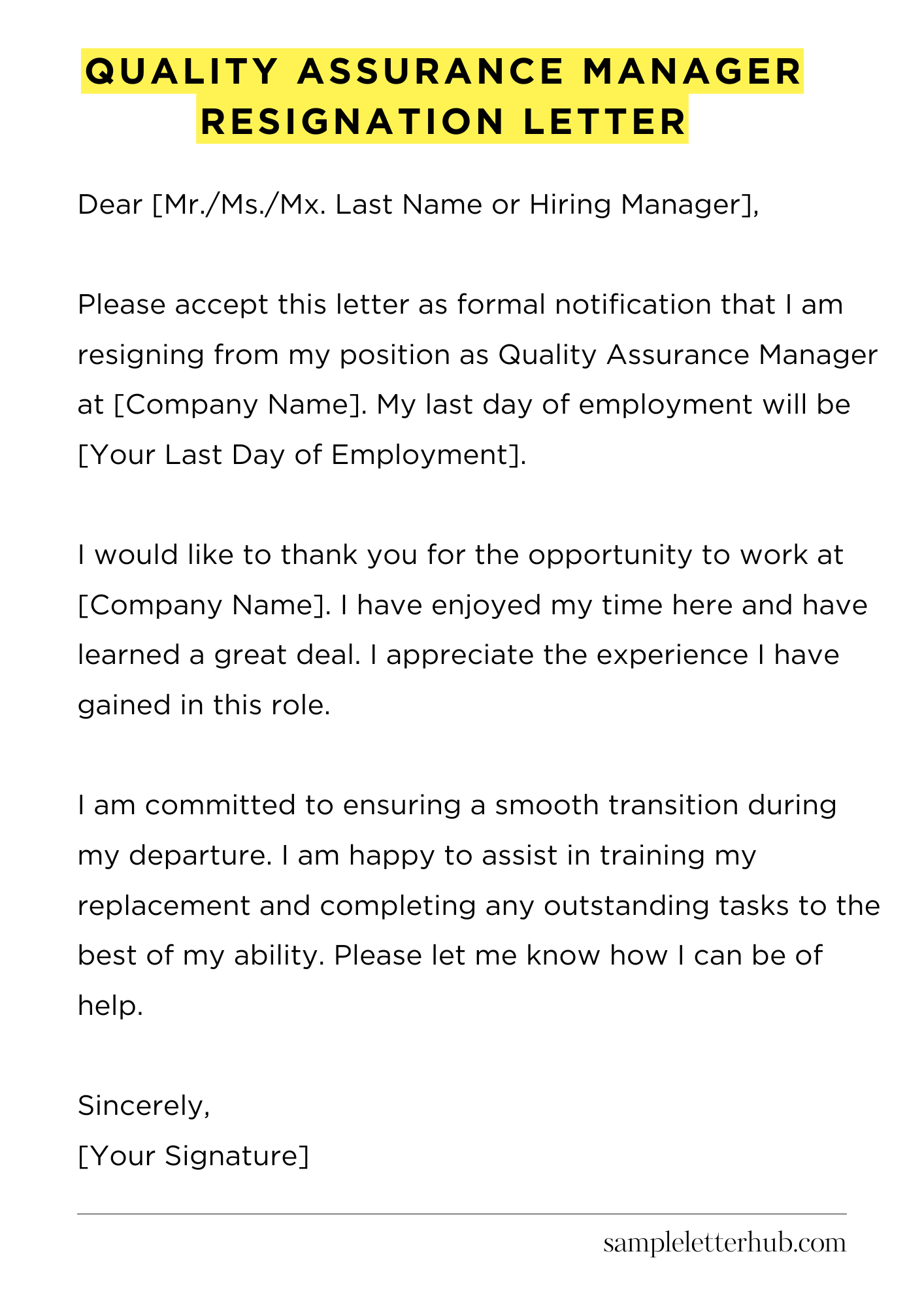
How to Write a Quality Assurance Manager Resignation Letter
1. Preparation is Key: Before You Begin
So, you’ve decided to move on. That’s a big step! Before you even think about putting pen to paper (or fingers to keyboard), take some time to prepare.
First, review your employment contract. Understand the specifics of your notice period. This is crucial to avoid any potential legal issues. Next, consider your reasons for leaving. Are you seeking new opportunities? A better work-life balance? Higher pay? Keep these reasons in mind, but aim for a tone of professionalism, even if the reality is far more complex.
A little reflection goes a long way. Think about what you want to convey in your letter. What details do you want to share? What do you want to avoid? Taking this time to plan will make the writing process smoother, and the final result more effective.
2. Structure and Format: The Building Blocks of a Great Letter
A well-structured letter is a sign of respect and professionalism. Your letter should follow a standard business letter format. Start with your contact information, the date, and the recipient’s information (usually your manager’s name and title). Use a formal salutation, such as “Dear [Manager’s Name]”.
The main body of your letter should be concise and direct. Begin with a clear statement of your resignation. State your last day of employment. Then, briefly express your gratitude for the opportunities you’ve been given. Keep it simple and easy to understand. Be sure to end with a professional closing, such as “Sincerely” or “Respectfully”.
3. Crafting the Content: What to Say and How to Say It
The core of your letter lies in the content. Start with a clear and concise statement of your intention to resign. For example, “Please accept this letter as formal notification that I am resigning from my position as Quality Assurance Manager, effective [Your Last Day of Employment].”
Next, express your gratitude for the opportunity to work at the company. Mention any specific experiences or skills you’ve gained, if relevant.
You may also choose to offer assistance during the transition period. This can be as simple as, “I am committed to ensuring a smooth handover of my responsibilities and am available to assist in any way possible during my remaining time here.” Refrain from making negative comments about the company or its employees.
Always maintain a positive and professional tone. A bit of professionalism will leave a good taste.
4. Proofreading and Editing: The Final Polish
Proofreading is essential! This is your last chance to catch any errors. Read your letter carefully, multiple times. Check for grammar, spelling, and punctuation mistakes. Don’t rely solely on spellcheck; it won’t catch everything. Have a colleague or friend review it as well. Fresh eyes often spot things you might miss.
Pay close attention to the tone. Is it professional and respectful? Does it accurately reflect your intentions? Ensure your letter is easy to read and understand. Remember, this is a formal document, so clarity is key. A polished letter reflects well on you and your professionalism.
5. Delivery and Follow-Up: The Finishing Touches
Once you’re happy with your letter, it’s time to deliver it. The best practice is to hand in your letter in person to your manager. This allows you to discuss your resignation in a private setting. If an in-person meeting isn’t possible, send your letter via email. Always keep a copy for your records.
After submitting your letter, be prepared for a conversation with your manager. They may ask about your reasons for leaving or try to negotiate. Remain professional and courteous during this discussion.
Finally, fulfill your commitments during your notice period. Assist with the transition, train your replacement, and leave on good terms. You never know when your paths might cross again!
FAQs about Quality Assurance Manager resignation letter
What is the primary purpose of a Quality Assurance Manager resignation letter?
The primary purpose of a Quality Assurance Manager resignation letter is to formally notify an employer of an employee’s intention to leave their position. It serves as a written record of the employee’s departure and typically includes the effective date of resignation.
What key elements should be included in a Quality Assurance Manager resignation letter?
Essential elements include a clear statement of resignation, the specific date of departure, a brief expression of gratitude for the opportunity, and potentially a statement regarding the willingness to assist with the transition. It should also include professional contact information if applicable.
How much notice should a Quality Assurance Manager give when resigning?
The standard notice period typically ranges from two to four weeks, but this can vary depending on company policy or the employment contract. It’s crucial to review the employment agreement to determine the required notice period. Adhering to the specified timeframe is important.
Is it necessary to provide a reason for resignation in the letter?
While not mandatory, briefly stating the reason for leaving can be beneficial. Reasons may include pursuing a new opportunity, personal circumstances, or career advancement. However, it’s generally best to keep the reason concise and professional.
How should a Quality Assurance Manager handle the transition of their responsibilities after submitting a resignation letter?
The departing manager should offer assistance in the transition process. This may include training a replacement, documenting key processes, or providing a handover report. Ensuring a smooth transition demonstrates professionalism and helps maintain a positive relationship with the former employer.
Related:
Resignation letter due to rude boss
Resignation letter moving to another state
Resignation letter due to illness of family member
Resignation letter due to study