

The “Executive Assistant to CEO resignation letter” is a formal document. It is a letter written by an Executive Assistant. Its purpose is to officially announce their departure from the company. It’s a key step in ending your employment.
This article will help you. We understand writing these letters can be tricky. We’ve got you covered with various templates. You’ll find examples of different resignation letters. They will suit various situations.
Consider these samples as your starting point. Use them as inspiration to craft your own perfect letter. They are designed to make the process easy. Writing your resignation will feel less daunting.
Executive Assistant To Ceo Resignation Letter
Below is a sample of a Executive Assistant To Ceo Resignation Letter:
[Your Name]
[Your Address]
[Your Phone Number]
[Your Email Address]
[Date]
[CEO’s Name]
[CEO’s Title]
[Company Name]
[Company Address]
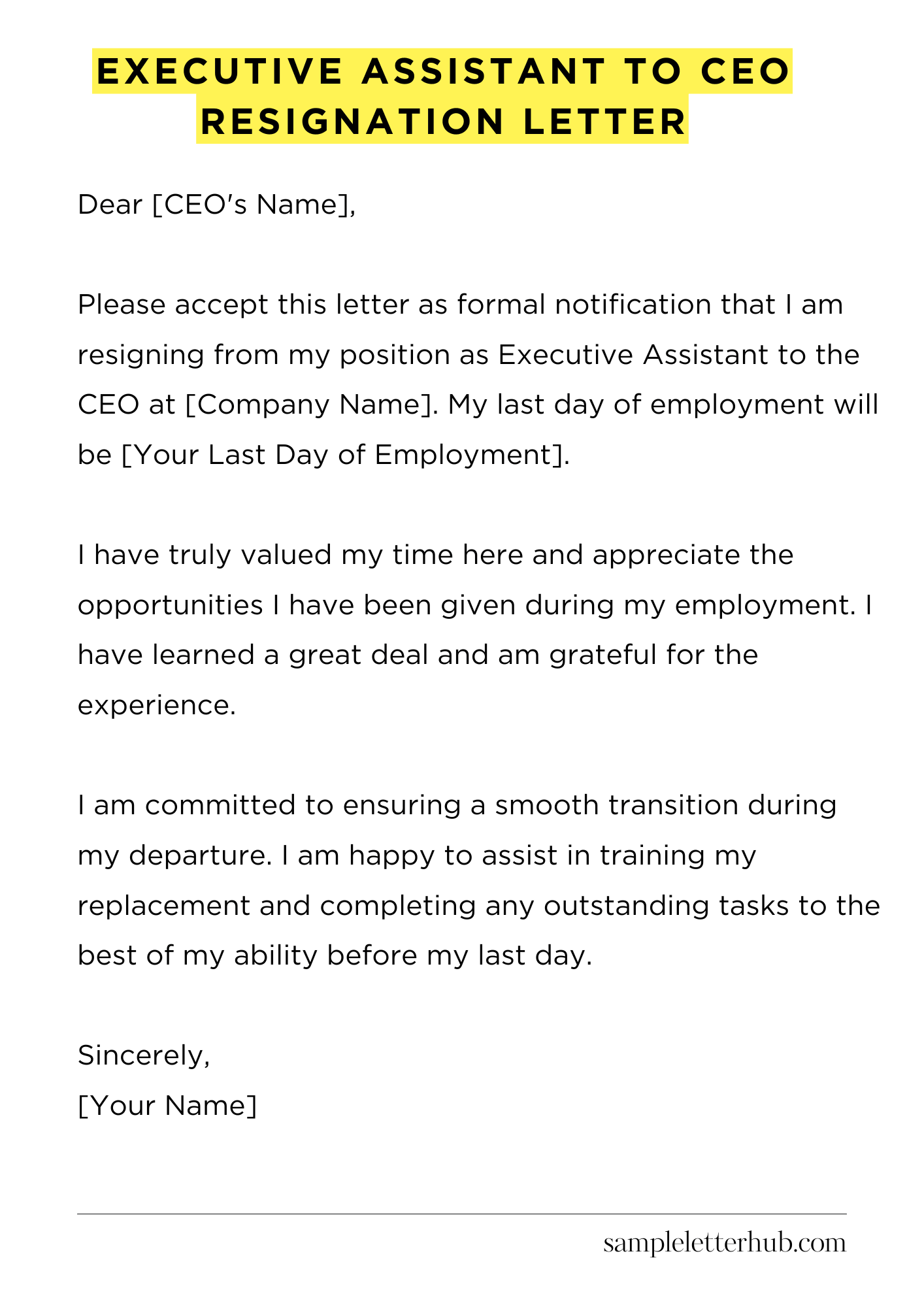
Dear [CEO’s Name],
Please accept this letter as formal notification that I am resigning from my position as Executive Assistant to the CEO at [Company Name]. My last day of employment will be [Your Last Day of Employment].
I have truly valued my time here and appreciate the opportunities I have been given during my employment. I have learned a great deal and am grateful for the experience.
I am committed to ensuring a smooth transition during my departure. I am happy to assist in training my replacement and completing any outstanding tasks to the best of my ability before my last day.
I wish you and [Company Name] all the best in the future.
Sincerely,
[Your Name]
How to Write an Executive Assistant to CEO Resignation Letter
Resigning from a position, especially one as high-profile as Executive Assistant to a CEO, requires a delicate approach. Your resignation letter serves as a formal declaration and leaves a lasting impression. It’s important to get it right. Here’s a guide to help you craft a professional and impactful resignation letter.
1. Formal Formatting: The Foundation of Professionalism
Your letter should scream professionalism. Begin by using formal business letter formatting. This means a clear structure with your contact information, the date, and the recipient’s information.
Use a standard business font like Times New Roman or Arial, and keep the font size consistent (typically 12 points). Keep it neat. Indent paragraphs appropriately and maintain consistent spacing throughout the document.
Consider using business letterhead, if applicable. Address the CEO directly by name using a formal salutation, such as “Dear Mr./Ms. [Last Name]”. Avoid slang or casual language.
2. The Core: Stating Your Resignation and Effective Date
The first paragraph is crucial, as this is where you announce your resignation. Be clear and concise. State your intention to resign from your position as Executive Assistant to the CEO.
Specify the effective date of your resignation. This is the last day of your employment.
This date is important. Ensure the date aligns with any existing agreements or company policies, and give sufficient notice, typically two weeks or as outlined in your employment contract. For instance: “Please accept this letter as formal notification that I am resigning from my position as Executive Assistant to the CEO, effective October 27, 2024.”
3. Expressing Gratitude and Highlighting Your Contributions
Acknowledging your experience and expressing gratitude is essential. Express your appreciation for the opportunity to work for the CEO and within the company. Reflect on the positive aspects of your time there.
Briefly mention any key contributions you made during your tenure. This is your chance to showcase your value. Mentioning a specific accomplishment subtly reminds them of your value and leaves a positive final impression.
For example, you could write: “I am grateful for the opportunities I’ve had during my time here and I’ve truly valued the experience. I particularly appreciated the chance to streamline the CEO’s scheduling and manage key projects.”
4. Offering Assistance with the Transition
Demonstrating a willingness to assist with the transition is a sign of professionalism and shows respect. Offer to help with the handover of your duties. This also helps ensure a smooth transition and reduces potential disruption.
Be specific about the assistance you are willing to provide. You can offer to train your replacement, compile documentation, or answer questions. However, remember to set boundaries. Don’t commit to more than you are comfortable with or is reasonable within your remaining timeframe.
You might write: “I am committed to ensuring a smooth transition. I am happy to assist in training my replacement and providing any necessary documentation before my departure.”
5. The Conclusion: A Professional and Positive Finish
Close your letter with a professional and positive statement. Reiterate your appreciation and wish the CEO and the company well for the future. Avoid negativity or any complaints.
Maintain a tone of respect and goodwill. End with a formal closing, such as “Sincerely” or “Respectfully,” followed by your full name and signature (if submitting a hard copy) or typed name.
Before sending your letter, proofread it carefully to ensure there are no errors in grammar or spelling. A polished letter reflects your professionalism and leaves a lasting positive impression. Always keep a copy for your records.
FAQs about Executive Assistant To CEO Resignation Letter
What is the primary purpose of an Executive Assistant to CEO resignation letter?
The primary purpose of a resignation letter from an Executive Assistant to a CEO is to formally notify the CEO and the company of the employee’s intent to leave their position.
It serves as an official record of the separation and outlines the effective date of departure. It’s also an opportunity to express gratitude, provide any necessary information for a smooth transition, and maintain a professional relationship.
What key elements should be included in an Executive Assistant to CEO resignation letter?
Essential elements include a clear statement of resignation, the effective date of resignation, a brief expression of gratitude for the opportunity, and an offer to assist with the transition. It should also include any relevant information about ongoing projects or tasks, contact information, and a professional closing.
How should an Executive Assistant to CEO address their resignation letter?
The letter should be addressed directly to the CEO. Use their formal title and name (e.g., “Dear Mr./Ms. [CEO’s Last Name]”). If a Human Resources representative or other designated individual needs to be copied, that can be indicated in the letter’s header or closing.
What is the recommended tone and language for an Executive Assistant to CEO resignation letter?
The tone should be professional, respectful, and positive. Even if the reasons for leaving are not entirely positive, the letter should maintain a constructive tone. Language should be clear, concise, and focused on the facts of the resignation and any transition-related matters. Avoid negative comments or complaints about the company or individuals.
What considerations should be made regarding the effective date in an Executive Assistant to CEO resignation letter?
The effective date should typically align with the employment contract or company policy regarding notice periods. The notice period should give the company enough time to find a replacement and ensure a smooth handover of responsibilities.
It’s often advisable to discuss the effective date and transition plan with the CEO or HR beforehand to ensure it meets both the employee’s and the company’s needs.
Related:
Resignation letter due to rude boss
Resignation letter moving to another state
Resignation letter due to illness of family member
Resignation letter due to study