

A Foreman resignation letter is a formal document. Its purpose is to officially notify your employer. It states your intention to leave your foreman position. It also includes the date of your last day of employment.
Are you a foreman planning to move on? Do you need to write a resignation letter? We can help. We have examples and templates. These will guide you.
This article gives you various sample letters. You can customize them. They are tailored for different situations. Use them to create your perfect Foreman resignation letter.
Foreman Resignation Letter
Below is a sample of a Foreman Resignation Letter:
[Your Name]
[Your Address]
[Your Phone Number]
[Your Email Address]
[Date]
[Recipient Name] (If known, otherwise use title)
[Recipient Title]
[Company Name]
[Company Address]
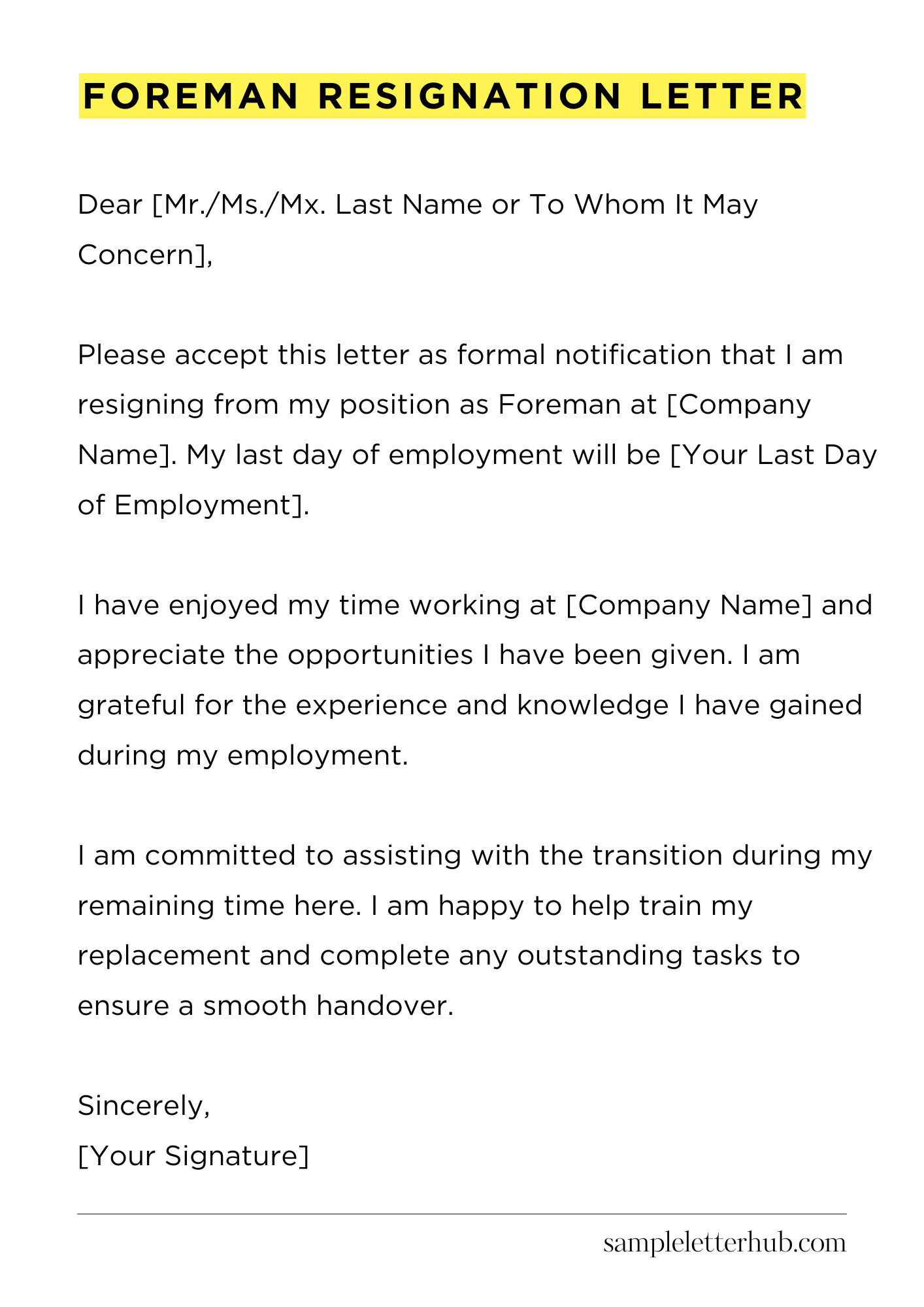
Dear [Mr./Ms./Mx. Last Name or To Whom It May Concern],
Please accept this letter as formal notification that I am resigning from my position as Foreman at [Company Name]. My last day of employment will be [Your Last Day of Employment].
I have enjoyed my time working at [Company Name] and appreciate the opportunities I have been given. I am grateful for the experience and knowledge I have gained during my employment.
I am committed to assisting with the transition during my remaining time here. I am happy to help train my replacement and complete any outstanding tasks to ensure a smooth handover.
I wish [Company Name] all the best in the future.
Sincerely,
[Your Signature]
How to Write a Foreman Resignation Letter
Leaving a job, especially a supervisory role like a foreman, requires more than just a casual conversation. A well-crafted resignation letter is absolutely essential. It’s your formal announcement, a record of your departure, and a chance to end things on a positive note.
This guide will walk you through writing a professional and effective Foreman resignation letter, ensuring a smooth transition for everyone involved.
1. Format and Structure: Your Blueprint for Success
First impressions matter, right? Your letter should look clean and professional. Use a standard business letter format. This means your name and contact information at the top, followed by the date, and then the employer’s details (name, title, company address). Next, a formal salutation like “Dear [Manager’s Name],” is crucial. Keep it simple, clear, and easy to read.
Utilize single-spaced text with a space between each paragraph. A clear and concise structure demonstrates professionalism and respect.
2. The Core Message: Stating Your Intentions
This is the most important part! The first paragraph should clearly state your intention to resign from your position as Foreman. Include the date of your last day of employment.
This leaves no room for confusion. For example, you might write: “Please accept this letter as formal notification that I am resigning from my position as Foreman at [Company Name], effective [Your Last Day of Employment].” Be direct, be polite, and be crystal clear. That is all that is required in this portion.
3. Expressing Gratitude and Appreciation: Building Bridges
Even if you’re leaving due to negative experiences, it’s beneficial to express gratitude. This is a crucial element for maintaining a positive relationship.
A brief thank you shows professionalism and leaves a good lasting impression. Acknowledge the opportunities and experiences you’ve gained during your time with the company.
You could say: “I am grateful for the opportunities I have been given during my time here and for the experience I have gained.” This makes your departure a little less abrupt and a lot more gracious. It’s a small thing that can make a big difference.
4. Smooth Transitions: Offering Assistance
Show your commitment to a smooth transition. Offer your assistance to help with the handover process. This is a very professional thing to do.
This can include training your replacement, documenting your key responsibilities, or answering any questions. Consider something like: “I am happy to assist in the transition process and will be available to train my replacement or answer any questions as needed.” This proactive approach demonstrates your responsibility and commitment to the company’s continued success.
5. Final Touches: Closing with Confidence
Conclude your letter with a professional closing, such as “Sincerely” or “Respectfully,” followed by your typed name. If you plan to send it physically, include a space for your signature above your typed name.
Review your letter carefully for any errors in grammar or spelling. Proofread it carefully. Double-check all dates and details. Make a copy for your records. This ensures you have a record of your formal communication. Now you have a properly formatted Foreman resignation letter.
FAQs about Foreman resignation letter
A Foreman’s resignation is a significant event, often requiring a formal letter. Understanding the nuances of this process can help ensure a smooth transition and maintain positive relationships.
What is the primary purpose of a Foreman resignation letter?
The primary purpose of a Foreman resignation letter is to formally notify the employer of the intent to leave the position. It serves as an official record of the resignation, including the effective date of departure, and allows for a structured handover process. It also provides an opportunity to express gratitude and maintain a professional relationship.
What essential information should be included in a Foreman resignation letter?
A Foreman resignation letter should include: the formal announcement of resignation, the specific effective date of the resignation, the intended position held (Foreman), a brief statement of gratitude for the employment opportunity, and any necessary details about the handover process or assistance offered during the transition.
The letter should be concise, professional, and courteous.
What is the appropriate notice period for a Foreman resignation?
The appropriate notice period for a Foreman resignation typically aligns with the company’s policy or employment contract, often two weeks or a month. It’s crucial to refer to the employment agreement to determine the required notice period.
Providing the stipulated notice period allows the company sufficient time to find a replacement and ensure a smooth operational transition.
How should a Foreman address their resignation letter?
A Foreman should address their resignation letter to their direct supervisor or the appropriate authority, as outlined by the company’s reporting structure (e.g., the Project Manager or the HR department). The letter should use a professional salutation (e.g., “Dear [Supervisor’s Name]”) and maintain a respectful tone throughout.
Can a Foreman include a reason for resigning in their letter, and is it necessary?
While not mandatory, a Foreman may choose to include a brief, professional reason for resigning in their letter. This is optional and not a requirement. It’s generally best to keep the reason concise, focusing on career advancement, personal reasons, or other opportunities.
Avoid providing overly negative or detailed information, particularly regarding internal conflicts. It’s important to remain positive, professional, and brief.
Related:
Resignation letter due to rude boss
Resignation letter moving to another state
Resignation letter due to illness of family member
Resignation letter due to study