

A Software Analyst resignation letter is a formal document. It informs your employer of your intent to leave your job. It marks the official end of your employment. This letter is crucial for a smooth transition.
Leaving a job can be tricky. Writing the perfect resignation letter is essential. We’ve got you covered. We’ll share various templates and examples. Use them as a starting point.
These samples will make it easy. We provide several options. You can customize them to fit your situation. Create a professional and polished letter in minutes. Good luck!
Software Analyst Resignation Letter
Below is a sample of a Software Analyst Resignation Letter:
[Your Name]
[Your Address]
[Your Phone Number]
[Your Email Address]
[Date]
[Employer’s Name]
[Employer’s Title]
[Company Name]
[Company Address]
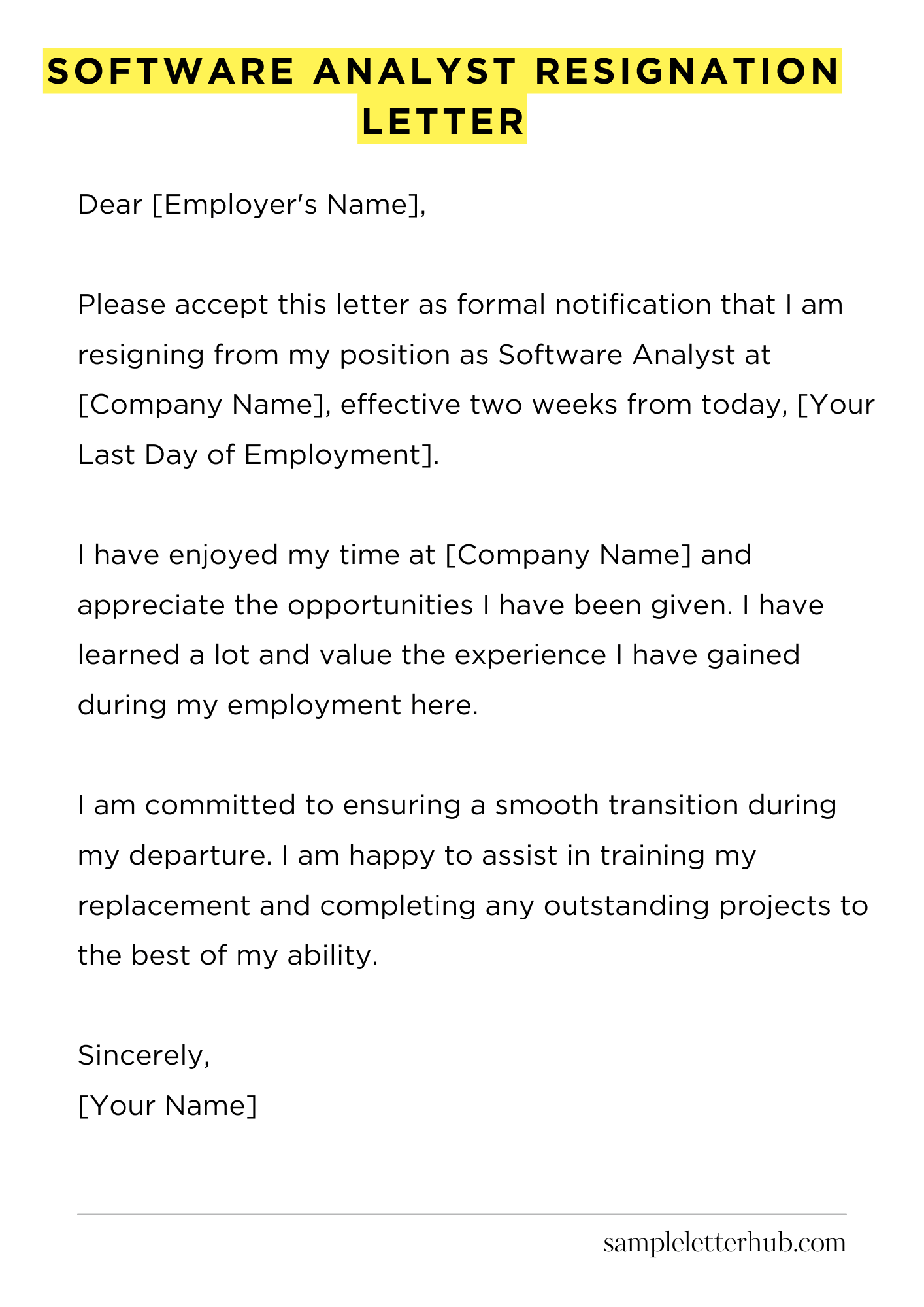
Dear [Employer’s Name],
Please accept this letter as formal notification that I am resigning from my position as Software Analyst at [Company Name], effective two weeks from today, [Your Last Day of Employment].
I have enjoyed my time at [Company Name] and appreciate the opportunities I have been given. I have learned a lot and value the experience I have gained during my employment here.
I am committed to ensuring a smooth transition during my departure. I am happy to assist in training my replacement and completing any outstanding projects to the best of my ability.
I wish you and the company continued success in the future.
Sincerely,
[Your Name]
How to Write Software Analyst Resignation Letter
Leaving a job is a significant decision. You’ve worked hard, gained experience, and now you’re moving on to something new. As a Software Analyst, you’re likely familiar with precision and detail.
That meticulous approach is essential when crafting your resignation letter. It is vital to properly articulate your intentions. Let’s delve into how to construct a professional and impactful resignation letter, specifically tailored for a Software Analyst.
1. Begin with a Clear and Concise Statement
Start with the basics. State your intention to resign unequivocally. This means being direct and avoid ambiguity. You don’t want any confusion about your departure. Your first sentence should make it explicitly clear that you are resigning from your position. Include the date you are submitting the letter and the date of your last day of employment.
For example: “Please accept this letter as formal notification that I am resigning from my position as Software Analyst, effective October 27, 2024.” Keep it simple. Clarity is key.
2. Express Gratitude and Positive Reinforcement
Even if you’re leaving for negative reasons, it’s always professional to express gratitude. You can acknowledge the opportunities and experiences the job provided. Did you learn valuable skills?
Mention them! Did you enjoy working with certain colleagues? Give a short acknowledgment. This shows you’re leaving on good terms. Think about what you gained. This will leave a positive and lasting impression.
Here’s an example: “I am grateful for the opportunities I have been given during my time at [Company Name], and I appreciate the experiences I have gained as a Software Analyst.”
3. Provide Necessary Details and Information
Your letter should contain any necessary information. This will help with a smooth transition. Include any details about the handover process or assistance you can offer.
This highlights your commitment to the company, even as you are departing. Are you willing to train a replacement? Are you available to answer questions after you leave?
Mention these things. You might include this in your letter: “I am committed to ensuring a smooth transition during my departure, and I am happy to assist in any way possible, including training my replacement and documenting project details.” Provide any necessary contact information, especially if you want to leave an email or phone number.
4. Keep the Tone Professional and Respectful
Maintain professionalism throughout the entire letter. Avoid negative comments about your current employer, colleagues, or the company culture.
It doesn’t matter what your personal feelings may be, don’t include them. Use a respectful tone. You want to leave a positive impression.
Regardless of your reasons for leaving, a positive tone is always the best approach. Refrain from gossip or personal attacks, and keep your language formal and polite. This reflects well on you. Proofread your letter carefully.
5. Finalize with a Proper Closing
End your letter with a formal closing and your signature. Use a professional closing such as “Sincerely,” or “Respectfully,” followed by your full name. If you are submitting a physical letter, sign it above your typed name. If submitting it electronically, you can type your name.
Consider the whole picture here. Your closing is important too. A properly formatted closing is crucial. This is especially important for Software Analysts as they are known for their great attention to detail. This final touch adds to the overall professional tone of your letter. This final step is an indication that you know how to write.
FAQs about Software Analyst resignation letter
How do I start my Software Analyst resignation letter?
Begin your resignation letter by clearly stating your intention to resign from your position as a Software Analyst. Include the date of the letter and the date of your last day of employment. Use a professional and respectful tone throughout the letter.
What should I include in the body of my Software Analyst resignation letter?
In the body of your letter, briefly express your gratitude for the opportunity to work at the company and any specific experiences or achievements you would like to mention. Keep it concise and avoid negativity or overly detailed explanations for your departure. A simple statement of your reason for leaving (e.g., pursuing other opportunities) is sufficient.
Is it necessary to provide a reason for leaving in my Software Analyst resignation letter?
While not mandatory, briefly stating your reason for leaving is often courteous. You can simply state that you are pursuing other opportunities, relocating, or seeking a different career path. Avoid providing excessive detail or negative feedback about your current role or the company.
What should be the tone of my Software Analyst resignation letter?
Maintain a professional and respectful tone throughout your resignation letter. Express gratitude for the opportunity, avoid negativity, and keep the language clear and concise. This approach leaves a positive lasting impression.
How should I end my Software Analyst resignation letter?
Conclude your letter by expressing your willingness to assist with the transition process. Offer to train your replacement, complete any outstanding tasks, or provide any necessary support. Thank the employer again for the opportunity and end with a formal closing such as “Sincerely” or “Respectfully,” followed by your full name and signature.
Related:
Resignation letter due to rude boss
Resignation letter moving to another state
Resignation letter due to illness of family member
Resignation letter due to study