

So, you’re an Information Security Analyst ready to move on. A resignation letter is the official document. It formally notifies your employer of your departure. It’s the first step in ending your employment professionally. It ensures a smooth transition.
Writing this letter can feel tricky. You want to be clear. You also want to maintain a good relationship. Don’t worry, we’ve got you covered. We’ll provide helpful templates. We have great examples. They’re designed to make the process easy.
We’ll share various sample letters. They’re suitable for different situations. Use them to craft your own perfect resignation. Say goodbye with confidence. This guide will help you leave a positive impression.
Information Security Analyst Resignation Letter
Below is a sample of a Information Security Analyst Resignation Letter:
[Your Name]
[Your Address]
[Your Phone Number]
[Your Email Address]
[Date]
[Hiring Manager Name] (If known, otherwise use title)
[Hiring Manager Title]
[Company Name]
[Company Address]
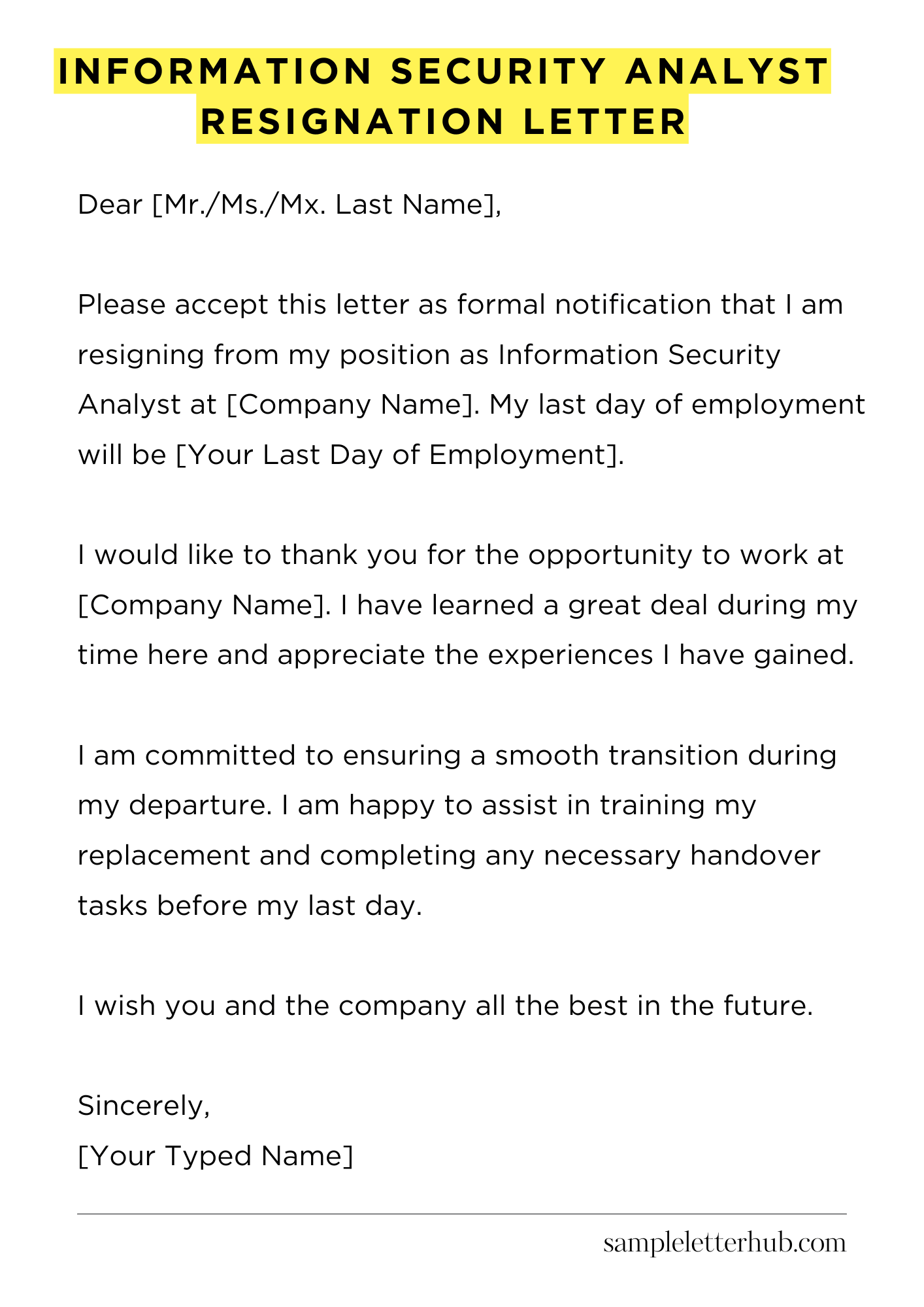
Dear [Mr./Ms./Mx. Last Name],
Please accept this letter as formal notification that I am resigning from my position as Information Security Analyst at [Company Name]. My last day of employment will be [Your Last Day of Employment].
I would like to thank you for the opportunity to work at [Company Name]. I have learned a great deal during my time here and appreciate the experiences I have gained.
I am committed to ensuring a smooth transition during my departure. I am happy to assist in training my replacement and completing any necessary handover tasks before my last day.
I wish you and the company all the best in the future.
Sincerely,
[Your Typed Name]
How to Write an Information Security Analyst Resignation Letter
1. Why Resign and Why Does the Letter Matter?
So, you’ve decided to move on. That’s a big step! Whether it’s a new opportunity, a better salary, or simply a change of pace, resigning from your Information Security Analyst position requires a formal letter.
Think of it as a bridge you’re building. It’s not just about saying goodbye; it’s about leaving on good terms. You’ll want to maintain positive relationships with your colleagues and former employer. This is incredibly important in the professional world.
This letter is your chance to document your departure professionally. It sets the tone for your exit and can influence your future career prospects. Leaving a bad impression can damage your reputation.
A well-crafted resignation letter shows professionalism and respect. This letter also serves as an official record of your resignation, protecting both you and your employer.
2. Essential Elements: What to Include
Your resignation letter isn’t complicated. It needs to be clear, concise, and professional. First things first: start with a formal salutation, like “Dear [Manager’s Name]”. Then, clearly state your intent to resign.
The first sentence should state this unequivocally. Include your job title. For example: “I am writing to formally resign from my position as Information Security Analyst at [Company Name].”
Next, state your last day of employment. This is crucial for payroll and handover purposes. Ensure it aligns with your employment contract or any company policies. A brief thank you is also essential.
Express your gratitude for the opportunity to work at the company. Keep it short and genuine. Briefly mention any specific skills or experiences you gained. This is a nice touch. Now, depending on the situation, consider a brief offer to assist with the transition. Be willing to help train your replacement or complete any ongoing tasks before you leave.
Finally, end with a professional closing, such as “Sincerely” or “Best regards,” followed by your name and contact information.
3. Crafting the Perfect Tone: Keep It Professional
The tone of your letter is critical. Always maintain a professional and respectful tone, even if you are leaving due to negative experiences. This isn’t the place to vent frustrations or air grievances.
Focus on the positive aspects of your employment, if possible, or keep the reasons for leaving neutral. Avoid overly emotional language, complaints, or negativity. Be polite, even if you are unhappy.
Proofread the letter carefully. Errors in grammar or spelling undermine professionalism. Ask a trusted friend to review it as well. Your letter represents your professionalism and attention to detail. Double-check all dates, names, and titles. Ensure your tone is polite and respectful. Always maintain your integrity, and your letter will reflect this.
4. Tailoring Your Letter: Examples and Templates
A template provides a starting point. There are many available online. However, it’s essential to tailor it to your specific situation and company. Never use a generic template verbatim. Customize it to reflect your role, the company culture, and your relationship with your manager.
For example, you could say: “I have valued the opportunity to work at [Company Name] and appreciate the experience I’ve gained as an Information Security Analyst. I’m especially grateful for the chance to [mention a specific skill or project]. I am committed to assisting with the transition of my responsibilities before my departure.”
Different companies may have different policies or expectations. So do your research, and tailor the letter accordingly. This shows you’re taking your departure seriously.
5. After the Letter: What Happens Next?
Once you’ve submitted your letter, your employer will likely acknowledge it. Be prepared for a meeting with your manager or HR. This meeting is for discussing your departure and any handover procedures. Be professional and cooperative during this meeting.
Cooperate with the transition. It’s crucial to assist in training your replacement. Your goal is to ensure a smooth transfer of your responsibilities. Provide documentation and answer any questions.
Maintain your professionalism until your last day. Leaving a good impression will serve you well in the long run. Follow through on any agreed-upon tasks or deadlines.
This includes returning company property, such as laptops, access badges, and other materials. Finally, stay in touch with your colleagues. Networking is key, and maintaining positive relationships can be beneficial throughout your career.
FAQs about Information Security Analyst resignation letter
Understanding the nuances of an Information Security Analyst resignation letter is crucial for a smooth transition and maintaining professional relationships. Here are some frequently asked questions:
What is the essential information to include in an Information Security Analyst resignation letter?
Your resignation letter should include your official resignation, the effective date of your departure, a concise statement of your reason for leaving (optional, but often included), and a formal expression of gratitude to the employer, manager, and/or team.
Be sure to provide contact information if you’re willing to be contacted for future reference. It’s also wise to mention the return of company property and any outstanding tasks you’ll complete. Avoid negativity and keep the tone professional and forward-looking.
How much notice should an Information Security Analyst give when resigning?
The standard notice period is typically two weeks, though this can vary depending on your employment contract, company policy, and the laws in your region.
Review your employment agreement to clarify the required notice. In some cases, providing more notice is considered professional and can leave a positive impression, especially if you hold a senior role or have extensive responsibilities. Discuss the appropriate timeline with your manager.
What should I do about confidential information and company assets when resigning as an Information Security Analyst?
You must adhere to all company policies regarding confidential information. This includes not sharing, disclosing, or retaining any sensitive data. During the notice period, prioritize the transfer of knowledge to your replacement or team members.
Ensure all company-owned assets, such as laptops, access badges, and other materials, are returned as instructed. If you were required to sign non-disclosure or other agreements, ensure you understand the terms, and are still compliant.
Can I include a reason for leaving in my Information Security Analyst resignation letter?
While optional, including a brief, professional reason for leaving can be beneficial. Keep it positive and concise. For example, you might state you’re pursuing a new opportunity, seeking career advancement, or relocating.
Avoid negative comments about the company or its employees. Focusing on your future aspirations is generally the best approach. If you wish to provide more detailed feedback, you might save it for an exit interview, where it can be handled privately and in a more controlled environment.
How can I ensure my Information Security Analyst resignation letter leaves a positive impression?
Maintain a professional and respectful tone throughout the letter. Express gratitude for the opportunities you’ve been given and acknowledge the positive aspects of your employment.
Offer your assistance in the transition process, such as training your replacement or documenting key processes. Proofread carefully for any errors in grammar and spelling.
Consider having a trusted colleague or mentor review it before submission to ensure clarity and professionalism. A well-crafted resignation letter can open doors to future opportunities and help maintain a positive professional reputation.
Related:
Resignation letter due to rude boss
Resignation letter moving to another state
Resignation letter due to illness of family member
Resignation letter due to study