

A Collection Officer resignation letter formally announces your departure. It’s a professional document. Its main purpose is to notify your employer of your intention to leave. This letter initiates the official process of your resignation.
Need to draft a collection officer resignation letter? We’ve got you covered. We’ll share several templates and examples. These samples are designed for easy use. They’ll help you create your own perfect letter.
Whether you’re moving on or pursuing new opportunities, we provide guidance. Find the right words with our examples. Customize them to fit your specific situation. This article makes writing your resignation simple.
Collection Officer Resignation Letter
Below is a sample of a Collection Officer Resignation Letter:
[Your Name]
[Your Address]
[Your Phone Number]
[Your Email Address]
[Date]
[Collection Officer’s Supervisor’s Name]
[Collection Officer’s Supervisor’s Title]
[Company Name]
[Company Address]
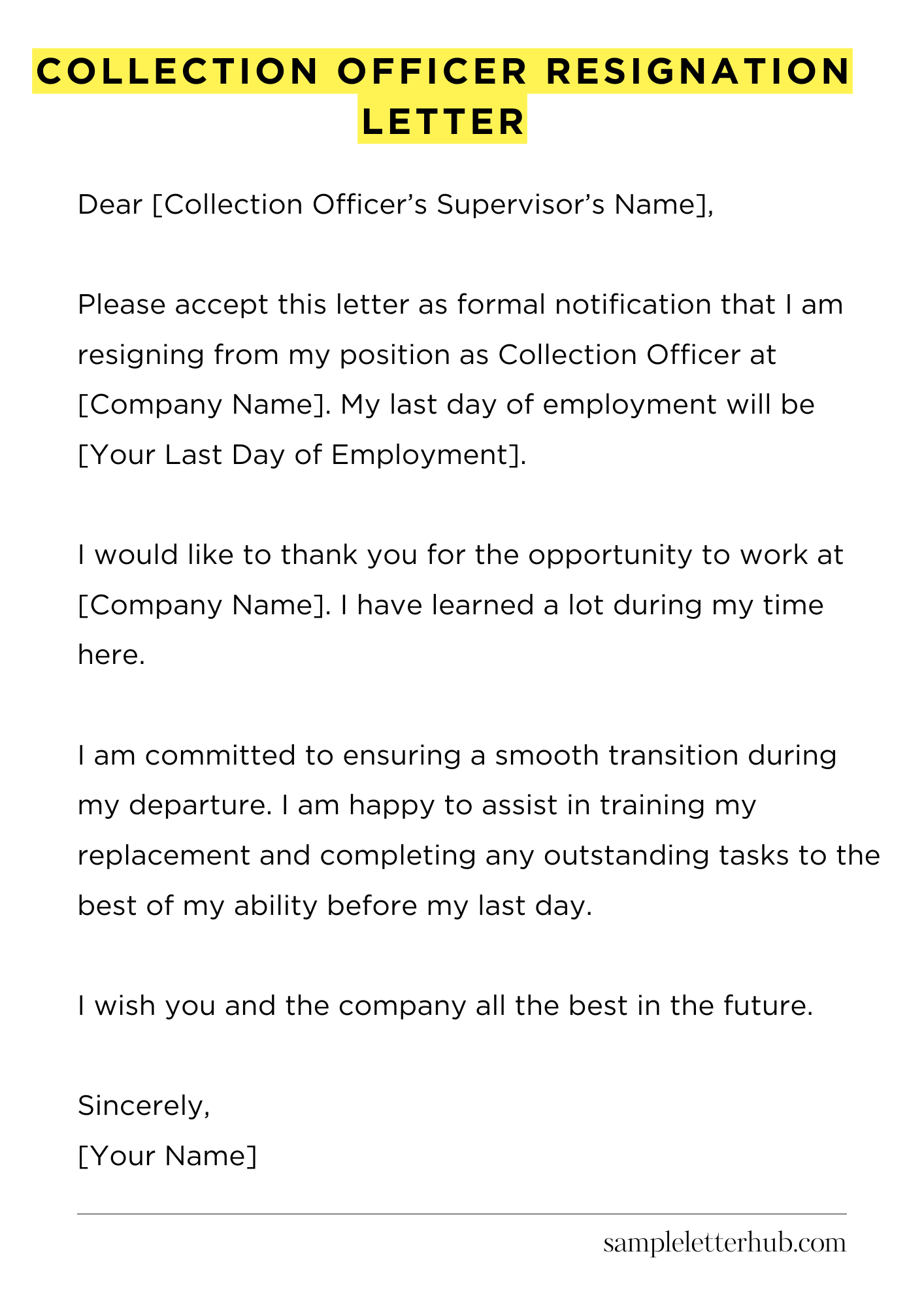
Dear [Collection Officer’s Supervisor’s Name],
Please accept this letter as formal notification that I am resigning from my position as Collection Officer at [Company Name]. My last day of employment will be [Your Last Day of Employment].
I would like to thank you for the opportunity to work at [Company Name]. I have learned a lot during my time here.
I am committed to ensuring a smooth transition during my departure. I am happy to assist in training my replacement and completing any outstanding tasks to the best of my ability before my last day.
I wish you and the company all the best in the future.
Sincerely,
[Your Name]
How to Write a Collection Officer Resignation Letter
1. Getting Started: The Basics You Need
Leaving a job is a big step, no matter the profession. You need a well-crafted resignation letter, especially if you’re a Collection Officer. The importance lies in making a clean break.
Before you even start typing, gather some important information. First, confirm your last day of employment. This is usually determined by your employment contract or company policy. Also, identify your direct supervisor’s name and title; you’ll need it for the address. Remember, keeping things professional is key here.
Ensure you have all the necessary information before you start writing.
2. Structure and Format: Laying it Out Right
A Collection Officer resignation letter, like any professional document, demands a standard format. Start with your contact information at the top.
This includes your name, address, phone number, and email. Then, add the date of the letter. Following the date, provide the recipient’s information. This usually means the name, title, and address of your supervisor or the HR department.
Next comes the body of the letter. The body of the letter needs to consist of a few key sections. Begin with a clear statement of your resignation and your last day. Keep this part concise and to the point. State your intent plainly, with no ambiguity.
3. The Body of Your Letter: Key Elements Explained
The core of your letter should address a few crucial points. First, state your resignation clearly. “Please accept this letter as formal notification that I am resigning from my position as Collection Officer…” is a great way to start.
Next, specify your last day of employment. Be sure to align this with any company policies. A common error is a failure to state the last day.
Consider offering a brief, professional expression of gratitude for the opportunity. You can mention any positive experiences you’ve gained. Avoid overly emotional language, as the goal is to maintain a professional tone throughout. This is also the section where you can offer assistance during the transition.
4. Keeping it Professional: Dos and Don’ts
Professionalism is everything. In any communication, it’s necessary, but particularly in something as important as a resignation letter. Avoid negativity or complaints about your job.
Even if you have had negative experiences, save those discussions for a separate conversation, if necessary. You do not have to give a reason, but sometimes it is nice to state a brief reason without being negative.
Focus on the positive aspects of the experience and show gratitude for the opportunity. Proofread the letter carefully before you send it. Always ensure proper grammar and spelling.
Also, be sure to send a printed copy if you are working remotely or hand it directly to your supervisor if you are in person. These small details show respect for the process.
5. Finishing Up and Moving On: The Final Steps
Conclude your letter with a formal closing. Use phrases like “Sincerely,” or “Respectfully,” followed by your full name. Also, make sure you sign the letter. After you’ve written your letter and proofread it, make a copy for your records. This is vital for your future reference.
Submit your letter to the appropriate person, usually your direct supervisor or HR. After submitting your letter, start preparing for your departure.
Clear your desk, organize your files, and hand over any pending projects. A graceful exit ensures you maintain a positive relationship with your previous employer. This can be important for future references. Follow the company policies. These final steps are important for a smooth transition.
FAQs about Collection Officer Resignation Letter
What is the primary purpose of a Collection Officer resignation letter?
The primary purpose of a Collection Officer resignation letter is to formally notify the employer of the employee’s intent to leave their position. It serves as an official record of the resignation, the last day of employment, and can include a statement of gratitude or provide reasons for leaving, depending on the employee’s preference and the company’s policy.
What key elements should be included in a Collection Officer resignation letter?
A well-crafted Collection Officer resignation letter should include: a clear statement of resignation, the effective date of the resignation, a formal salutation and closing, the employee’s name and job title, and the recipient’s name and title.
It’s often beneficial to express gratitude for the opportunity, and providing contact information might be helpful for future communication, if desired. Optional elements include a brief, professional reason for leaving and an offer to assist with the transition process.
What is the typical notice period required for a Collection Officer resignation?
The typical notice period for a Collection Officer resignation varies. It’s usually outlined in the employment contract or company policy. Common notice periods are two weeks, however, it’s essential to consult the specific employment agreement or company handbook to understand the required timeframe.
Adhering to the prescribed notice period helps ensure a smooth transition and avoids potential issues.
How should a Collection Officer address any outstanding tasks or responsibilities in their resignation letter?
In a Collection Officer resignation letter, it’s wise to address outstanding tasks by offering to help in their completion during the notice period.
This can be done by stating the willingness to train a replacement, transfer ongoing projects, or provide necessary documentation. This proactive approach demonstrates professionalism and helps ensure a seamless handover of responsibilities.
Can a Collection Officer include the reason for their resignation in the letter, and is it advisable?
A Collection Officer can include the reason for their resignation in the letter, but it’s not always mandatory. It depends on personal preference and the relationship with the employer.
If the departure is due to a positive reason (e.g., career advancement), it’s generally acceptable to briefly mention it. However, if the reason involves negative aspects of the job, it’s often advisable to keep the explanation brief, professional, and focus on the future.
Related:
Resignation letter due to rude boss
Resignation letter moving to another state
Resignation letter due to illness of family member
Resignation letter due to study
Resignation letter due to long commute
Resignation letter due to insult
Resignation letter to focus on family
Resignation letter to temp agency