

A Library Director resignation letter is a formal document. It announces a library director’s departure. The purpose is to officially inform the employer. It also sets the resignation date.
Crafting the perfect letter can be tough. We understand. That’s why we’re here to help. This article offers helpful templates.
Need inspiration? We have you covered. Explore various sample letters. Find the perfect fit for your situation. Make your resignation process smooth and stress-free.
Library Director Resignation Letter
Below is a sample of a Library Director Resignation Letter:
[Your Name/Address]
[Your Phone Number]
[Your Email Address]
[Date]
[Library Director’s Name]
[Library Name]
[Library Address]
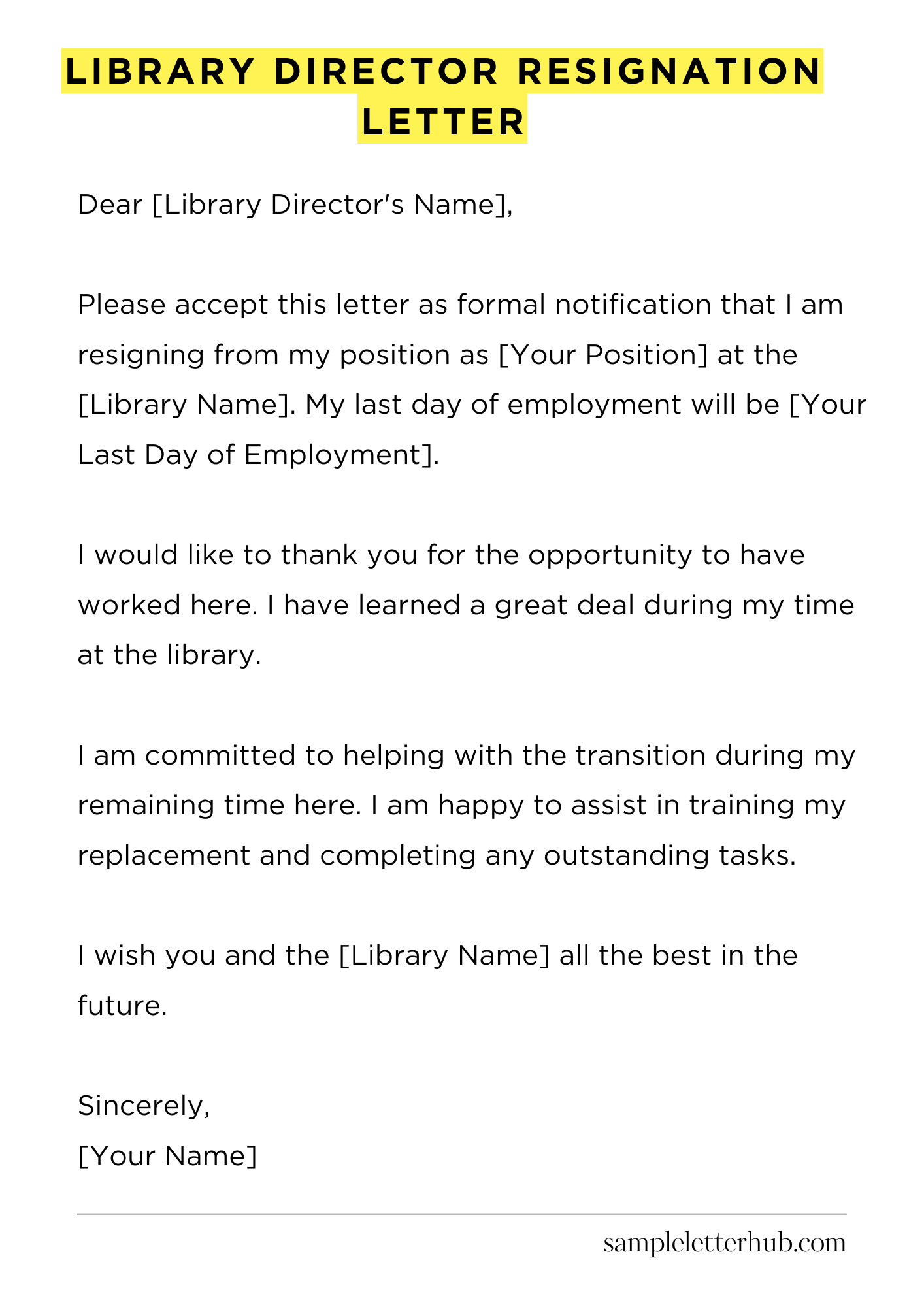
Dear [Library Director’s Name],
Please accept this letter as formal notification that I am resigning from my position as [Your Position] at the [Library Name]. My last day of employment will be [Your Last Day of Employment].
I would like to thank you for the opportunity to have worked here. I have learned a great deal during my time at the library.
I am committed to helping with the transition during my remaining time here. I am happy to assist in training my replacement and completing any outstanding tasks.
I wish you and the [Library Name] all the best in the future.
Sincerely,
[Your Name]
How to Write a Library Director Resignation Letter
1. Preparation is Key
Leaving your position as Library Director is a significant step. It requires careful planning. Before you even think about putting pen to paper (or fingers to keyboard), you must have a concrete reason for resigning.
Think about it carefully. Do you have a new job lined up? Or maybe you’re looking for a change of pace? Whatever your motivation, be sure of it. This will help inform the tone of your letter.
Review your employment contract and any internal policies about resigning. Understand the requirements, like the amount of notice you must provide. This might change based on your location. Knowing these rules beforehand is crucial. It avoids any unnecessary surprises down the road.
2. Essential Components of Your Letter
Your resignation letter is a formal document. It requires certain elements. First, include the date. Always address the letter to the appropriate person. Usually, this is the chair of the library board or your direct supervisor.
Next, clearly state your intention to resign. This should be the very first line of your letter. It should be direct and unambiguous. State your last day of employment. This is where the notice period comes into play. Provide the required notice. Keep it professional. Briefly, express your gratitude for the opportunity to work at the library.
Mention any positive experiences or accomplishments you are proud of. Keep your explanation for leaving brief and positive. Avoid negativity. If possible, offer assistance during the transition.
For example, offer to help train your replacement. Finally, end with a professional closing. Use “Sincerely” or “Best regards,” followed by your name and title. Don’t forget to sign the letter.
3. Crafting the Right Tone
The tone of your letter should be professional and courteous. Remember that your resignation letter is a reflection of your character. Even if you’ve faced challenges during your tenure, avoid airing grievances.
Focus on the positive aspects of your experience. Keep the language polite and respectful. Avoid overly emotional language, even if you’re feeling it! Be brief and to the point. Long, rambling letters are often less effective.
Maintain a positive attitude, even if you are not feeling optimistic about the situation. You might be asked to provide references in the future. Remember that.
4. Specific Considerations for a Library Director
As a Library Director, you often have a prominent role in the community. Your resignation will likely attract attention. Consider the impact of your departure on staff, patrons, and the board. Include a brief mention of your experience working with the community. You can acknowledge the impact that the library has on the community.
If appropriate, offer to assist with the transition. Your offer to help can be invaluable. This shows your commitment to the library’s continued success. Consider the current projects or initiatives you are involved in. If relevant, offer to provide details about these for the next director. This can make the transition much easier.
5. Proofreading and Final Steps
Before sending your letter, proofread it carefully. Check for any grammatical errors or typos. Double-check the recipient’s name and title. Ask a trusted colleague or friend to review the letter. A fresh pair of eyes can often catch mistakes you missed. Make sure you keep a copy of your resignation letter for your records.
Deliver the letter according to the library’s protocol. Whether it’s in person, by mail, or electronically, make sure you follow the correct procedure. Then, be prepared for follow-up conversations or meetings. They might ask questions. Be ready to answer professionally and maintain a positive attitude.
FAQs about Library Director resignation letter
How much notice should a Library Director give when resigning?
The standard practice is to adhere to the notice period specified in the Library Director’s employment contract. This period typically ranges from two weeks to a month, though longer notice periods may be required depending on the terms of the contract and the complexity of the library system.
Giving adequate notice allows for a smooth transition, the completion of ongoing projects, and the recruitment of a replacement. It is also a professional courtesy to the employer.
What key information should be included in a Library Director’s resignation letter?
A resignation letter should clearly state the intention to resign, the effective date of resignation, and a brief statement of gratitude for the opportunity to have worked at the library. It is often customary to acknowledge any key individuals who were important for your development and thank the board and staff for their support.
The letter should also offer assistance with the transition process and the transfer of responsibilities, if applicable, to ensure a smooth handover.
Should a Library Director state the reason for their resignation in the letter?
While you are not obligated to disclose the reason for your resignation, it’s generally best to keep the letter concise and professional. You can state something generic, such as a desire to pursue new opportunities, but you are not required to provide detailed explanations of why you are leaving.
However, it’s appropriate to discuss the reasons during your exit interview with the board, or the relevant stakeholders.
What is the appropriate tone for a Library Director’s resignation letter?
The tone of the resignation letter should be professional, respectful, and positive. Avoid expressing negativity, grievances, or criticism. Maintain a positive and appreciative tone for the opportunity, even if the work experience was not ideal. A well-written, professional letter helps maintain a positive relationship with the library and avoids unnecessary conflict.
How can a Library Director facilitate a smooth transition after resigning?
To facilitate a smooth transition, a Library Director can offer to assist in the handover of duties, prepare detailed documentation of current projects and ongoing tasks, and provide training or orientation to the incoming director or staff members.
They should also cooperate with the library’s management to ensure that library operations continue without interruption, assisting in any way needed during the transition period.
Related:
Resignation letter due to rude boss
Resignation letter moving to another state
Resignation letter due to illness of family member
Resignation letter due to study