

A Music Director resignation letter is a formal document. It is written to inform an employer about leaving a music director position. The letter also states the last day of employment. It serves as a professional record of the departure.
Crafting the perfect resignation letter can be tricky. Don’t worry, we’re here to help. This article offers several templates. We’ll share examples and samples.
You can customize these letters. They cover various scenarios. Use them as a starting point. Make the process simple and stress-free.
Music Director Resignation Letter
Below is a sample of a Music Director Resignation Letter:
[Your Name]
[Your Address]
[Your Phone Number]
[Your Email Address]
[Date]
[Music Director’s Supervisor Name]
[Music Director’s Supervisor Title]
[Organization Name]
[Organization Address]
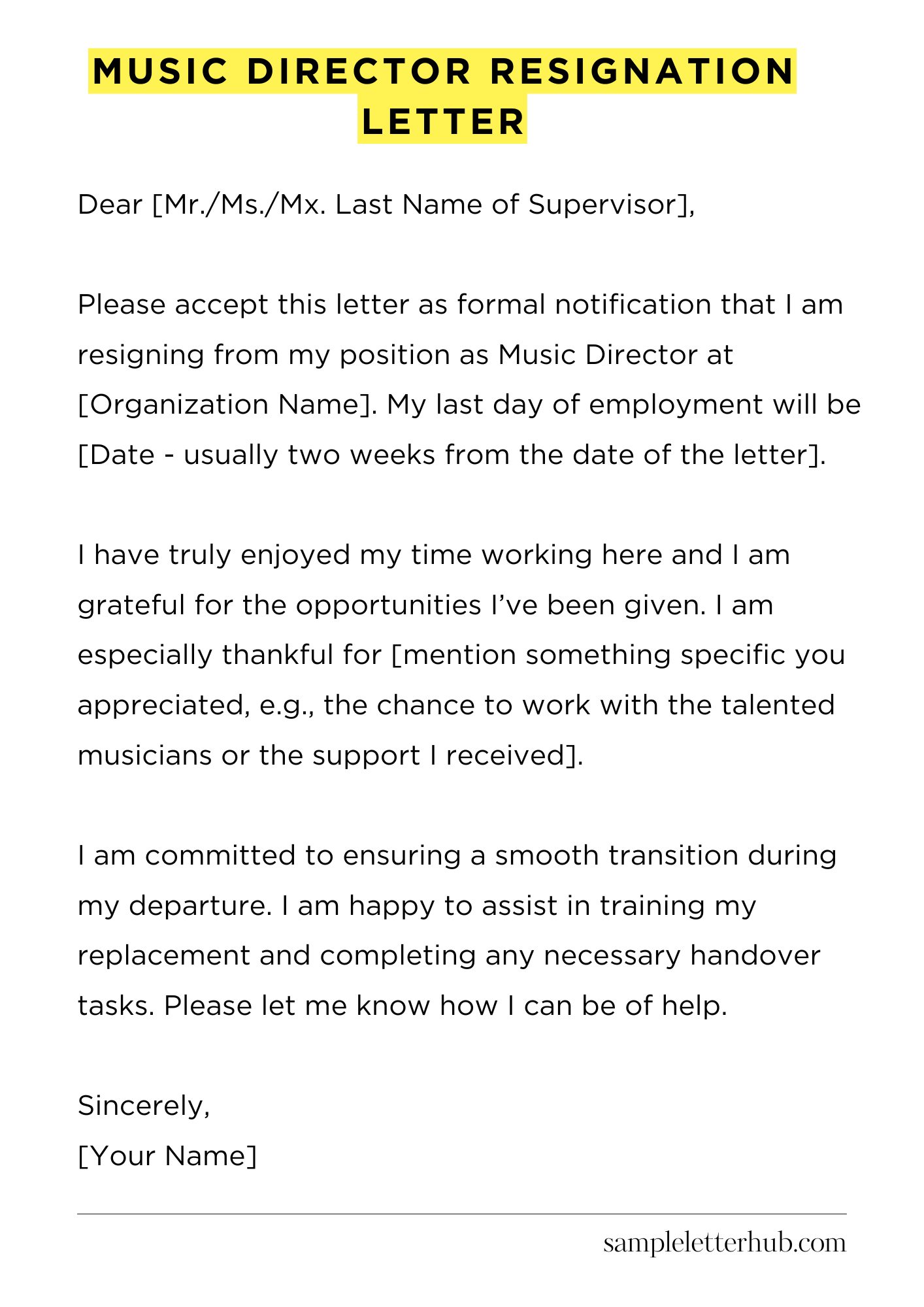
Dear [Mr./Ms./Mx. Last Name of Supervisor],
Please accept this letter as formal notification that I am resigning from my position as Music Director at [Organization Name]. My last day of employment will be [Date – usually two weeks from the date of the letter].
I have truly enjoyed my time working here and I am grateful for the opportunities I’ve been given. I am especially thankful for [mention something specific you appreciated, e.g., the chance to work with the talented musicians or the support I received].
I am committed to ensuring a smooth transition during my departure. I am happy to assist in training my replacement and completing any necessary handover tasks. Please let me know how I can be of help.
Thank you again for the experience. I wish you and the organization all the best in the future.
Sincerely,
[Your Name]
How to Write a Music Director Resignation Letter
1. Preparation is Key: Before You Start
Resigning from any position requires careful thought. This is especially true when it comes to a role as important as a Music Director. Before you put pen to paper (or fingers to keyboard), take some time to reflect. Why are you leaving? Consider this question deeply. Are you pursuing another opportunity?
Perhaps it’s a matter of creative differences. Whatever the reason, having a clear understanding of your motivations is critical. This will inform the content and tone of your letter. Review your contract, if you have one. Understand the terms regarding notice periods. You will need to know what you are bound by legally.
Think about the people you will leave behind. Planning is vital. Start early, and avoid hasty decisions. Now, you can begin the writing process.
2. Crafting the Opening: Set the Stage
Your opening paragraph is your introduction. Be direct and state your intentions clearly. Use formal language. A simple, yet effective approach is to state that you are resigning from your position as Music Director.
The date of your resignation should be included here too. Address the letter to the appropriate person, usually your supervisor or the board president. Keeping it professional helps maintain a positive relationship. Be mindful of this.
Example: “Dear [Recipient’s Name], Please accept this letter as formal notification that I am resigning from my position as Music Director of [Organization Name], effective [Date].” It’s as simple as that.
3. Providing Context: Briefly Explain the Reason (Optional)
While not always mandatory, offering a brief reason for your departure can be beneficial. It helps provide context. It can also help smooth the transition for the organization.
Keep this section concise and avoid negativity. Focus on the facts. If you’re moving on to another opportunity, you can briefly mention this. If you are not comfortable stating the reason, you do not have to.
Example: “I am writing to inform you of my resignation. I have accepted a new position that will allow me to explore other areas of my career.” Or, “I have enjoyed my time at the [Organization Name], however, I am now pursuing other opportunities.” Remember, keeping the message brief is fine.
4. Expressing Gratitude and Offering Assistance: Leaving on Good Terms
This section is crucial for ending on a positive note. Express your gratitude for the opportunity to have served as Music Director. Acknowledge the experience you’ve gained and the relationships you’ve built.
Offer your assistance during the transition period. This shows professionalism. Offer to help with finding a replacement or providing any necessary documentation. It can go a long way in ensuring a smooth handover. Maintain a positive attitude.
Example: “I am grateful for the opportunity to have worked with the talented musicians and dedicated staff. I am happy to assist with the transition. I am available to help with finding a successor.”
5. The Closing: Formalities and Signature
Conclude your letter with a formal closing and your signature. Use a professional closing like “Sincerely,” or “Respectfully,” followed by your typed name. If you are sending a physical letter, sign it by hand. Include your contact information.
This is very important. This allows for easy contact should they need to reach you. Proofread your letter carefully before sending it. Double-check for any errors in grammar or spelling. Ensure that the tone is professional and respectful throughout.
Example: “Sincerely, [Your Typed Name] [Your Contact Information]”
FAQs about Music Director Resignation Letter
What is the primary purpose of a Music Director resignation letter?
The primary purpose is to formally notify the employer (typically a music organization, school, or church) of the Music Director’s intent to leave their position. It serves as an official record of the resignation, the effective date, and often includes a brief expression of gratitude and, in some cases, offers of assistance during the transition.
What key information should be included in a Music Director resignation letter?
Essential components include a clear and concise statement of resignation, the effective date of the resignation (the last day of employment), the Music Director’s name and contact information, the employer’s name and address, a brief expression of gratitude for the opportunity, and any relevant details regarding the transition process.
Some letters may include a statement of reason for leaving, though this is not always required.
What is the proper format for a Music Director resignation letter?
The format generally follows a standard business letter format. This includes a formal salutation (e.g., “Dear [Hiring Manager Name]”), a clear body that states the intent to resign, a closing (e.g., “Sincerely”), the Music Director’s signature, and their typed name. The letter should be printed on professional paper if possible, and delivered in person or via certified mail to ensure receipt.
Should I provide a reason for resigning in my Music Director resignation letter?
While not mandatory, providing a reason is often considered professional. Keep the reason concise and positive, focusing on personal or professional growth, a new opportunity, or other relevant factors. Avoid negative or overly critical language. It can be as simple as “I am pursuing a new opportunity that will allow me to further develop my skills,” or “I am relocating for family reasons.”
How much notice should I give in my Music Director resignation letter?
The amount of notice required is typically specified in the employment contract. If there’s no contract, a minimum of two weeks’ notice is generally considered standard practice.
However, consider the nature of the organization and the responsibilities of the role; more notice, such as a month or more, might be appropriate for a Music Director, especially to allow for a smooth transition, particularly for preparing for the upcoming season or major events.
Related:
Resignation letter due to rude boss
Resignation letter moving to another state
Resignation letter due to illness of family member
Resignation letter due to study