

A “Saler resignation letter” is a formal notice. It’s written by an employee. The employee tells their employer they are leaving. This letter serves to officially end employment. It ensures everything is documented properly.
Need to resign from your Saler position? You’re in the right place! We’ll give you a helping hand. We have prepared several templates. They’re designed for different situations. These examples will make your writing easy.
Our goal is to assist you. Choose a template. Customize it. Make it your own. Your perfect resignation letter is just a few steps away. We will help you in every step.
Saler Resignation Letter
Below is a sample of a Saler Resignation Letter:
[Your Name]
[Your Address]
[Your Phone Number]
[Your Email Address]
[Date]
[Employer’s Name]
[Employer’s Title]
[Company Name]
[Company Address]
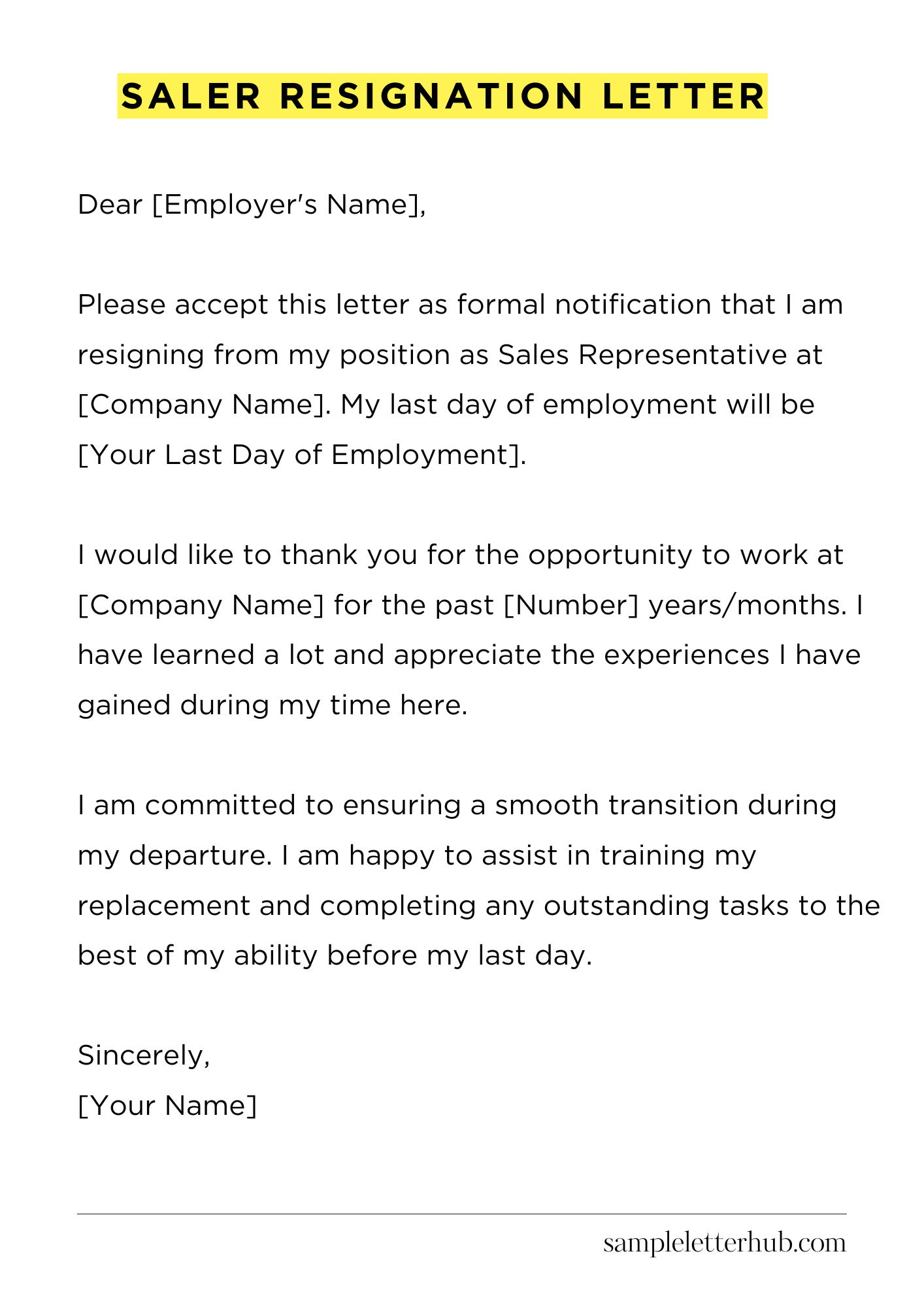
Dear [Employer’s Name],
Please accept this letter as formal notification that I am resigning from my position as Sales Representative at [Company Name]. My last day of employment will be [Your Last Day of Employment].
I would like to thank you for the opportunity to work at [Company Name] for the past [Number] years/months. I have learned a lot and appreciate the experiences I have gained during my time here.
I am committed to ensuring a smooth transition during my departure. I am happy to assist in training my replacement and completing any outstanding tasks to the best of my ability before my last day.
I wish you and [Company Name] all the best in the future.
Sincerely,
[Your Name]
How to Write a Sales Resignation Letter
So, you’ve made the decision: it’s time to move on from your sales role. Congratulations! This is a big step, and you’re probably already looking forward to your next adventure.
Before you can fully embrace the future, however, you need to handle the present. A well-crafted resignation letter is crucial. It’s your official notice, and it’s your final opportunity to leave a lasting, positive impression. Let’s delve into how to write a resignation letter that helps you exit gracefully and professionally.
1. Keep it Concise and Clear
Your sales resignation letter isn’t the place to pour out your heart. It should be brief, to the point, and easy to understand. Start by stating your intention clearly. Use simple language.
Don’t beat around the bush; directly state that you’re resigning from your position. Include the date of your last day of employment. This is the most crucial piece of information. Everything else is secondary to this core element.
A good starting point is something like: “Please accept this letter as formal notification that I am resigning from my position as Sales Representative, effective [Your Last Day of Employment].” This immediately establishes the purpose of the letter.
2. Show Gratitude (Yes, Even if You Didn’t Love the Job)
Even if your experience was less than stellar, expressing gratitude is a crucial aspect. It’s about maintaining professionalism and leaving on a positive note. A simple thank you can go a long way. Consider mentioning any specific experiences or opportunities you’ve appreciated during your time in the role.
For example, you could write: “I am grateful for the opportunities I’ve had to develop my sales skills and build relationships with clients during my time here.”
Or: “I appreciate the experience and the support I’ve received from the team.” Such sentiments can help maintain a positive relationship with your employer, which might be helpful in the future.
3. Be Professional, Professional, Professional!
Professionalism is key. This is not the moment to vent your frustrations or complain about your manager or the company. Focus on your departure and what you will do.
Remember, this letter might become part of your permanent employment record. It is essential to maintain a courteous and respectful tone throughout the letter. Avoid any negative comments or personal attacks. Even if your experience wasn’t ideal, focusing on positivity is always the best strategy.
Keep your language formal. Avoid slang or casual expressions. Proofread your letter carefully for any grammatical errors or typos. You want to make a good final impression, and a polished letter shows you care about your professionalism.
4. Offer Assistance with the Transition
Offering your help with the transition is a great way to solidify your professionalism. It shows that you care about the company’s success and that you’re willing to make the handover as smooth as possible.
Offer to assist in training your replacement. Offer to complete any pending tasks. This will leave your employer with a favorable impression of your work ethic.
You might write: “I am happy to assist in the transition process and am available to train my replacement or answer any questions during my remaining time here.” Demonstrating this helpfulness demonstrates your dedication.
5. Close with a Positive Note and Contact Information (Optional)
End your letter on a positive note. Reiterate your appreciation and wish the company well. You can include your contact information (personal email address or phone number) if you wish, although this is optional. This lets your employer know how to reach you if needed.
A good closing sentence could be: “I wish the company continued success in the future. Thank you again for the opportunity. I can be reached at [Your Contact Information] if needed.” This is polite and leaves the door open for future communication (if you so choose).
Writing a solid resignation letter isn’t a complex process, but it is important. It requires clarity, professionalism, and a touch of gratitude. By following these guidelines, you can ensure a smooth transition and leave a positive lasting impression. Now, go forth and write that letter, and good luck with your next endeavor!
FAQs about Saler resignation letter
What is the primary purpose of a Sales Resignation Letter?
The primary purpose of a sales resignation letter is to formally notify your employer of your intention to leave your sales position. It serves as an official record of your departure and helps to establish a clear and professional end to your employment.
It typically includes your official date of departure and may also express gratitude, provide context for your leaving, and offer assistance with the transition.
What key information should always be included in a Sales Resignation Letter?
A Sales Resignation Letter should always include your name, the date you are writing the letter, the name of your employer, the date of your last day of employment (typically two weeks from the date of the letter, or as per your contract), and a clear statement of your resignation.
While not mandatory, it’s also a good practice to express gratitude for the opportunities provided and to offer assistance during the transition period.
Is it necessary to provide a reason for resigning in a Sales Resignation Letter?
While not strictly required, providing a brief, professional reason for your resignation can be beneficial. It allows your employer to understand the context of your departure.
You can choose to be vague (e.g., “pursuing other opportunities”) or offer more specific, but still professional, reasons (e.g., “to focus on personal development” or “to accept a position with another company”). Avoid negative or overly critical statements.
How should I handle confidentiality in my Sales Resignation Letter?
When drafting your sales resignation letter, be mindful of confidentiality agreements you may have signed. Avoid including any proprietary information, trade secrets, or client lists.
If you are joining a competitor, be particularly cautious about referencing your new employment to prevent potential legal issues. Focus on expressing your intentions and not divulging sensitive company data.
Can I negotiate my last day of employment in a Sales Resignation Letter?
Generally, you can state your desired last day of employment in your sales resignation letter. However, the final date is often subject to the employer’s approval and your company’s policies, typically allowing a standard two-week notice.
If you have a specific reason to negotiate this, such as a pre-planned travel or personal commitment, you can mention it. Be prepared to discuss your reasons and reach a mutual agreement with your employer.
Related:
Resignation letter due to rude boss
Resignation letter moving to another state
Resignation letter due to illness of family member
Resignation letter due to study