

It’s time to move on. A “Talent Acquisition Resignation Letter” formally announces your departure. It tells your employer you’re leaving. The letter outlines your last day. It’s a professional document.
Need to write your own letter? This article is for you. We’ll provide helpful templates. You’ll find different examples. We aim to make it easy. We want to take the stress out of writing.
Consider this your quick guide. You’ll discover different letter styles. Use them as a starting point. Adapt the samples to fit your needs. Good luck with your next chapter!
Talent Acquisition Resignation Letter
Below is a sample of a Talent Acquisition Resignation Letter:
[Your Name]
[Your Address]
[Your Phone Number]
[Your Email Address]
[Date]
[Hiring Manager Name] (If known, otherwise use title)
[Hiring Manager Title]
[Company Name]
[Company Address]
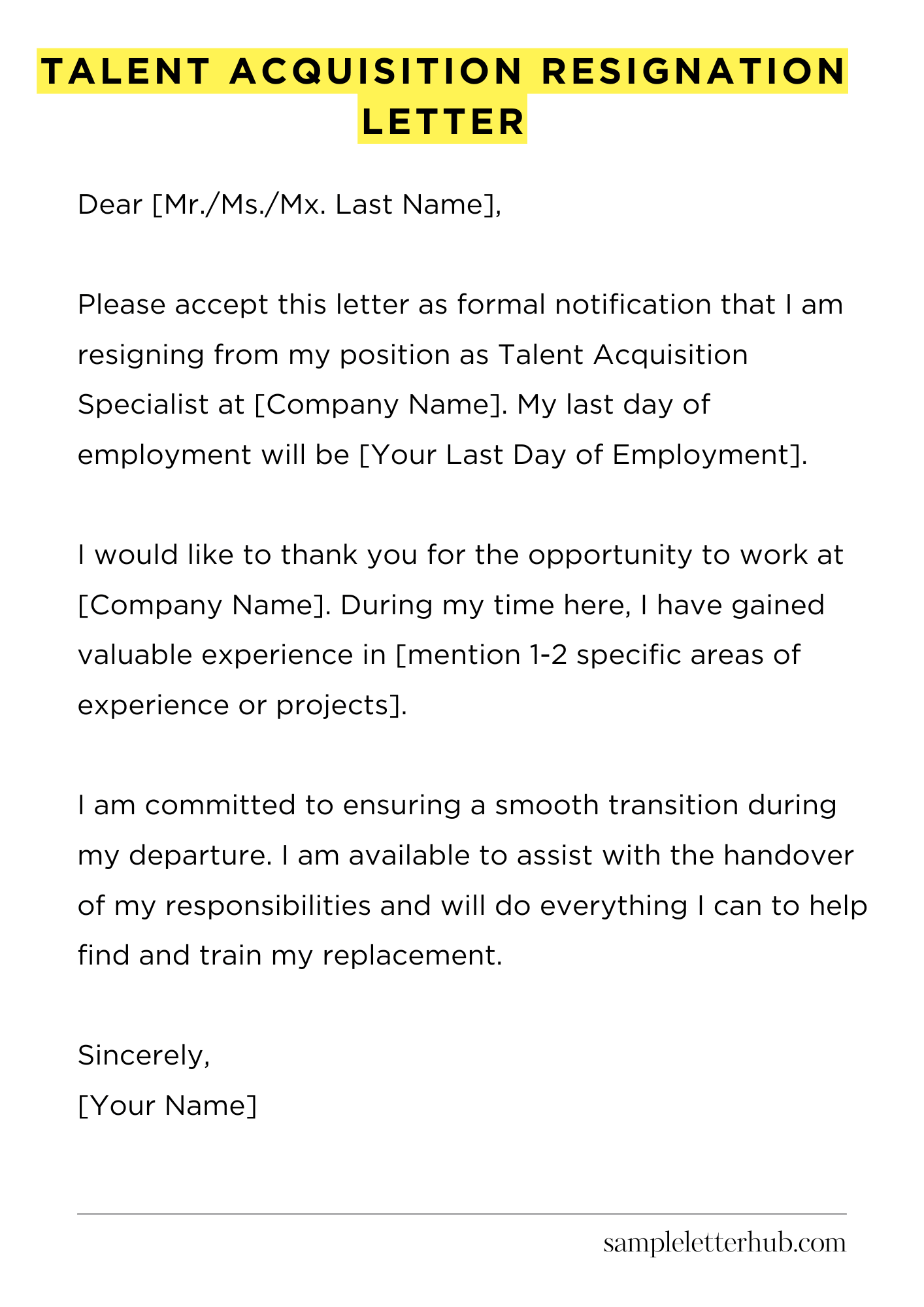
Dear [Mr./Ms./Mx. Last Name],
Please accept this letter as formal notification that I am resigning from my position as Talent Acquisition Specialist at [Company Name]. My last day of employment will be [Your Last Day of Employment].
I would like to thank you for the opportunity to work at [Company Name]. During my time here, I have gained valuable experience in [mention 1-2 specific areas of experience or projects].
I am committed to ensuring a smooth transition during my departure. I am available to assist with the handover of my responsibilities and will do everything I can to help find and train my replacement.
I wish you and [Company Name] all the best in the future.
Sincerely,
[Your Name]
How to Write a Talent Acquisition Resignation Letter
Know Your Audience (and Yourself) First
Leaving a job is a big decision. It’s vital, before you even think about writing, that you have a firm grasp of your reasons. Why are you leaving your Talent Acquisition role? Are you pursuing a better opportunity? Do you need a change of pace? Understanding your motives helps you frame your letter appropriately.
Think about who will be reading it: Your direct manager? HR? Perhaps both? This impacts the tone and level of formality. Be honest and professional.
Also, take a deep breath. Resignations can be emotional. Take time to reflect on your time in the role. Your letter is a professional document; it should reflect that.
The Basic Structure: Keep it Simple
A good resignation letter follows a pretty standard formula. You don’t need to reinvent the wheel! Clarity is the name of the game here. Start with your name, the date, and the recipient’s name and title. Then, get to the point, clearly stating your intention to resign and the effective date. Make sure the date is aligned with company policy and your employment contract.
Next, express your gratitude. Acknowledge the opportunities you’ve been given. Briefly mention any specific experiences or skills you’ve gained. This adds a touch of professionalism and goodwill.
Finally, end by offering your assistance with the transition. Offer to help train your replacement, complete any outstanding tasks, or provide any necessary handover documents. Close the letter politely, and sign off.
Crafting the Right Tone: Be Professional
The tone is super important. This is not the time to air grievances. Maintain a respectful and professional demeanor, no matter how you truly feel about the job. Avoid negativity and complaints, even if you had a negative experience. You don’t want to burn any bridges.
Use clear, concise language. Avoid jargon or overly flowery language. Focus on the facts. Keep it short and sweet. If you’re unsure about something, err on the side of formality. Proofread your letter carefully for any typos or grammatical errors. This is crucial!
What to Include (and What to Leave Out)
Besides the essentials (your intention, the date, thanks, and transition support), consider including a very brief, neutral statement about your reason for leaving, but only if you are comfortable and it does not disparage your company or colleagues.
Avoid mentioning details about your new job or salary, unless specifically required. Also, it’s generally best to avoid providing a detailed critique of your previous role or company. Keep the focus on the positive aspects of your experience, and the next step in your career.
You may also include your personal contact information (email or phone) if you are open to being contacted for reference checks or future opportunities.
Final Check and Delivery
Before you send your letter, have someone else review it. A fresh pair of eyes can catch any mistakes you missed. Make sure you proofread it again yourself.
Deliver your resignation letter according to your company’s policy. This is usually to your manager or HR department. Consider handing them a hard copy and emailing it, too. This provides a clear, documented record of your resignation.
Be prepared for a conversation after you hand in the letter. Your manager may want to discuss your reasons for leaving or try to counteroffer. Stay professional, stick to your decision (if you’re sure), and be ready to move forward. Best of luck!
FAQs about Talent Acquisition Resignation Letter
What is the primary purpose of a Talent Acquisition resignation letter?
The primary purpose of a Talent Acquisition resignation letter is to formally notify your employer of your intention to leave your position. It serves as an official record of your departure and helps to initiate the offboarding process.
This letter allows you to state your last day of employment and provide any necessary context regarding your reason for leaving (though this is typically kept brief and professional).
What key elements should be included in a Talent Acquisition resignation letter?
A well-crafted Talent Acquisition resignation letter should include your formal announcement of resignation, your official job title, your last day of employment, and a brief and professional statement of appreciation or gratitude.
It’s also often advisable to offer assistance with the transition process. It should be addressed to the appropriate person (typically your direct manager or HR) and signed.
How far in advance should I submit my Talent Acquisition resignation letter?
The timing for submitting your resignation letter typically depends on your employment contract or company policy. However, as a general rule, providing at least two weeks’ notice is considered standard practice in most countries.
This allows your employer sufficient time to find a replacement and begin the handover process. Check your employment agreement for specifics about the required notice period.
Should I provide a detailed reason for leaving in my Talent Acquisition resignation letter?
While you are not obligated to provide an in-depth explanation, a Talent Acquisition resignation letter typically contains a brief, professional statement about your reason for leaving.
You may simply state that you are pursuing other opportunities or that you have accepted a new role elsewhere. Detailed reasons are generally better discussed in person with your manager, not in the formal letter.
How can I ensure my Talent Acquisition resignation letter is professional and respectful?
To ensure professionalism, keep your letter concise and to the point. Maintain a positive tone, even if you are leaving due to negative experiences. Express your gratitude for the opportunity to work there, and offer your assistance during the transition period. Proofread the letter carefully for any spelling or grammatical errors before submission.
Always maintain professionalism and respect, as this letter is a record of your departure and the impression it leaves can affect future references and opportunities.
Related:
Resignation letter due to rude boss
Resignation letter moving to another state
Resignation letter due to illness of family member
Resignation letter due to study