

A team member resignation letter is a formal notice. It tells your employer you are leaving your job. The letter’s main purpose is to officially announce your departure. It also states your last day of employment.
Writing this letter can feel tricky. Don’t worry, we’ve got you covered. We’ll show you different letter templates. You can use them to create your own letter. Each sample is easy to adapt to your situation.
We’ll share various examples. They cover different job roles and reasons for leaving. Find the perfect fit for your needs. We’ll make writing your resignation letter a breeze.
Team Member Resignation Letter
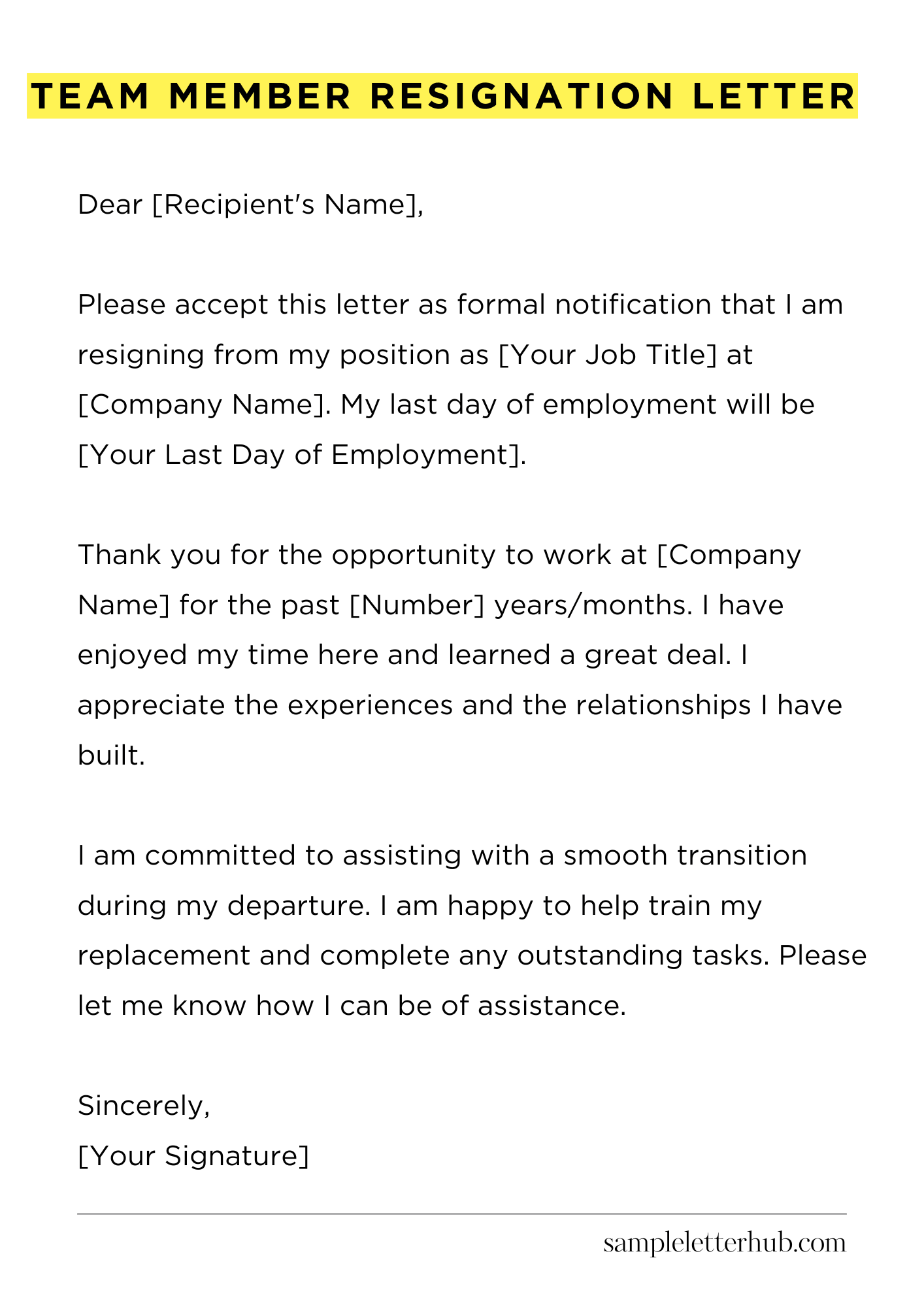
Below is a sample of a Team Member Resignation Letter:
[Your Name]
[Your Address]
[Your Phone Number]
[Your Email Address]
[Date]
[Recipient’s Name]
[Recipient’s Title]
[Company Name]
[Company Address]
Dear [Recipient’s Name],
Please accept this letter as formal notification that I am resigning from my position as [Your Job Title] at [Company Name]. My last day of employment will be [Your Last Day of Employment].
Thank you for the opportunity to work at [Company Name] for the past [Number] years/months. I have enjoyed my time here and learned a great deal. I appreciate the experiences and the relationships I have built.
I am committed to assisting with a smooth transition during my departure. I am happy to help train my replacement and complete any outstanding tasks. Please let me know how I can be of assistance.
I wish you and the company continued success in the future.
Sincerely,
[Your Signature]
How to Write a Team Member Resignation Letter
1. Why is a Resignation Letter Important?
Leaving a job is a big step. Therefore, doing it professionally matters a great deal. A well-crafted resignation letter is your official notice to your employer. It’s more than just a formality, though it is that too. It documents your departure. This can be important for legal and administrative purposes.
It sets a positive tone for your exit. You want to leave a good impression. This is even if you’re unhappy. It can benefit you later. You may want to return one day! Consider it a stepping stone. A professional letter protects you, and the company. It makes the transition smoother for everyone.
2. Essential Elements to Include
Your resignation letter needs key information. First, state your intention to resign. Make it clear and direct. Use a simple sentence. Next, clearly state your last day of employment.
This is crucial for payroll and handover purposes. Always thank your employer for the opportunity. This shows respect. Briefly mention your reasons for leaving. It can be a simple sentence. However, if you’re not comfortable sharing, you can keep it vague. A brief overview is usually all that’s needed.
Finally, offer assistance during the transition. Offer to help train a replacement. This shows you are a team player. Include your contact information. This is to keep the lines of communication open. You might need it.
3. Crafting the Right Tone
The tone of your letter is important. Keep it professional. Avoid negativity, even if you’ve had a bad experience. Focus on the positive aspects of your time at the company.
Be brief and to the point. Avoid overly emotional language. Stick to the facts. Express gratitude. Even if the job wasn’t a perfect fit. End with a positive and forward-looking statement. Maintain a friendly and respectful tone throughout the letter.
4. Formatting and Delivery
Proper formatting is essential. Start with your contact information. Place it at the top. Follow with the date. Then, address the letter to the appropriate person. Typically, this is your manager or HR.
Keep it concise. Use a standard business letter format. Use clear and easy-to-read fonts. Proofread carefully before sending. Check for any errors. Deliver the letter in a timely manner. Give your employer the required notice. This is usually two weeks. Always keep a copy for your records. Consider both a hard copy and an electronic one.
5. Examples and Templates
Need some help? Here is a simple framework.
[Your Name]
[Your Address]
[Your Phone Number]
[Your Email]
[Date]
[Recipient’s Name]
[Recipient’s Title]
[Company Name]
Dear [Recipient’s Name],
Please accept this letter as formal notification that I am resigning from my position as [Your Position] at [Company Name]. My last day of employment will be [Your Last Day of Employment].
I am grateful for the opportunity to have worked here. I have learned a lot. I wish you and the company continued success.
I am happy to assist in the transition of my responsibilities. Please let me know how I can help.
Sincerely,
[Your Signature]
[Your Typed Name]
You can customize the above template. Remember to tailor the reasons for leaving to your situation. Using a template gives you a head start.
FAQs about Team Member Resignation Letter
Here are some frequently asked questions and their answers regarding team member resignation letters.
What is the primary purpose of a team member resignation letter?
The primary purpose of a team member resignation letter is to formally communicate an employee’s decision to leave their position with the company. It serves as an official record of the employee’s intent to resign and typically includes the effective date of their departure. The letter also facilitates the handover process and helps ensure a smooth transition.
What essential information should be included in a resignation letter?
A well-crafted resignation letter should include the employee’s clear and unambiguous intent to resign, the employee’s name and job title, the effective date of resignation, and a concise statement of gratitude for the opportunity to work at the company. It is also good practice to acknowledge any specific company policies regarding resignation.
Additional details, such as reason for leaving or offering assistance during the transition, are optional.
How much notice should I provide in my resignation letter?
The amount of notice to provide is typically determined by the employment contract, company policy, or local labor laws. The standard is often two weeks, however, it is essential to consult the relevant documentation to determine the required notice period. Providing adequate notice is crucial for maintaining a professional relationship and ensuring a smooth transition.
Should I provide a reason for resigning in the letter?
While not always mandatory, providing a reason for resignation is optional. If you choose to include it, keep the tone positive and concise. You may state you’re pursuing another opportunity, seeking new challenges, or relocating. Avoid negative comments about the company or colleagues, especially if you may need them for a reference.
Can I use a resignation letter template, or do I need to write my own?
You can certainly use a resignation letter template as a starting point. There are many readily available templates online. However, it’s recommended to personalize the template to reflect your specific situation and circumstances. Tailoring the letter allows you to maintain professionalism and to express your gratitude appropriately.
Related:
Resignation letter due to rude boss
Resignation letter moving to another state
Resignation letter due to illness of family member
Resignation letter due to study