

A “Presenter resignation letter” is a formal document. It is written when a presenter decides to leave their job. The main purpose is to officially inform the employer of the presenter’s decision.
This article is all about making your resignation easy. We will provide helpful templates. These templates include examples. You can use them as a guide.
We aim to simplify the writing process. You can adapt these samples to your specific situation. Craft your letter with confidence.
Presenter Resignation Letter
Below is a sample of a Presenter Resignation Letter:
[Your Name]
[Your Address]
[Your Phone Number]
[Your Email Address]
[Date]
[Recipient Name] (If known, otherwise use title)
[Recipient Title]
[Company Name]
[Company Address]
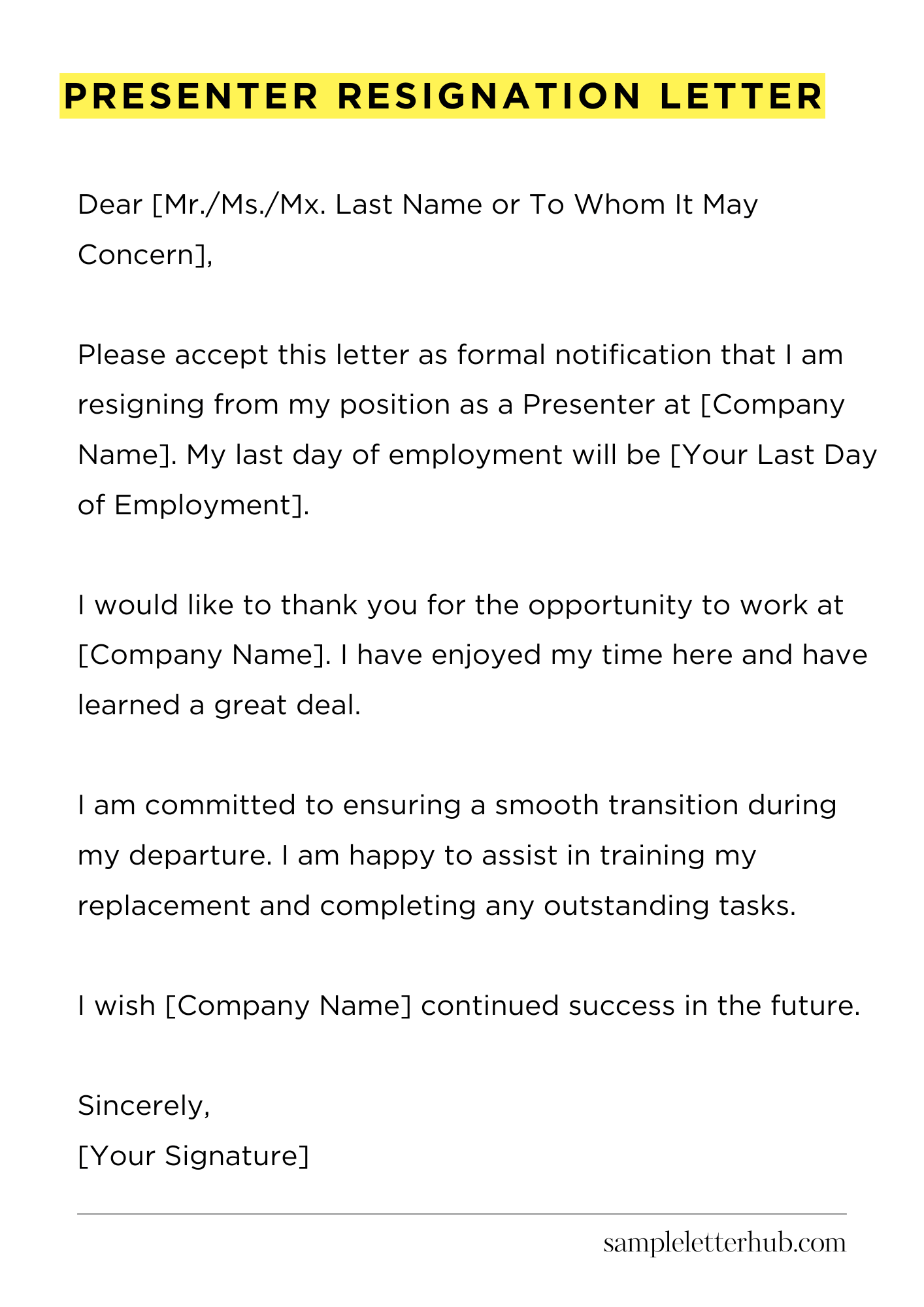
Dear [Mr./Ms./Mx. Last Name or To Whom It May Concern],
Please accept this letter as formal notification that I am resigning from my position as a Presenter at [Company Name]. My last day of employment will be [Your Last Day of Employment].
I would like to thank you for the opportunity to work at [Company Name]. I have enjoyed my time here and have learned a great deal.
I am committed to ensuring a smooth transition during my departure. I am happy to assist in training my replacement and completing any outstanding tasks.
I wish [Company Name] continued success in the future.
Sincerely,
[Your Signature]
How to Write a Presenter Resignation Letter
So, you’ve decided to move on from your presenter role. Congratulations on making a choice that you feel is best for you! The next step, a crucial one, is crafting your resignation letter.
This isn’t just about saying “I quit.” It’s a professional document, a final statement, and a reflection of your character. It’s also often a legal necessity, so let’s get it right, shall we?
1. The Essential Elements
Your resignation letter should be concise, clear, and professional. It needs to contain a few key pieces of information. First, you must clearly state your intention to resign.
This seems obvious, but don’t be vague. State the date of your resignation explicitly. This provides clarity and avoids any misunderstandings. Secondly, you need to state the role you are leaving. Finally, specify your last day of employment. This is usually determined by your contract or company policy. Keep it short and to the point.
2. The Tone and Content
The tone of your letter should be professional and courteous, even if you’re leaving due to negative reasons. Avoid negativity! Refrain from venting any frustrations or airing grievances.
Briefly and positively acknowledge your experience. You could mention something you enjoyed during your time at the organization. If you are comfortable, you can express gratitude for the opportunities you’ve been given.
You might even thank specific individuals if appropriate. This reflects well on you. It’s a small gesture, but it goes a long way. This is your exit interview in written form.
3. Formatting Your Letter
Keep your letter well-formatted. Use a standard business letter format. Include your contact information (name, address, phone number, email address) at the top. Date the letter.
Address the letter to the appropriate person, usually your direct supervisor or HR department. Use a professional closing such as “Sincerely,” or “Best regards,” followed by your full name. Proofread the document carefully before sending it. Errors create a bad impression.
4. Offering Assistance During the Transition
If you’re willing to assist with the transition, it’s a classy move to mention this in your letter. This shows respect for the company and your colleagues.
This also demonstrates your professionalism. It will help in a smooth hand over. This doesn’t mean you’re obligated to stay beyond your last day, but offering help during your notice period can leave a positive impression. You can offer to help train your replacement, document your tasks, or answer questions.
5. Sample Resignation Letter
Here’s a basic template to get you started. Remember to customize it to fit your specific situation!
[Your Name]
[Your Address]
[Your Phone Number]
[Your Email Address]
[Date]
[Recipient’s Name]
[Recipient’s Title]
[Company Name]
[Company Address]
Dear [Recipient’s Name],
Please accept this letter as formal notification that I am resigning from my position as [Your Position] at [Company Name], effective [Your Last Day of Employment].
I would like to thank you for the opportunities I have been given during my time here. I have learned a lot and gained valuable experience.
I am happy to assist in the transition process in any way I can.
Sincerely,
[Your Signature]
[Your Typed Name]
There you have it! Writing a resignation letter, while a formal task, doesn’t have to be daunting. Follow these simple steps and create a professional document.
FAQs about Presenter Resignation Letter
Understanding the nuances of a presenter resignation letter is crucial for a smooth transition. Here are some frequently asked questions to help you navigate this process effectively.
What essential information should be included in a presenter resignation letter?
A presenter resignation letter should include: your formal resignation statement, the effective date of your resignation, a statement of gratitude (optional, but recommended), and any necessary handover information.
Be sure to address the letter to the appropriate person, usually your supervisor or HR representative, and keep the tone professional and concise. If there is a reason for resignation you can include it.
How much notice should a presenter provide when resigning?
The standard notice period varies depending on the employment contract or company policy. However, a general rule of thumb is to provide at least two weeks’ notice. Review your employment agreement to confirm the required notice period. Providing ample notice allows for a smoother transition, a replacement presenter to be found, and shows professionalism.
Should I provide a reason for my resignation in the letter?
While not always mandatory, offering a brief and professional reason for your departure can be beneficial. It’s especially useful if you are moving onto a new job as you can use this as an opportunity to be thankful to the organization, or if you can see yourself coming back to the organization in the future.
Keep the explanation brief and avoid negative comments about the company or colleagues. If you prefer to keep the reason private, you are not obligated to disclose it.
How should I handle handover responsibilities in my resignation letter?
In your letter, offer to assist with the handover process. State your willingness to train a replacement, transfer knowledge, and provide documentation. Include specific details on how you will aid in the transition, such as providing necessary files or being available for consultations during your notice period. This shows your commitment to a professional departure.
What is the proper format for a presenter resignation letter?
A professional resignation letter should be formatted in a business letter style. Begin with your contact information, the date, and the recipient’s information. Use a formal salutation (e.g., “Dear [Name]”).
State your intention to resign, the effective date, and your gratitude, then address the handover and end with a professional closing (e.g., “Sincerely”). Keep the letter concise and focused on the key information.
Related:
Resignation letter due to rude boss
Resignation letter moving to another state
Resignation letter due to illness of family member
Resignation letter due to study