

A “Pricing Analyst resignation letter” is a formal document. It is written to inform your employer of your decision. The letter officially states your departure date. It serves as a record of your resignation.
Leaving a job can be tricky. This article is here to help. We’ll provide you with several templates. These templates cover various situations. You can adapt them to your specific needs.
Ready to move on? We have samples for different circumstances. Need to keep it short and sweet? We have a template. Want to express gratitude? We have a version for that too. Let’s get started.
Pricing Analyst Resignation Letter
Below is a sample of a Pricing Analyst Resignation Letter:
[Your Name]
[Your Address]
[Your Phone Number]
[Your Email Address]
[Date]
[Hiring Manager Name] (If known, otherwise use title)
[Hiring Manager Title]
[Company Name]
[Company Address]
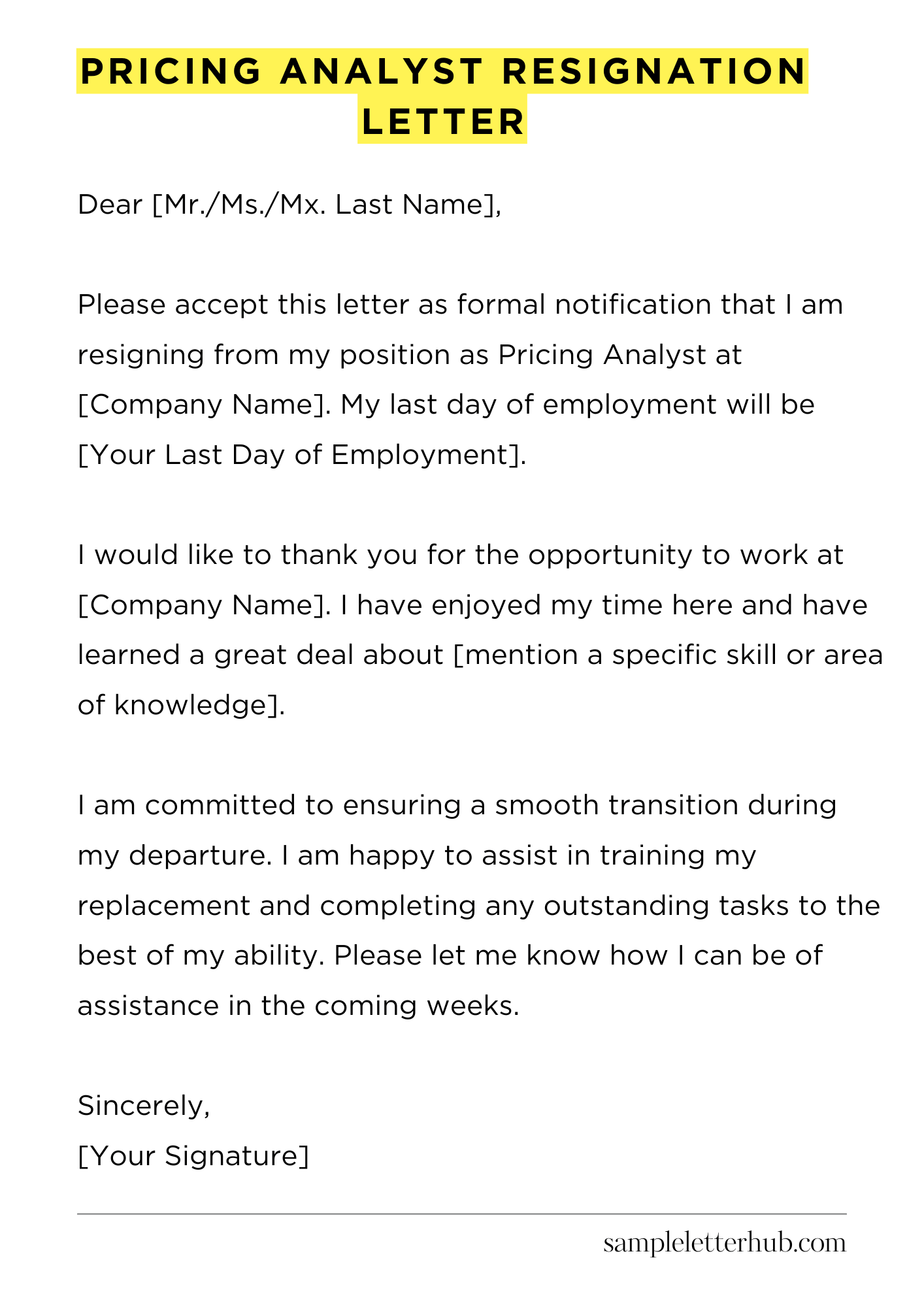
Dear [Mr./Ms./Mx. Last Name],
Please accept this letter as formal notification that I am resigning from my position as Pricing Analyst at [Company Name]. My last day of employment will be [Your Last Day of Employment].
I would like to thank you for the opportunity to work at [Company Name]. I have enjoyed my time here and have learned a great deal about [mention a specific skill or area of knowledge].
I am committed to ensuring a smooth transition during my departure. I am happy to assist in training my replacement and completing any outstanding tasks to the best of my ability. Please let me know how I can be of assistance in the coming weeks.
I wish you and [Company Name] all the best in the future.
Sincerely,
[Your Signature]
How to Write a Pricing Analyst Resignation Letter
So, you’re moving on! Congratulations on your next chapter. Leaving a job, especially a role like a Pricing Analyst, requires professionalism and grace. You need to ensure a smooth transition. A well-crafted resignation letter is key. It’s more than just informing your employer; it’s a reflection of your character and your commitment to a positive exit.
Step 1: The Basics – Addressing and Introduction
Let’s get down to the basics. Your letter should be properly addressed to your direct manager or the appropriate HR representative. Always use a formal tone. Begin by clearly stating your intention to resign.
Keep it concise. In the first paragraph, explicitly state your resignation, your current position, and the effective date of your departure. This eliminates any ambiguity. For example: “Please accept this letter as formal notification that I am resigning from my position as Pricing Analyst, effective two weeks from today, [Date].”
Step 2: Expressing Gratitude and Highlighting Contributions
Next, show appreciation. A touch of gratitude goes a long way. This is a crucial step! Briefly acknowledge the opportunities you’ve been given. Mention any specific skills you’ve developed or projects you’ve worked on. Focus on positive experiences. Show respect for the company and its leadership.
Here’s an example: “I am grateful for the opportunities I’ve had during my time at [Company Name]. I especially appreciate the chance to [mention a specific project or skill gained]. I learned a lot here.”
Step 3: Offer of Assistance During Transition
This is where you demonstrate integrity. Offer assistance with the transition. This sets you apart. If possible, offer to help train your replacement or complete any ongoing tasks.
This speaks volumes about your work ethic. Consider a statement like this: “I am committed to ensuring a smooth handover of my responsibilities. I am happy to assist in training my replacement and to complete any pending projects before my departure.” It can be super valuable!
Step 4: Formal Closing and Contact Information
Now, close out your letter formally. Reiterate your effective date one last time. Include your contact information. Make sure it’s up to date. This ensures they can reach you if needed.
It’s professional. Add a closing that is appropriate, such as “Sincerely,” or “Best regards.” Sign the letter and type your full name. Provide your personal email and phone number, just in case! This concludes everything you need.
Step 5: Review and Proofread
The most important part! Always review and proofread your letter carefully. Check for any grammatical errors or typos. Ensure your tone is professional and respectful throughout.
Make sure the dates and details are accurate. A well-written, error-free letter reflects your professionalism. Ask a friend or colleague to review it as well. Don’t rush this step; It’s the final impression you are making.
FAQs about Pricing Analyst Resignation Letter
What is the essential information to include in a Pricing Analyst resignation letter?
A comprehensive resignation letter should include your formal resignation, stating your last day of employment. Mention the role you are resigning from (Pricing Analyst).
Provide a concise and professional reason for your departure if desired, but it’s not always required. Express gratitude for the opportunities you’ve been given, and if appropriate, offer assistance with the transition. Include your contact information for any necessary communication after your departure.
How should a Pricing Analyst address their supervisor or manager in the resignation letter?
The letter should be addressed formally to your supervisor or manager. Use their correct title and name. Maintain a professional tone throughout the letter, reflecting respect for their position and the working relationship you’ve had. Avoid overly casual language or negativity. A sincere expression of thanks for the experience and opportunities is often appropriate.
What is the typical notice period required for a Pricing Analyst resignation?
The standard notice period is typically two weeks (14 calendar days). However, this can vary based on company policy, your employment contract, or any specific agreements you have with your employer.
Always consult your employment contract or employee handbook to confirm the required notice period. Adhering to the specified timeframe is crucial for a smooth transition.
Should a Pricing Analyst provide a reason for resigning in the letter, and if so, what is the best approach?
Providing a reason for your resignation is optional. If you choose to do so, keep it brief, positive, and professional. Avoid negativity or personal complaints.
General statements such as “pursuing other opportunities” or “seeking a new career direction” are often sufficient. If you are comfortable, you can briefly mention a specific reason, but it’s essential to maintain a professional and courteous tone.
What are some common mistakes to avoid when writing a Pricing Analyst resignation letter?
Avoid being overly emotional, negative, or airing grievances. Do not burn bridges by making disparaging remarks about the company, colleagues, or management.
Ensure your letter is free of grammatical errors and typos. Avoid disclosing confidential company information. Finally, ensure you have a copy of the letter for your records and send it via the appropriate channels as required by your company.
Related:
Resignation letter due to rude boss
Resignation letter moving to another state
Resignation letter due to illness of family member
Resignation letter due to study