

Ready to move on from your recruiting role? You’ll need a recruiter resignation letter. This document officially informs your employer of your departure. It’s a crucial step in a professional exit. The letter serves as a formal record of your resignation.
Crafting the perfect letter can feel tricky. Don’t worry, we’ve got you covered. We’ll provide you with useful templates. You can adapt these to fit your unique situation. We also have examples to inspire you.
Use these samples to make your own. We’ll simplify the writing process. Write your letter with confidence and ease. Let’s get started.
Recruiter Resignation Letter
Below is a sample of a Recruiter Resignation Letter:
[Your Name]
[Your Address]
[Your Phone Number]
[Your Email Address]
[Date]
[Hiring Manager Name] (If known, otherwise use title)
[Hiring Manager Title]
[Company Name]
[Company Address]
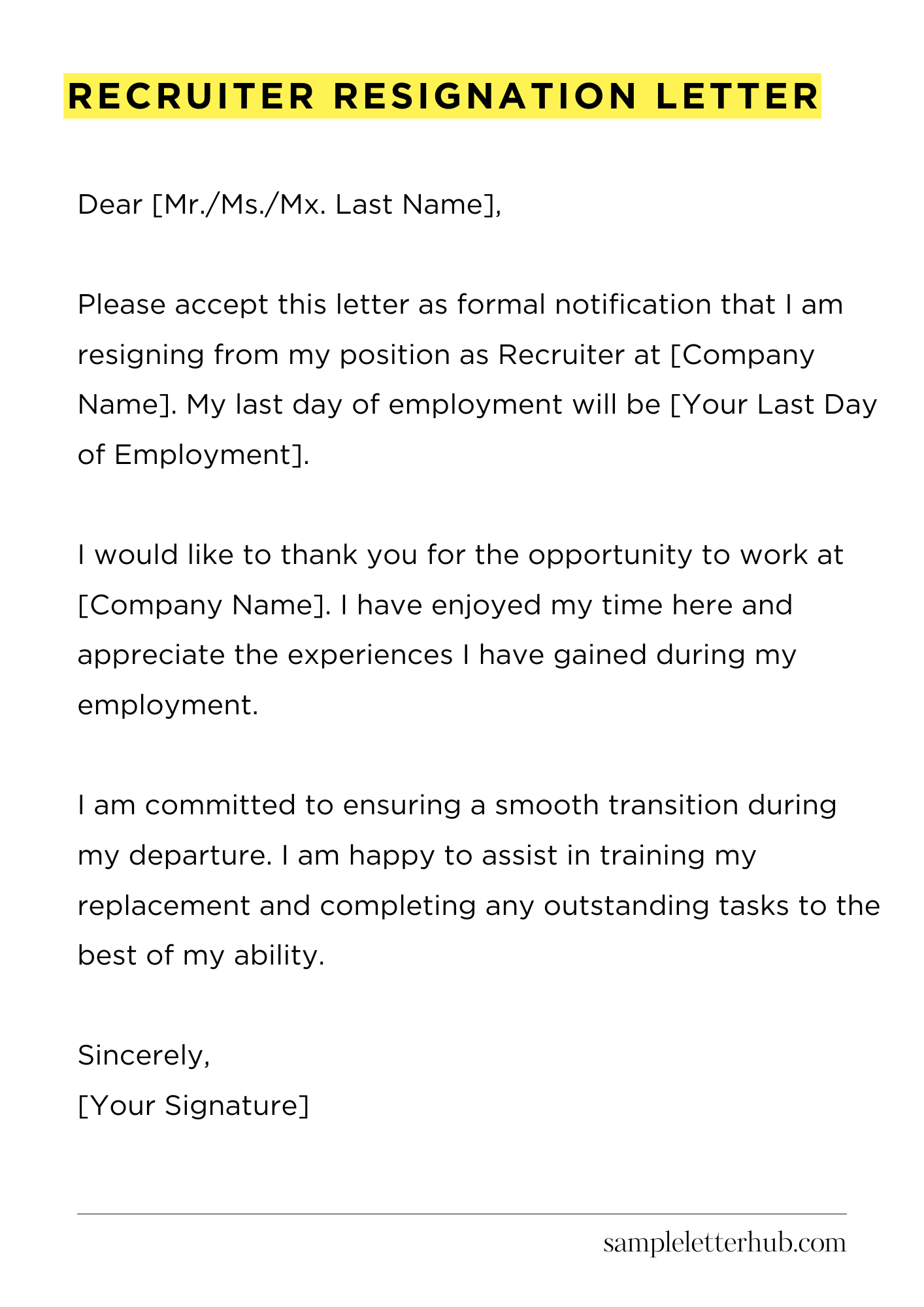
Dear [Mr./Ms./Mx. Last Name],
Please accept this letter as formal notification that I am resigning from my position as Recruiter at [Company Name]. My last day of employment will be [Your Last Day of Employment].
I would like to thank you for the opportunity to work at [Company Name]. I have enjoyed my time here and appreciate the experiences I have gained during my employment.
I am committed to ensuring a smooth transition during my departure. I am happy to assist in training my replacement and completing any outstanding tasks to the best of my ability.
I wish you and [Company Name] all the best in the future.
Sincerely,
[Your Signature]
How to Write a Recruiter Resignation Letter
So, you’re moving on from your recruiting role? Congratulations! Writing a resignation letter is a crucial, professional step. This document formally communicates your departure and sets the tone for your future interactions. It’s more than just a formality; it’s a reflection of your professional brand.
1. Preparation is Key: Before You Start Typing
Before putting pen to paper (or fingers to keyboard), there are a few things you need to do. First, confirm the date of your departure with your manager. This is your official last day. Next, understand company policy. What’s the required notice period? Make sure your letter aligns with these guidelines.
Research internal procedures regarding your resignation. Is there a specific format required? Knowing these details will save you headaches later. Finally, think about your tone. Be positive and professional, even if you’re leaving because of negative circumstances. Your goal is to leave a good impression.
2. Crafting the Core: What to Include
Let’s get down to the actual writing. Your letter should be clear, concise, and courteous. Start with a straightforward statement. Clearly state your intention to resign and the effective date.
Next, express gratitude for the opportunity. Briefly acknowledge the experience you’ve gained and any positive aspects of your time at the company. Then, offer assistance with the transition.
Be willing to help with onboarding your replacement or transferring your current responsibilities. After that, keep it simple. Avoid negativity or lengthy explanations for your departure. Finally, conclude with a thank you and a professional sign-off. Remember to include your contact information for future reference.
3. Format and Style: Making it Look Good
Presentation matters! Your letter should be well-formatted and easy to read. Use a standard business letter format. This typically includes your contact information, the date, the recipient’s contact information, and a professional salutation (e.g., “Dear [Manager’s Name]”).
Keep your letter brief—aim for one page. Use a clear and readable font, like Times New Roman or Arial, with a size of 12 points. Proofread carefully. Check for any grammar mistakes or typos before sending. A well-formatted letter shows respect and attention to detail.
4. The Do’s and Don’ts: Things to Avoid
There are a few things to avoid when writing your resignation letter. Don’t use negative language. Refrain from criticizing the company, your colleagues, or your manager. Avoid including details about your new job or salary, unless specifically requested. Do not make any personal attacks.
Keep it focused on your departure and the handover process. Always be respectful, even if you are unhappy. On the flip side, do be professional, be clear and concise. Be appreciative, even if you are leaving under less-than-ideal circumstances. Also, offer your assistance during the transition phase. Doing these things will show you are professional.
5. After Submission: What Happens Next
Once you’ve submitted your letter, what happens? Your manager will likely reach out to discuss your departure. Be prepared for this conversation. You might be asked about your reasons for leaving or asked to provide more information about your responsibilities. Follow up on any transition tasks you agreed to in your letter.
Make sure you complete them before your last day. Maintain a professional demeanor throughout the transition process. Finally, maintain the same positive attitude even after your departure. You never know when you might cross paths with former colleagues or managers again.
FAQs about Recruiter Resignation Letter
What is the primary purpose of a recruiter resignation letter?
The primary purpose of a recruiter resignation letter is to formally notify your employer of your intention to leave your current role. It serves as a written record of your departure, officially communicating your last day of employment and allowing for a smooth transition process.
It provides an opportunity to express your gratitude and potentially offer assistance during the handover.
What key elements should be included in a recruiter resignation letter?
A comprehensive recruiter resignation letter should include your formal notification of resignation, stating your intention to leave and the effective date of your departure.
You should also express gratitude for the opportunities you’ve been given, and briefly mention your reason for leaving. A brief acknowledgement of any outstanding projects and an offer to assist with the transition is also a good addition. Finally, include your contact information for any future correspondence.
How far in advance should a recruiter submit their resignation letter?
It is generally advisable to submit your resignation letter at least two weeks before your intended last day of employment. This timeframe allows your employer sufficient time to process your resignation, begin the search for a replacement, and plan for the handover of your responsibilities. Refer to your employment contract for the required notice period, as this can vary.
Can a recruiter use a template for their resignation letter?
Yes, recruiters can certainly use templates for their resignation letters. Templates provide a good starting point and help ensure you include all the necessary information. However, it’s essential to personalize the template to reflect your specific circumstances, experiences, and the relationships you’ve built within the company. Modify it to reflect your role and tone.
What are some common mistakes to avoid in a recruiter resignation letter?
Common mistakes to avoid include being overly negative or critical of your employer or colleagues. Avoid listing negative reasons for leaving in detail; keep it brief and professional. Don’t include any personal attacks or irrelevant information. Finally, ensure your letter is proofread for any spelling or grammatical errors before submission.
Related:
Resignation letter due to rude boss
Resignation letter moving to another state
Resignation letter due to illness of family member
Resignation letter due to study