

A “cleaner resignation letter” is a polite way to leave your job. It’s a formal document. Its main purpose is to officially inform your employer of your departure. It keeps things professional and respectful.
Writing this letter can feel tricky. Don’t worry, though. We’ve got you covered. We’ll provide different templates for you. Use them to craft your own perfect resignation.
You’ll find various examples here. These are designed to be simple. They will help you express yourself clearly. Say goodbye with grace and ease.
Cleaner Resignation Letter
Below is a sample of a Cleaner Resignation Letter:
[Your Name]
[Your Address]
[Your Phone Number]
[Your Email Address]
[Date]
[Employer’s Name]
[Cleaning Company Name]
[Company Address]
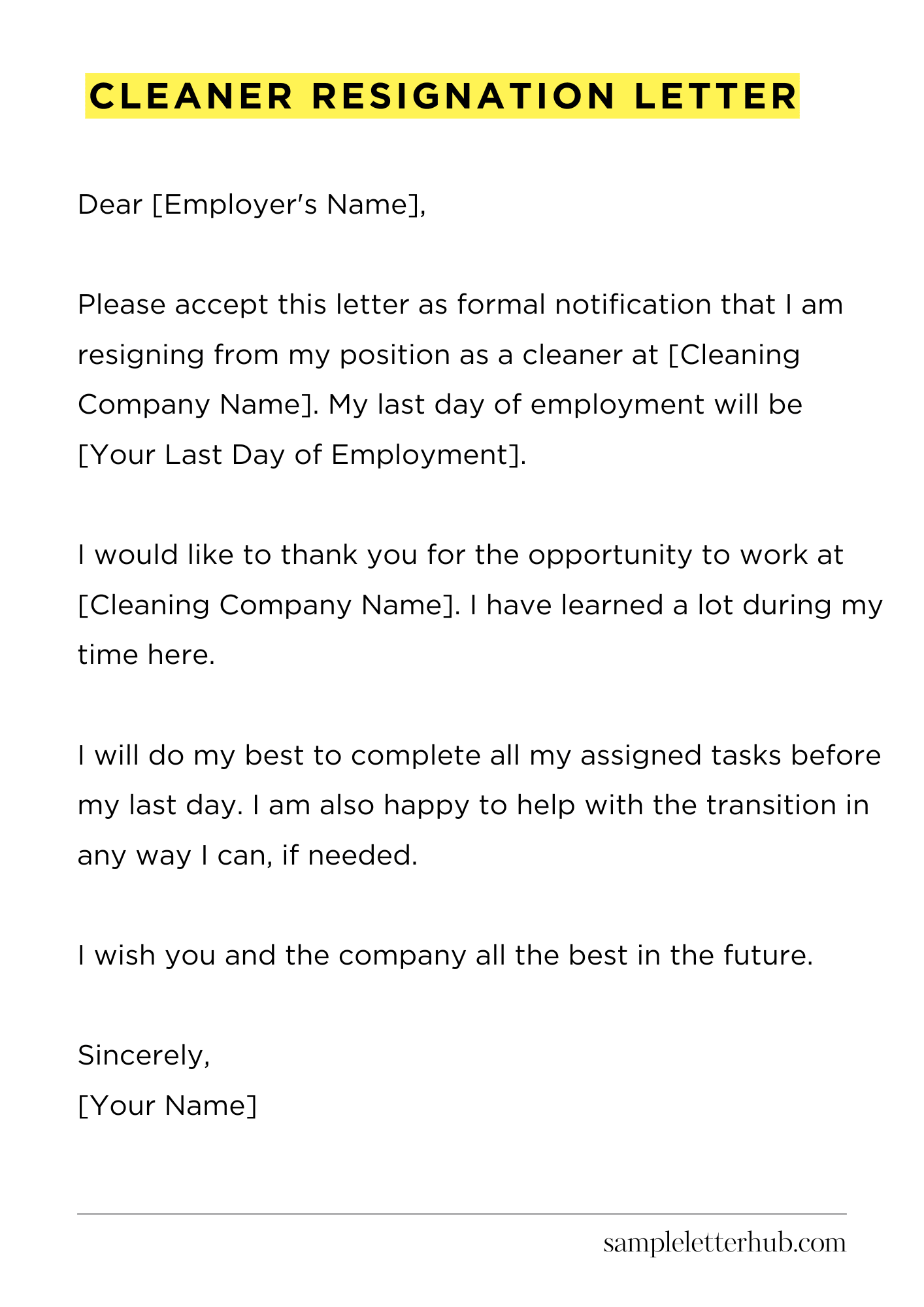
Dear [Employer’s Name],
Please accept this letter as formal notification that I am resigning from my position as a cleaner at [Cleaning Company Name]. My last day of employment will be [Your Last Day of Employment].
I would like to thank you for the opportunity to work at [Cleaning Company Name]. I have learned a lot during my time here.
I will do my best to complete all my assigned tasks before my last day. I am also happy to help with the transition in any way I can, if needed.
I wish you and the company all the best in the future.
Sincerely,
[Your Name]
How to Write Cleaner Resignation Letter
1. Why Clean Matters When You Quit
Resigning from a job is a big deal. You are ending a professional relationship. It’s really that simple. How you do it can have a lasting impact. A well-written resignation letter shows respect. It also leaves a positive impression, even if you’re leaving on less-than-ideal terms.
Think of it like this: your resignation letter is your final statement. And you want it to be a good one. A messy, angry, or unclear letter can backfire. It could burn bridges or even affect future job prospects.
So, keep it clean.
2. The Must-Have Basics: What to Include
There are some key elements to a solid resignation letter. First, you need a clear statement of your intent to resign. State your name, your position, and the date you are resigning. Then, specify your last day of employment. This is crucial for your employer’s records and planning. Always be sure of this date.
Next, express your gratitude. Thank your employer for the opportunity. Mention anything specific if you wish. This shows professionalism. Then, offer to help with the transition. It can be a simple sentence. This is important to ensure a smooth handover.
Finally, your contact information. Include it for follow-up questions or communication.
3. The Stuff You Should Leave Out
Avoid any negativity. This is really, really important. Resist the urge to complain about your boss, colleagues, or the company. Criticizing your employer is not only unprofessional but also irrelevant.
This is not the place for airing grievances. Do not include details about your new job. This information is unnecessary and can be seen as rubbing it in or being disrespectful. Also, keep it concise. Don’t write a novel. Stick to the essentials. Lengthy, rambling letters are often confusing and ineffective.
Trust me on this.
4. Keeping it Simple: The Right Tone
The tone of your letter should be professional and polite. It is not a place for jokes, sarcasm, or personal attacks. Be respectful. Use formal language.
Avoid slang or casual expressions. Even if you have a good relationship with your boss, maintain a professional tone. Keep your language clear and direct. Your goal is to communicate your resignation effectively.
You need to keep things simple for them. Acknowledge your contribution to the team. Mentioning any positive experiences reinforces your professional behavior.
You want to leave a good impression, right?
5. Proofread and Polish: The Finishing Touches
Before you send your letter, proofread it carefully. Check for any grammatical errors, spelling mistakes, or typos. These mistakes look unprofessional. Have someone else read it over too. Another pair of eyes can catch errors you may have missed. Make sure your formatting is clean and easy to read.
A well-formatted letter looks organized. Use a professional font like Times New Roman or Arial. Keep the layout simple with clear margins. Save your letter as a PDF. This ensures the formatting stays consistent.
Now, submit it. And move on with confidence.
FAQs about Cleaner resignation letter
How do I write a cleaner resignation letter?
A cleaner resignation letter should be concise and professional. Begin by clearly stating your intention to resign, mentioning your position and the date of your last day of employment.
Express gratitude for the opportunity to work there, and briefly state the reason for your departure if you wish (optional). Keep the tone positive and respectful. Include your contact information if needed. Review the letter carefully before sending it.
What should I include in a cleaner resignation letter?
Your letter should include: your name and contact information, the date of the letter, the name and address of your employer or the appropriate person, a clear statement of resignation (e.g., “I am writing to inform you that I am resigning from my position as Cleaner”), the date of your last day, a brief expression of gratitude (optional), and your signature.
It’s also wise to keep a copy for your records.
What is the proper notice period for a cleaner resignation?
The notice period depends on your employment contract or local labor laws. Often, it’s a minimum of two weeks’ notice. Review your employment agreement to clarify the required notice. If you’re unsure, consulting with an HR professional or legal advisor is recommended.
Can I provide a reason for resigning in my letter?
Yes, you can optionally include a brief reason for your resignation, but it’s not mandatory. You can keep it simple, such as “due to personal reasons,” or “to pursue a new opportunity.” Keep the tone professional.
Should I hand-deliver or email my resignation letter?
It is typically fine to email a resignation letter, as it provides a written record of your intent. However, depending on company protocol, it may be customary to also provide a printed copy. Always adhere to your company’s communication guidelines, but both methods are generally accepted.
Related:
Resignation letter due to rude boss
Resignation letter moving to another state
Resignation letter due to illness of family member
Resignation letter due to study