

So, you’re leaving your accounting job. You’ll need an accountant resignation letter. This is a formal document. It informs your employer of your departure. It states your last day of employment.
Writing this letter can feel tricky. You want to be professional. You want to make a good impression. Don’t worry. We’ve got you covered.
Here, you’ll find different templates. We’ll show you various examples. They can help you craft your own letter. This article will make the process simple.
Accountant Resignation Letter
Below is a sample of a Accountant Resignation Letter:
[Your Name]
[Your Address]
[Your Phone Number]
[Your Email Address]
[Date]
[Recipient Name]
[Recipient Title]
[Company Name]
[Company Address]
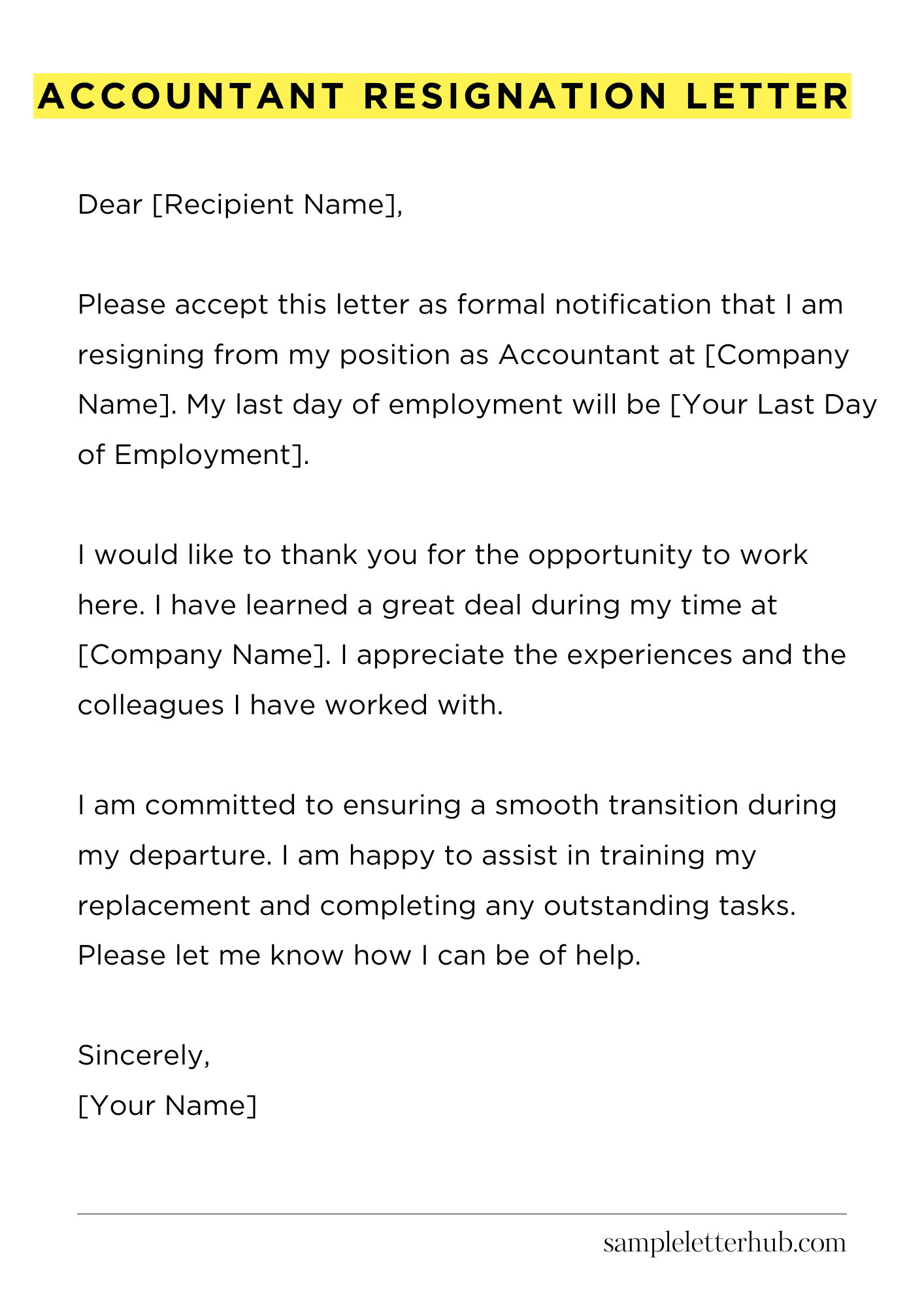
Dear [Recipient Name],
Please accept this letter as formal notification that I am resigning from my position as Accountant at [Company Name]. My last day of employment will be [Your Last Day of Employment].
I would like to thank you for the opportunity to work here. I have learned a great deal during my time at [Company Name]. I appreciate the experiences and the colleagues I have worked with.
I am committed to ensuring a smooth transition during my departure. I am happy to assist in training my replacement and completing any outstanding tasks. Please let me know how I can be of help.
I wish you and [Company Name] all the best in the future.
Sincerely,
[Your Name]
How to Write an Accountant Resignation Letter
Getting Started: Why a Proper Resignation Matters
Leaving a job, especially as a professional like an accountant, requires a strategic approach. It is not just about walking out the door. You need a resignation letter. Think of it as a crucial formal document that will forever be part of your employment record. Writing a thoughtful letter is essential for several reasons.
Firstly, it ensures a smooth transition. You don’t want to burn any bridges. This can affect your future career prospects. It sets a positive tone for your departure. Secondly, a well-written letter is a professional courtesy to your employer. It shows respect for the time you spent with the company.
Thirdly, it is important to comply with the employment contract. Your contract likely specifies the required notice period. Failure to do so could lead to issues later. Therefore, a good resignation letter is not optional; it’s a necessity.
The Essential Elements: What to Include
So, what should you actually put in your letter? Clarity and professionalism are your best friends. Begin with a clear and concise statement of your intent to resign.
State the effective date of your resignation. This date should align with your contract’s notice period, if there is one. You must provide it. Briefly express your gratitude for the opportunity to work there. Then, express your gratitude. After that, acknowledge any positive experiences. Consider mentioning specific projects or skills gained.
Keep this section brief. Avoid long, emotional rambles. Next, offer your assistance during the transition period. Propose helping with training or knowledge transfer. Mentioning the transition is a great gesture.
Finally, end the letter with a professional closing. Use a formal sign-off. Then, type your full name. Also, make sure to include all of the required components to ensure you are leaving on good terms.
Structuring Your Letter: A Template for Success
Here’s a basic template you can adapt:
[Your Name]
[Your Address]
[Your Phone Number]
[Your Email Address]
[Date]
[Employer’s Name]
[Company Name]
[Company Address]
Dear [Manager’s Name],
Please accept this letter as formal notification that I am resigning from my position as [Your Job Title] at [Company Name]. My last day of employment will be [Your Last Day of Employment].
I am grateful for the opportunities I have been given during my time here. [Mention something specific you appreciated, if you wish.]
I am happy to assist with the transition process in any way I can, including [mention specific offers of help].
Thank you for everything.
Sincerely,
[Your Full Name]
This template is a great starting point, but always customize it to your specific situation and role.
Common Pitfalls: What to Avoid
There are some things you should NOT do. First, avoid making negative comments about your employer, colleagues, or the company itself. Keep your tone positive and professional, even if your experience wasn’t perfect. Second, do not provide excessive detail about your reasons for leaving.
It is generally sufficient to state you are pursuing another opportunity, if asked. Refrain from oversharing. Third, do not include demands or ultimatums. Keep it simple and to the point. Fourth, and finally, do not leave your resignation to a last-minute decision. Allow enough time and consideration for your current employment. Plan accordingly.
Final Steps: Proofreading and Delivery
Before you send it, proofread your letter carefully. Check for grammatical errors, typos, and inconsistencies. Ensure the formatting is professional and easy to read.
After you’ve finalized your letter, decide on the best way to deliver it. Usually, it’s best to hand the letter to your manager in person. It is generally the most professional approach. If that isn’t possible, send it via email, and keep a copy for your records. Remember to follow up as needed to confirm the acceptance of your resignation.
Proper communication can prevent a lot of problems in the future. Following these steps can help you resign from your accounting position with grace, respect, and professionalism. Good luck with your next endeavor!
FAQs about Accountant Resignation Letter
What are the essential elements to include in an Accountant resignation letter?
An effective Accountant resignation letter should include: a clear statement of resignation, the date of your last day of employment, a brief expression of gratitude for the opportunity, and any relevant details regarding the handover of responsibilities. It is also standard to include your contact information for future correspondence. Avoid negative language or criticisms about the company.
How much notice should an Accountant give when resigning?
The standard notice period for Accountants is typically two weeks, although this can vary depending on the employment contract or company policy. Review your employment agreement to confirm the required notice period. In certain senior roles, a longer notice period (e.g., a month or more) may be necessary.
Should I provide a reason for resigning in my resignation letter?
It’s generally not required to provide a detailed explanation for your resignation. A simple statement like “I am resigning to pursue other opportunities” or “I am moving on to a new role” is sufficient. However, if you wish to offer a brief explanation, keep it positive and professional. Avoid making critical comments about your current employer.
How should I handle the handover of my duties in my resignation letter?
Your resignation letter should briefly mention your willingness to assist in the transition. Offer to help with the handover of your duties and the training of your replacement. While not a detailed plan, it shows your professionalism. Discuss specific handover plans with your supervisor or manager separately.
Is it necessary to send a hard copy of my resignation letter, or can I submit it electronically?
Check your company’s policy on resignation procedures. Many companies accept electronic submissions (email), while others might require a hard copy. Confirm with your supervisor or HR department to know their preferred method of submission. It’s often beneficial to have both a digital and a physical copy for your records.
Related:
Resignation letter due to rude boss
Resignation letter moving to another state
Resignation letter due to illness of family member
Resignation letter due to study