

An IT Director resignation letter is a formal document. It is written when an IT Director decides to leave their job. The letter officially informs their employer about the resignation. It also confirms the last day of employment.
So, you’re an IT Director, planning your next move? Congratulations! We understand that crafting the perfect resignation letter can feel daunting. That’s why we’re here to help. We’ve gathered several templates and examples for you.
You’ll find various samples in this article. These will provide a helpful starting point. They’ll simplify your writing process. Use these to create a professional and effective letter. We’ve covered different scenarios.
It Director Resignation Letter
Below is a sample of a It Director Resignation Letter:
[Your Name]
[Your Address]
[Your Phone Number]
[Your Email Address]
[Date]
[Recipient’s Name]
[Recipient’s Title]
[Company Name]
[Company Address]
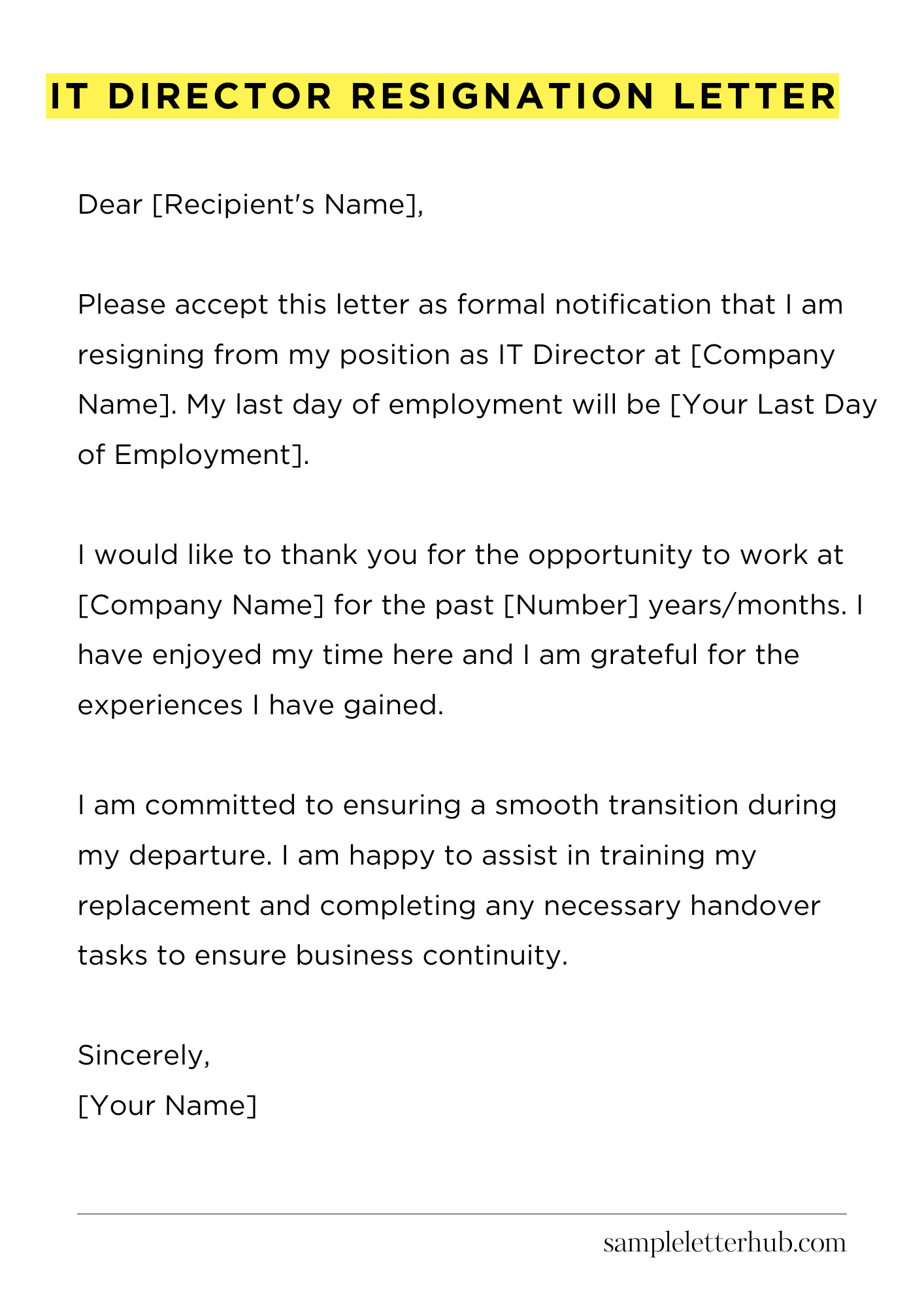
Dear [Recipient’s Name],
Please accept this letter as formal notification that I am resigning from my position as IT Director at [Company Name]. My last day of employment will be [Your Last Day of Employment].
I would like to thank you for the opportunity to work at [Company Name] for the past [Number] years/months. I have enjoyed my time here and I am grateful for the experiences I have gained.
I am committed to ensuring a smooth transition during my departure. I am happy to assist in training my replacement and completing any necessary handover tasks to ensure business continuity.
I will be available to answer any questions and provide any support needed until my last day.
I wish you and the company all the best in the future.
Sincerely,
[Your Name]
How to Write an IT Director Resignation Letter
1. Prepare Yourself: Knowing When It’s Time
Leaving a job is a big deal. Thinking about resigning from your position as an IT Director requires careful consideration. Make sure you’ve weighed your options. Reflect on the reasons you want to leave.
Are you seeking a better opportunity, a change in career direction, or is the current role not a good fit? These are important questions. Understanding your motivations will help you write a clear and concise resignation letter. This clarity will also help during any exit interviews.
Before you even begin the letter, secure your next opportunity. Do your research. Have you accepted another job? Make sure your departure aligns with your personal goals. Don’t rush the process.
2. Structure and Format: The Anatomy of a Good Resignation
A well-structured letter is crucial. You want to leave a good impression, even as you depart. Start with a professional header. Include your name, address, and the date. Next, address the letter to the appropriate person. Typically, this is your immediate supervisor or the Human Resources department. Keep it simple and to the point.
The body of the letter needs to be organized. First, state your intention to resign and your last day of employment. This is the most crucial information. Be direct and polite.
Next, express gratitude for the opportunity. Mention any positive experiences or skills you’ve gained during your tenure. Keep the tone professional. Avoid negativity, even if your experience hasn’t been perfect.
3. Content is King: What to Actually Write
The content is the heart of your letter. It has to be effective. Keep it brief. You don’t need to write a novel. Start with a clear statement of resignation.
For example, “Please accept this letter as formal notification that I am resigning from my position as IT Director, effective [Date].” It’s important to provide a specific date. You’ll need to know your company’s policy on resignation notice, usually two weeks. Check your employment contract.
Follow this statement with a brief expression of gratitude. Thank the company for the opportunities you’ve been given. Offer assistance during the transition period.
Offering help can demonstrate your professionalism. It will also make the handover process smoother. You can state that you are available to train your replacement or assist with any ongoing projects. End the letter with a polite closing, such as “Sincerely” or “Respectfully,” followed by your name and signature.
4. The Do’s and Don’ts: Avoiding Common Pitfalls
There are some things you should never do. Avoid negativity at all costs. Don’t use the letter as a platform to complain about the company or your colleagues. Keep the focus positive. Refrain from revealing confidential information. If you’re leaving for a competitor, don’t mention this. Keep the information general.
Ensure that your letter is proofread carefully. Errors can undermine your professionalism. Double-check grammar, spelling, and punctuation. Have a friend read the letter before sending it. Finally, keep a copy of the letter for your records. This is helpful for future reference. Always keep this record.
5. After the Letter: The Next Steps
Sending the resignation letter is just the first step. After delivering the letter, be prepared for a response. Your supervisor may want to discuss your decision. Be polite and professional.
Be ready to answer questions. However, don’t feel pressured to reveal more information than you’re comfortable with. Prepare yourself for an exit interview. This is a common practice.
During your remaining time, focus on your work. Complete your projects. Prepare your handover documents. Make the transition as seamless as possible. Leaving on good terms can open doors for future opportunities. Remember to be professional until your very last day.
FAQs about IT Director resignation letter
Navigating a job change, especially at a leadership level like an IT Director, involves careful planning and execution. Resignation letters are a critical part of this process. Here are some frequently asked questions regarding IT Director resignation letters.
What is the essential information to include in an IT Director resignation letter?
An effective IT Director resignation letter should contain the following essential elements: a clear statement of resignation, the effective date of your departure, a concise expression of gratitude for the opportunity, and a professional offer to assist with the transition.
It’s also advisable to include any specific instructions regarding handover procedures if applicable. Avoid any negative comments about the company or its employees.
How much notice should an IT Director give when resigning?
The standard notice period for an IT Director typically aligns with their employment contract. This period usually ranges from one to three months, depending on the company’s size, industry norms, and the terms of the individual’s agreement. Always review your contract to determine the required notice period and adhere to it to maintain professionalism.
What tone should be used in an IT Director resignation letter?
The tone of the resignation letter should be professional and positive. Express gratitude for the opportunities you’ve been afforded and maintain a respectful demeanor. Even if your experience wasn’t ideal, avoid negative language or criticisms. A positive and professional tone leaves a lasting positive impression and fosters a smooth transition.
Should an IT Director provide a reason for resigning in the letter?
Providing a specific reason for resigning is not generally required in a resignation letter. You can keep it brief and professional by stating you are pursuing other opportunities. If you feel it’s necessary, you may offer a general reason, such as pursuing career advancement or a different professional path.
However, it’s not essential, and keeping the letter concise and focused on the transition is usually sufficient.
What should an IT Director do after submitting the resignation letter?
Once you have submitted your letter, the next steps are crucial for a smooth transition. First, be prepared to meet with your supervisor or HR to discuss your departure.
Offer your assistance in the handover process, which might include training your replacement, documenting key processes, and ensuring a seamless transfer of knowledge. Maintain a positive and cooperative attitude throughout the transition period.
Related:
Resignation letter due to rude boss
Resignation letter moving to another state
Resignation letter due to illness of family member
Resignation letter due to study