


The “Business Head resignation letter” is a formal document. It is written by a Business Head. The purpose is to officially announce their departure from a company. It informs the employer about the resignation. It also provides key details like the last day of employment.
You’re probably here because you need to resign. You might be unsure how to write the perfect letter. Don’t worry, we’ve got you covered.
This article offers several templates. They’re tailored to different situations. You can use these examples as a starting point. Make it easier to craft your own resignation letter.
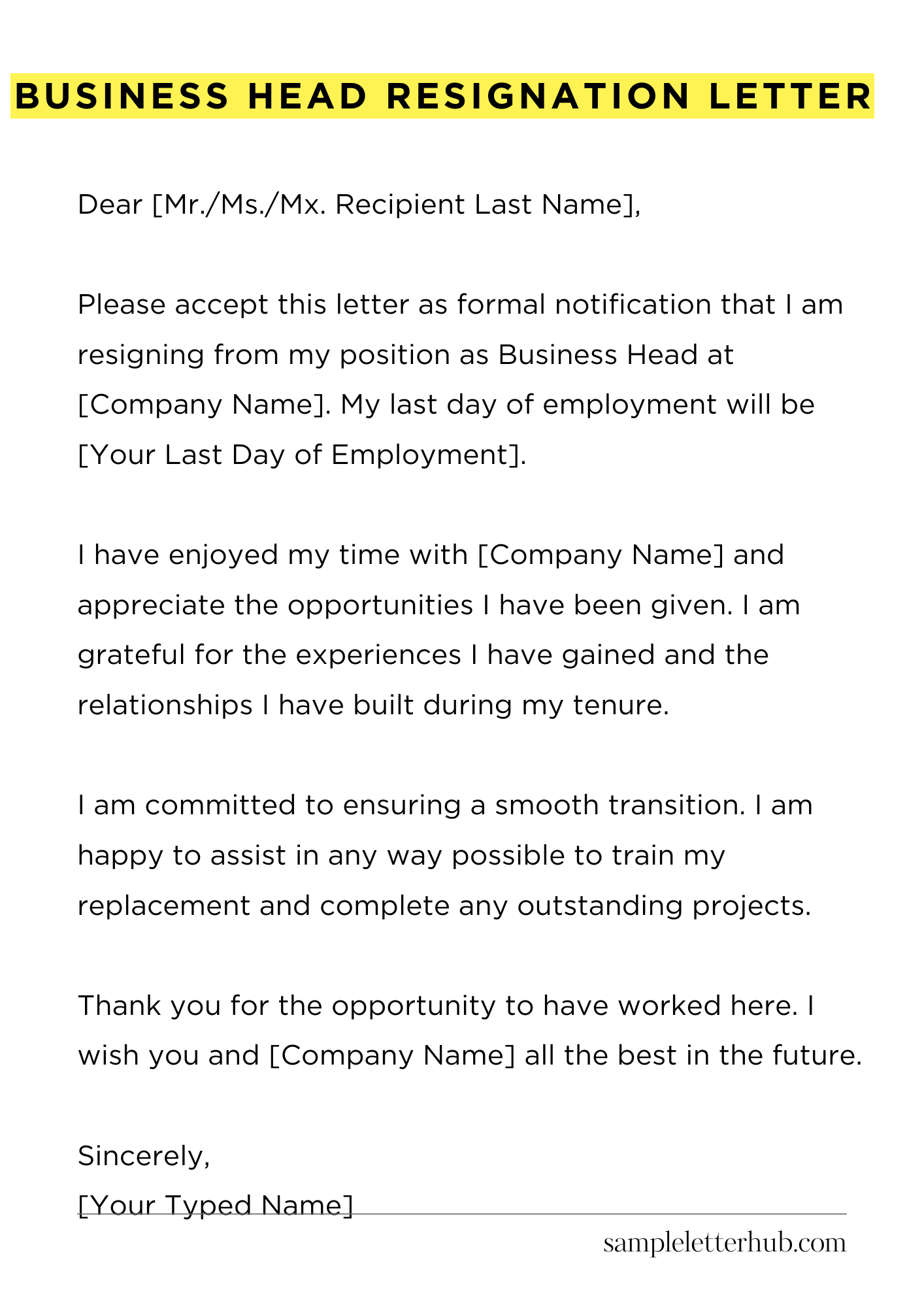
Business Head Resignation Letter
Below is a sample of a Business Head Resignation Letter:
[Your Name]
[Your Address]
[Your Phone Number]
[Your Email Address]
[Date]
[Recipient Name]
[Recipient Title]
[Company Name]
[Company Address]
Dear [Mr./Ms./Mx. Recipient Last Name],
Please accept this letter as formal notification that I am resigning from my position as Business Head at [Company Name]. My last day of employment will be [Your Last Day of Employment].
I have enjoyed my time with [Company Name] and appreciate the opportunities I have been given. I am grateful for the experiences I have gained and the relationships I have built during my tenure.
I am committed to ensuring a smooth transition. I am happy to assist in any way possible to train my replacement and complete any outstanding projects.
Thank you for the opportunity to have worked here. I wish you and [Company Name] all the best in the future.
Sincerely,
[Your Typed Name]
How to Write a Business Head Resignation Letter
1. Preparation is Key: Before You Put Pen to Paper (or Fingers to Keyboard)
Resigning from a leadership position is a significant step. It’s not a decision to be taken lightly. Before even thinking about crafting your letter, take some time for introspection.
Consider the reasons behind your departure. Are you seeking new opportunities? Facing personal challenges? Whatever the impetus, clarity on your motivations is crucial. This will inform the tone and content of your resignation.
Next, familiarize yourself with your employment contract and company policies. Understand the required notice period. This is a critical detail that needs to be clearly stated in your letter.
Ensure you have the details about when you want to leave. Additionally, check for any clauses regarding confidentiality, non-compete agreements, or other relevant stipulations. Ignorance is definitely not bliss here!
2. Structure and Substance: Crafting the Core of Your Letter
The structure of your resignation letter should be straightforward and professional. Start with a clear and concise statement of your intention. This is where you state you are resigning from your position as Business Head. Specify your last day of employment. Use a formal and respectful tone throughout.
Follow this with a brief and positive statement expressing your gratitude for the opportunity. Acknowledge the experience and the skills you have gained. Keep it brief.
There is no need for a lengthy narrative here. After that, you could offer to assist in the transition period. Offer your cooperation. This demonstrates professionalism and a commitment to a smooth handover.
3. Key Elements: What to Include and What to Avoid
Your letter should definitely include essential information. Your name, title, and the date are all a must. Be precise about your resignation date. Avoid rambling or negativity. This is not the time to air grievances. If you’re leaving due to negative circumstances, keep the mention brief and professional. The goal is to exit gracefully.
Avoid burning bridges. While honesty is important, being overly critical can be detrimental. Steer clear of making personal attacks or disparaging remarks about colleagues or the company. Think carefully about what you say. Remember, this letter is a permanent record of your departure.
4. The Handover: Facilitating a Smooth Transition
Offering your assistance during the transition period is a crucial aspect of your professionalism. This is what helps the company. Be specific. This could involve training your replacement, documenting key processes, or providing support to your team. Demonstrate your commitment to ensuring a seamless handover.
Consider what information will be useful to your successor. A well-organized handover plan demonstrates respect for the company. This also shows respect for your colleagues. It reflects positively on your leadership style.
5. Final Touches: Polishing and Sending Your Letter
Before sending your letter, proofread it carefully. Check for any grammatical errors, spelling mistakes, and clarity. Ensure the tone is appropriate for the business environment. This ensures your message comes across correctly.
If possible, deliver the letter in person to the appropriate person, usually your direct supervisor or HR. Keep a copy for your records. Consider sending a digital copy via email for confirmation. This confirms they received the letter. Finally, follow up with your supervisor to discuss your departure and transition plan.
FAQs about Business Head Resignation Letter
What essential information should be included in a Business Head’s resignation letter?
A Business Head’s resignation letter should contain the following essential elements: a clear and concise statement of resignation, the effective date of resignation, a brief expression of gratitude for the opportunity, and any required information about handover procedures.
It’s also advisable to state the reason for leaving, which can range from seeking new opportunities to personal reasons. Ensure the letter is professionally formatted and addressed to the appropriate authority, typically the CEO, Board of Directors, or immediate superior.
How much notice should a Business Head provide when resigning?
The notice period a Business Head provides should align with their employment contract, company policy, and any relevant legal requirements.
Standard practice often involves a notice period of 30 to 90 days. It is crucial to review the employment agreement to determine the specific timeframe agreed upon.
Adhering to the contract’s stipulations ensures a smooth transition and minimizes potential legal complications. Providing ample notice also allows for an effective handover of responsibilities.
What are the legal implications of a Business Head resigning?
The legal implications of a Business Head’s resignation depend on the employment contract, applicable labor laws, and any non-compete agreements.
Key considerations include ensuring compliance with notice periods, understanding potential severance pay requirements, and clarifying the enforceability of any restrictive covenants. Legal counsel should be consulted to navigate complexities and ensure compliance with employment regulations, especially if there are disputes.
How should a Business Head handle the handover process?
A Business Head should manage the handover process with professionalism and thoroughness. This includes preparing a detailed handover document outlining current projects, ongoing initiatives, key contacts, and critical information.
Active participation in training the successor, assisting with the transfer of knowledge, and ensuring the continuity of business operations are essential. Maintaining open communication with the team and stakeholders throughout the transition also enhances the effectiveness of the process.
What should be avoided when writing a Business Head’s resignation letter?
When composing a resignation letter, Business Heads should avoid certain pitfalls. These include being overly emotional, making negative comments about the company or its employees, or revealing confidential company information.
It’s also best to refrain from including any statements that could be construed as inflammatory or could potentially damage their professional reputation. Maintaining a positive and professional tone throughout the letter is paramount.
Related:
Resignation letter due to rude boss
Resignation letter moving to another state
Resignation letter due to illness of family member
Resignation letter due to study