

An HR resignation letter is a formal document. Employees use it to officially notify their employer of their departure. This letter is a vital part of the exit process. It ensures a smooth transition.
Preparing to resign can be tough. Crafting the letter shouldn’t be. We’re here to help make it easier. Inside, you’ll find different templates. We’ll show you examples. Use them as a starting point.
No more staring at a blank page. We have various samples. These will help you write a perfect HR resignation letter. They’re designed to fit different situations. Say goodbye to stress. Get ready to move on.
Hr Resignation Letter
Below is a sample of a Hr Resignation Letter:
[Your Name]
[Your Address]
[Your Phone Number]
[Your Email Address]
[Date]
[HR Manager Name] (If known, otherwise use title)
HR Department
[Company Name]
[Company Address]
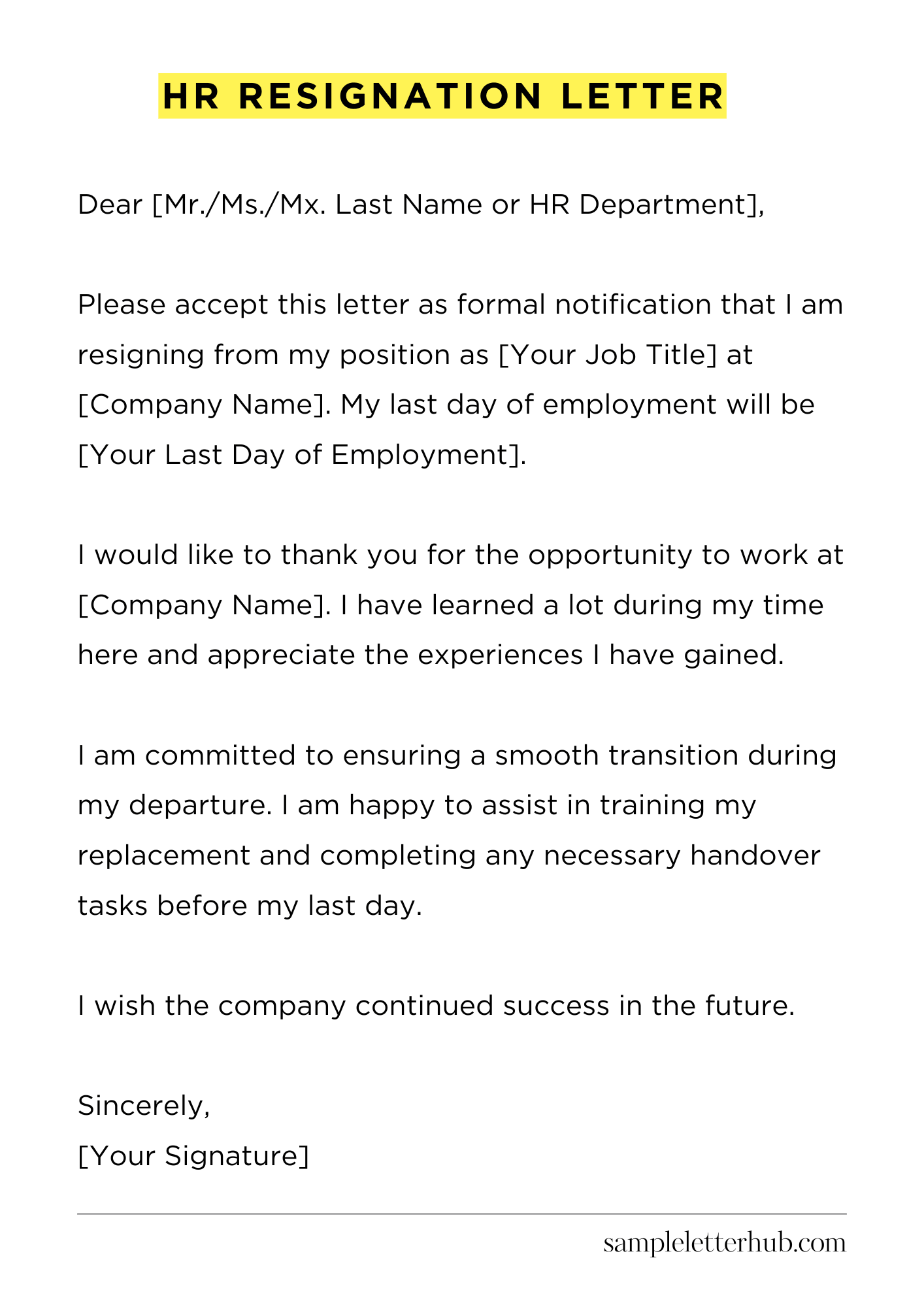
Dear [Mr./Ms./Mx. Last Name or HR Department],
Please accept this letter as formal notification that I am resigning from my position as [Your Job Title] at [Company Name]. My last day of employment will be [Your Last Day of Employment].
I would like to thank you for the opportunity to work at [Company Name]. I have learned a lot during my time here and appreciate the experiences I have gained.
I am committed to ensuring a smooth transition during my departure. I am happy to assist in training my replacement and completing any necessary handover tasks before my last day.
I wish the company continued success in the future.
Sincerely,
[Your Signature]
How to Write an HR Resignation Letter
Know the Basics Before You Start
Resigning from a job is a big decision, and it requires some thought. Your resignation letter is a formal document. Therefore, it’s not the place to vent frustrations or burn bridges. Think of it as your official goodbye. Before you start writing, make sure you know your company’s policies. Are there specific protocols you need to follow? Do you know who your direct supervisor is?
Your goal is to leave on a positive note, even if you’re unhappy. This document should reflect professionalism. Remember, the world is small, and you never know when your paths might cross again. You want to make a good impression.
Crafting the Core: Essential Components
Every effective HR resignation letter contains a few key elements. You need to get these right. First, clearly state your intent to resign. Be direct and avoid ambiguity. Specify the date of your last day of employment.
Next, express your gratitude for the opportunity. This is a nice thing to do, showing appreciation. Then, briefly mention your reason for leaving, if you choose. You do not need to overshare! Finally, include your contact information for any follow-up.
Formatting for a Professional Look
Presentation matters. A well-formatted letter looks polished and shows respect. Use a standard business letter format. Include your name, address, and contact information at the top, along with the date.
Address the letter to your direct supervisor, or the HR department. Keep the body of the letter concise and easy to read. Use a professional font like Times New Roman or Arial and stick to a font size between 10 and 12 points. Proofread, proofread, proofread! Make sure there are no spelling or grammatical errors.
Adding the Personal Touch (Without Going Overboard)
While professionalism is key, you can still add a personal touch. Expressing gratitude to specific individuals can be meaningful. If you learned something valuable from your time at the company, consider mentioning it.
However, avoid excessive details about why you’re leaving. You don’t need to explain everything. Keep it brief and focused on the essentials. A simple “Thank you for the opportunity” can go a long way.
The Final Review and Submission
Before you hit “send,” review everything one last time. Does the letter reflect your intentions clearly and professionally? Is it free of errors? Does it meet the company’s requirements?
If you’re unsure, ask a trusted friend or colleague to read it over. Once you’re confident, submit the letter according to company policy. Whether it’s in person, or via email, follow the designated process. Good luck in your future endeavors!
FAQs about HR Resignation Letter
What is the purpose of an HR resignation letter?
An HR resignation letter serves as a formal, written notice of an employee’s intent to leave their job. It officially informs the employer of the employee’s departure date, allowing for a smooth transition, the completion of required documentation, and the processing of final payments.
What key elements should be included in an HR resignation letter?
A well-structured resignation letter should include: a clear statement of resignation, the effective date of departure, a brief expression of gratitude (optional), and your signature. Additional information, such as contact information for future correspondence or an offer to assist with the transition, is also common.
How much notice should I give in my HR resignation letter?
The notice period is typically specified in your employment contract or company policy. Common notice periods are two weeks, one month, or longer for senior roles. Ensure your resignation letter aligns with the agreed-upon timeframe to avoid any potential issues.
Can I submit my HR resignation letter electronically?
Yes, in most cases, electronic submission of a resignation letter is acceptable. Check your company’s policy on resignation procedures. If no specific instructions are provided, sending the letter via email to your manager and HR representative is a standard practice.
What should I do after submitting my HR resignation letter?
After submitting your letter, discuss the next steps with your manager and HR. They may provide information about exit interviews, the return of company property, final paychecks, and benefits. It’s also a good time to clarify any questions you may have about your departure process.
Related:
Resignation letter due to rude boss
Resignation letter moving to another state
Resignation letter due to illness of family member
Resignation letter due to study