

A Senior Human Resources Manager resignation letter is a formal document. It is written by a Senior HR Manager. Its main purpose is to officially announce their departure. The letter is given to the employer. It also sets the terms of leaving.
Writing a resignation letter can be tricky. You want to be professional. You also want to be clear. We’ve got you covered. We have examples and templates.
We’ll share helpful samples. These are designed to make it simple. Use them as a starting point. Adapt them to fit your needs. Craft your perfect letter with ease.
Senior Human Resources Manager Resignation Letter
Below is a sample of a Senior Human Resources Manager Resignation Letter:
[Your Name]
[Your Address]
[Your Phone Number]
[Your Email Address]
[Date]
[Senior Human Resources Manager’s Name]
[Company Name]
[Company Address]
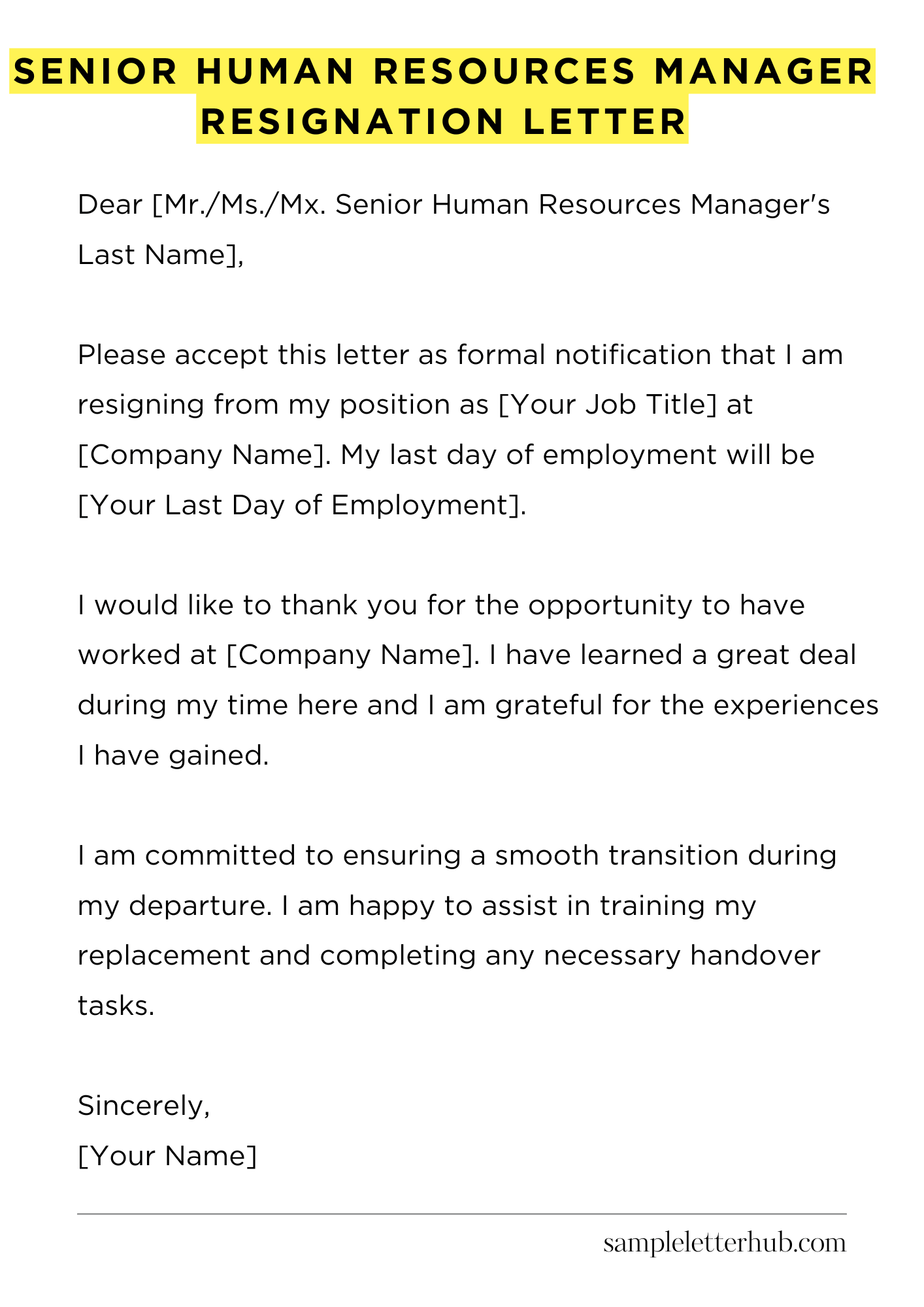
Dear [Mr./Ms./Mx. Senior Human Resources Manager’s Last Name],
Please accept this letter as formal notification that I am resigning from my position as [Your Job Title] at [Company Name]. My last day of employment will be [Your Last Day of Employment].
I would like to thank you for the opportunity to have worked at [Company Name]. I have learned a great deal during my time here and I am grateful for the experiences I have gained.
I am committed to ensuring a smooth transition during my departure. I am happy to assist in training my replacement and completing any necessary handover tasks. Please let me know how I can be of assistance in the coming weeks.
I wish you and [Company Name] all the best in the future.
Sincerely,
[Your Name]
How to Write Senior Human Resources Manager Resignation Letter
1. Grasping the Basics: Why Your Letter Matters
Leaving a job, especially a senior role like Senior HR Manager, requires careful handling. Your resignation letter isn’t just about saying “I quit.” Think of it as your final professional statement to your current company. It’s a chance to exit gracefully, maintain good relationships, and protect your future career prospects.
This letter sets the tone for your departure, and you want to leave a positive impression. A well-written letter can pave the way for a smooth transition and even a positive reference down the road.
This is crucial, trust me.
2. Essential Elements: What Your Letter MUST Include
You can’t just dash something off. Several key pieces are absolutely essential. First, and foremost, state your intention to resign clearly. Include the effective date of your resignation.
This date is when your employment officially ends. Next, you need a brief but sincere expression of gratitude for the opportunity to have worked there. Then, briefly mention any assistance you’re willing to provide during the transition period.
Finally, and this is important, include your contact information. This is to keep the lines of communication open, especially for any final paperwork or questions.
Don’t leave anything out!
3. Crafting the Content: Tone and Specifics
The tone of your letter should be professional and respectful. Avoid any negativity or complaints about your job or employer. Keep the language concise and direct, getting to the point quickly.
While showing appreciation, avoid going overboard with flattery. A simple, genuine “Thank you” is often enough. Be specific if you’re offering to assist with the transition. Mention any ongoing projects or tasks you can help hand over to your successor. Do not ramble; be as clear as possible.
Good communication is always key.
4. Tailoring for Senior HR Manager: Special Considerations
As a Senior HR Manager, you might have specific responsibilities. Consider this as you write your letter. For example, if you’re involved in any sensitive ongoing processes, mention your willingness to assist with them.
Additionally, if you have overseen any employees, think about how to best communicate your departure to them. You may want to suggest a smooth transition to your replacement in order to avoid unrest.
Demonstrate your understanding of the importance of this information by being as professional as possible. This shows leadership and demonstrates your commitment to your colleagues and the organization.
Think about others.
5. Proofreading and Final Steps: Before You Hit Send
Before submitting your letter, proofread it thoroughly. Check for any grammatical errors, typos, and ensure your formatting is clean and professional. It is best to review several times!
Once you’re confident it’s error-free, review it again! Consider having a friend or colleague read it over as well; a fresh pair of eyes can often catch mistakes you missed. Ensure you have a copy for your records, too. Once the letter is ready, send it to the appropriate person, usually your direct supervisor or the CEO/President. That’s it, you’re done!
Always double-check everything!
FAQs about Senior Human Resources Manager Resignation Letter
What is the most appropriate tone for a Senior HR Manager’s resignation letter?
The tone should be professional and courteous. It is crucial to maintain a respectful and objective tone, regardless of the reasons for leaving. Avoid expressing negativity, grievances, or overly personal opinions.
The letter should reflect your professionalism and desire to leave on good terms. A tone of gratitude for the opportunities provided by the company is also highly recommended.
What key information must be included in a Senior HR Manager resignation letter?
The core information includes the formal announcement of your resignation, the effective date of your departure, a concise statement of appreciation for your experience, and an offer to assist with the transition.
It should also include your contact information for any post-departure communication. It’s often helpful to mention your willingness to help train your replacement, if possible.
How far in advance should a Senior HR Manager submit their resignation letter?
Generally, a Senior HR Manager should provide at least four weeks’ notice, but this can vary depending on company policy and employment contracts. It’s best practice to review your contract or company guidelines to understand the required notice period. Providing more notice is often seen as a sign of professionalism and courtesy, particularly in a leadership role.
Should a Senior HR Manager explain the reason for their resignation in the letter?
While not mandatory, a brief and general statement about the reason for leaving is acceptable. However, avoid going into excessive detail. Common, professional reasons can include pursuing new opportunities, personal relocation, or a desire for career advancement.
You can simply state that you are pursuing a new opportunity or a different career path. Do not mention any negative reasons for leaving in this letter.
What should a Senior HR Manager do after submitting their resignation letter?
After submitting the letter, it’s essential to cooperate fully with the transition process. This includes assisting in finding and training your replacement, completing any outstanding tasks, and following the company’s exit procedures.
Maintain a positive attitude throughout your remaining time and be professional in your interactions with colleagues and superiors. Ensure that all company property is returned according to company policies.
Related:
Resignation letter due to rude boss
Resignation letter moving to another state
Resignation letter due to illness of family member
Resignation letter due to study